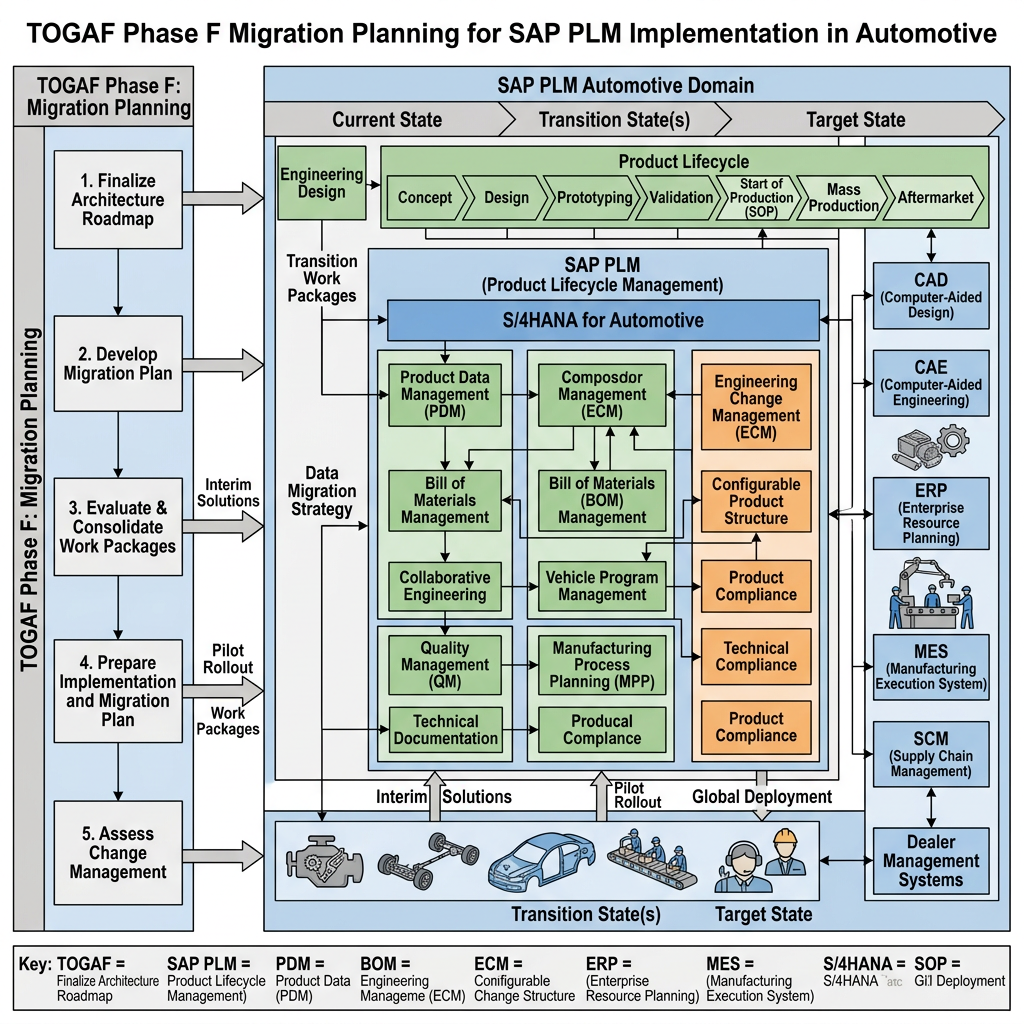
For project managers leading global SAP and PLM implementations, TOGAF® ADM Phase F (Migration Planning) is the critical stage where strategy becomes executable.
The objective of Phase F is to prioritize implementation projects and translate them into a realistic Implementation and Migration Plan, evaluating dependencies, costs, and benefits. In automotive Tier 1 environments—where SAP and PLM are tightly coupled—design changes, BOM synchronization, costing, quality, and global rollout are deeply interdependent. Explicitly assigning Business Value and Risk to each work package significantly impacts project success rates.
Reference: http://www.togaf.com/admref/_chap12.html
Key Considerations for PMs in Phase F
Phase F is not just about arranging a roadmap chronologically. It requires structured evaluation of Business Value and Risk for each project and work package.
According to The Open Group:
- “The objective of this phase is to sort the various implementation projects into priority order. Activities include assessing the dependencies, costs and benefits of the various migration projects.”
- “Develop an estimated value to the business for each project… based on a value index dimension and a risk index dimension.”
- “The value index includes… financial contribution, strategic alignment, and competitive position. The risk index includes… size and complexity, technology, organizational capacity, and impact of a failure.”
Source:
http://www.togaf.com/admref/_chap12.html
https://coe.qualiware.com/resources/togaf/9-1/part2-adm/phase-f-migration-planning/
This highlights a key principle: Phase F is not driven by ROI alone. PMs must evaluate both:
- Business Value: financial contribution, strategic alignment, competitive advantage
- Risk: complexity, technology, organizational readiness, failure impact
Automotive Tier 1 Scenario
Consider a Japan-headquartered automotive Tier 1 supplier deploying SAP S/4HANA and PLM globally across:
- Japan HQ (engineering + plant)
- Thailand plant
- Mexico plant
- European sales company
Objectives include:
- Strengthening engineering change control
- Ensuring BOM consistency
- Improving cost accuracy
- Standardizing global operations
- Enhancing supply chain visibility
PLM plays a key role in managing engineering changes, centralizing product data, and connecting design with manufacturing.
Reference: https://cloudwellserved.com/togaf-9-adm-phase-f-migration-planning/
In Phase F, the PM must break down transformation into executable work packages, assign value and risk, and determine sequencing based on dependencies.
Work Package Design Example
A practical decomposition into manageable work packages:
- WP1: Global Business & Data Standard Definition
- WP2: SAP Core Template Development
- WP3: PLM Change Management Platform
- WP4: SAP–PLM Integration
- WP5: Domestic Pilot Deployment
- WP6: Wave 1 Global Rollout (Thailand)
- WP7: Wave 2 Global Rollout (Mexico & Europe)
This structure allows PMs to evaluate:
- Business standardization
- System implementation
- Integration complexity
- Deployment scalability
Without this breakdown, value and risk concentration becomes opaque.
Business Value Allocation
- WP1 (Global Standards): High value. Enables reuse across SAP, PLM, and global rollout; foundational for strategic alignment.
- WP2 (SAP Template): High value. Integrates finance and supply chain, enabling global KPI comparability and governance.
- WP3 (PLM Platform): High value. Improves engineering speed, quality, and centralized data management; critical for OEM responsiveness.
- WP4 (Integration): Very high value. Connects engineering changes directly to manufacturing, procurement, and costing.
- WP5–WP7 (Deployments): Medium to high value. Pilot delivers learning; global rollout scales business impact.
Key insight: Some value is foundational rather than immediately visible, especially in early phases.
Risk Allocation
- WP1: Medium risk. Organizational alignment challenges outweigh technical difficulty.
- WP2: Medium–high risk. Scope creep and complexity can undermine template integrity.
- WP3: Medium–high risk. Adoption risk in engineering organizations is significant.
- WP4: High risk. Integration failures directly impact production, costing, and operations.
- WP5–WP7: Increasing risk across rollout waves due to localization, regulation, and data readiness.
Integration (WP4) is the highest-risk domain and must be carefully sequenced.
Recommended Prioritization Sequence
Following TOGAF® principles:
- WP1 Global Standards
- WP2 SAP Template
- WP3 PLM Platform
- WP5 Domestic Pilot
- WP4 SAP–PLM Integration
- WP6 Global Rollout Wave 1
- WP7 Global Rollout Wave 2
Rationale:
- Standards first enable reuse
- Stabilize SAP and PLM independently
- Validate through pilot
- Execute high-risk integration afterward
- Scale globally once validated
This reduces failure probability in the most complex areas.
Evaluation Sheet for PM Practice
A practical scoring model (1–5 scale):
- Financial Contribution: cost reduction, inventory optimization
- Strategic Alignment: global standardization, OEM responsiveness
- Competitive Position: speed, traceability, launch efficiency
- Size & Complexity: scope, sites, interfaces
- Technology Risk: SAP, PLM, CAD, MDM integration
- Organizational Capacity: adoption, training, change readiness
- Failure Impact: production stop, mis-shipments, cost errors
This enables clear justification of prioritization in PMO and steering committees.
Practical Takeaway for PMs
In global SAP and PLM programs, the highest-value areas often carry the highest risk.
Therefore, PMs should not aim for maximum integration upfront. Instead, design a migration sequence aligned with Phase F:
- Standardization
- System stabilization
- Pilot validation
- Integration
- Global rollout
In automotive Tier 1 environments, where engineering changes directly impact cost, quality, and supply, this sequencing is not just project management—it is enterprise architecture in practice.
Summary
TOGAF® ADM Phase F requires balancing Business Value and Risk—not maximizing one at the expense of the other. Business Value includes strategic alignment and competitive advantage, while Risk extends beyond technology to organizational readiness and failure impact. Successful PMs design migration plans that respect both dimensions.
Reference Links
- The Open Group – Phase F: Migration Planning
This is the primary source for TOGAF ADM Phase F. It explains the purpose of Migration Planning, prioritization, dependencies, cost-benefit analysis, and risk assessment. - TOGAF Phase F: Migration Planning – QualiWare
This source is useful for explaining how business value is assigned to each work package and how projects are evaluated in Phase F. - TOGAF 9: ADM Phase F – Migration Planning – Cloud well served
This is helpful for describing the implementation and migration plan, architecture roadmap, and prioritization logic. - PLM in the Automotive Industry | PTC
This source supports the automotive PLM context, including engineering change management and quality improvement. - SAP Global Platform for Automotive Parts Industry – NEC
This source helps frame the SAP global rollout context for an automotive parts manufacturer. - SAP Smart Manufacturing Case Study for an Automotive Parts Company
This can be used as a supporting reference for SAP adoption in the automotive parts industry.
Disclaimer
Parts of this article were developed with reference to generative AI suggestions and were reviewed, refined, and supplemented based on the author’s professional expertise and judgment.

Leave a Reply