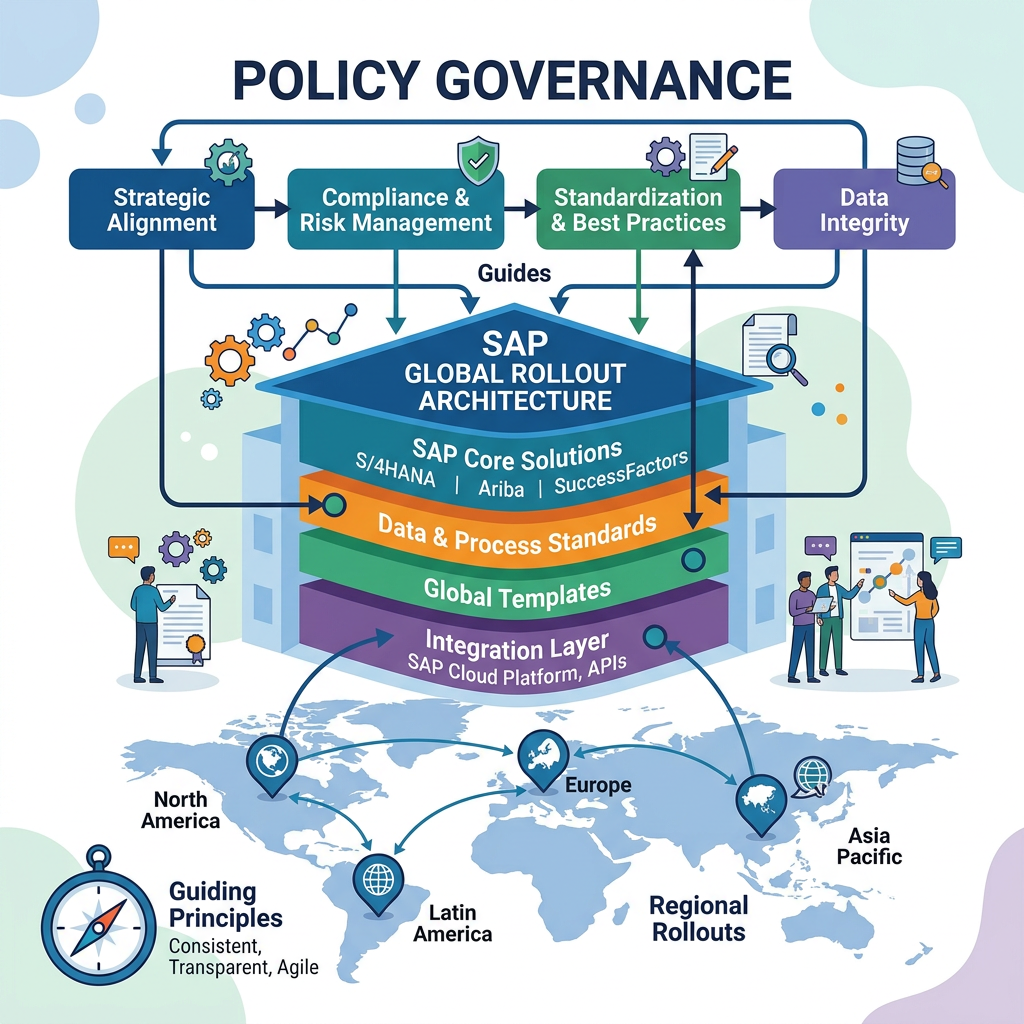
Focus Keyword: SAP Global Governance
When automotive Tier 1 suppliers deploy SAP S/4HANA alongside ERP, SCM, MES, and PLM globally, the real challenge is not system design—it is governance.
The core questions are:
- What should be globally standardized?
- What should be delegated to regions or plants?
- How should exceptions be approved?
- How far should EA intervene in implementation?
- How do we evaluate architectural compliance?
Over-centralization limits compliance with local regulations and OEM requirements. Over-decentralization leads to fragmented SAP configurations, master data inconsistency, and unsustainable operations.
This is where John Carver’s Policy Governance provides a powerful lens. While not part of TOGAF® ADM, it significantly strengthens Architecture Governance, especially Phase G: Implementation Governance.
This article explains how EA leaders and program managers can apply this model in SAP global rollouts for automotive suppliers.
1. Governance Challenges in SAP Global Rollouts
Typical conditions in Tier 1 environments:
- Multiple production sites across Japan, North America, Europe, China, ASEAN
- OEM-specific EDI and delivery processes
- Different ERP, MES, WMS, and master data structures per plant
- Region-specific regulations (tax, e-invoicing, data protection)
- SAP S/4HANA as core with IBP, EWM, Digital Manufacturing, PLM
Without clear governance:
- Headquarters over-controls → slow decisions, bottlenecks
- Local autonomy expands → inconsistent systems and data
The goal is not centralization vs decentralization, but clear boundaries of decision-making.
2. What is Policy Governance?
John Carver’s model separates:
- Ends: The outcomes to achieve
- Executive Limitations: The boundaries that must not be violated
Ends (Business Outcomes)
Examples:
- Global inventory visibility
- Profitability by product/customer/plant
- Improved delivery performance
- Faster design change propagation
- Accelerated financial closing
- Full traceability
Executive Limitations (Constraints)
Examples:
- No regulatory violations
- No loss of traceability
- No inconsistency in global master data
- No unsupportable core modifications
- No security bypass
- No designs that block future rollout
The key principle: Define outcomes and boundaries—not detailed methods.
3. Translating Policy Governance into EA
Mapping to SAP/EA:
- Owners → Stakeholders (customers, regulators, group management)
- Board → Architecture Board / Steering Committee
- Ends → Business outcomes, KPIs
- Executive Limitations → Architecture principles, constraints
- Delegation → CIO / Program / Regional leads
- Reasonable Interpretation → Local decision-making within constraints
- Monitoring → Compliance reviews, KPI tracking
EA’s role shifts from:
- Controlling design details
to: - Defining outcomes
- Setting boundaries
- Governing decisions
- Evaluating compliance
4. Application Across TOGAF® ADM
Preliminary Phase
Define decision rights:
- Global: S/4HANA core, CoA, BP model, integration, security, Clean Core
- Local: tax, EDI, banking, language, plant operations
Phase A: Architecture Vision
Shift from system goals to business outcomes:
Weak:
“Deploy SAP globally.”
Strong:
“Enable end-to-end global visibility from demand to financial consolidation with actionable KPIs.”
Phase B: Business Architecture
Define standardization based on outcomes, not uniformity.
Example (O2C):
- Ends: demand visibility, delivery tracking
- Constraints: no loss of order-shipment linkage
- Delegation: EDI formats, workflows
Phase C: Data & Application
Focus on consistency:
- Ends: unified master data and cross-system semantics
- Constraints: no duplicate business partners, no uncontrolled local IDs
- Delegation: MDG tools, integration methods
Phase D: Technology
Define “prohibited zones”:
- No unsupported tech
- No shared IDs
- No unmonitored interfaces
- No uncontrolled data transfer
Phase E/F: Architecture Contracts
Define per rollout wave:
- Outcomes
- Constraints
- Delegation scope
- KPIs
- Exception process
Phase G: Implementation Governance
Evaluate based on:
- Outcome achievement
- Constraint compliance
- Reasonable interpretation
Not “Did you follow the template exactly?”
5. Practical Use Cases
Example 1: Global Inventory Visibility
- Ends: daily visibility by plant/product/customer
- Constraints: no non-global item mapping, no spreadsheet-only tracking
- Delegation: WMS choice, integration method
Example 2: Clean Core Governance
- Ends: rollout speed, maintainability
- Constraints: no unjustified add-ons, no undocumented deviations
- Delegation: BTP extensions, UI design
Example 3: Production Traceability
- Ends: full traceability from product to component
- Constraints: no missing linkage, no tamperable records
- Delegation: MES selection, RFID/barcode usage
Example 4: Local Compliance
- Ends: regulatory compliance + global financial consistency
- Constraints: no violation of tax laws, no broken account mapping
- Delegation: e-invoicing solutions, banking integration
6. Rethinking Architecture Reviews
Traditional:
- SAP standard usage?
- Template compliance?
Carver-based:
- Are outcomes achieved?
- Are constraints respected?
- Is the decision rational?
Use Architecture Decision Records (ADR) to document:
- Objective
- Constraints
- Alternatives
- Rationale
- Risks
- Evidence
7. EA vs PM Roles
EA Lead
- Define outcomes and constraints
- Set governance model
- Evaluate compliance
- Manage exceptions strategically
Program Manager
- Embed governance into execution
- Track KPIs and benefits
- Manage risks and exceptions
- Ensure accountability
8. EA Policy Template Example
Policy: Global Item & BOM Consistency
- Ends: Global comparability and traceability
- Constraints: No unmanaged local items, no inconsistent revisions
- Delegation: UI, workflows, local classification
- Monitoring: duplicate rate, BOM inconsistencies, lead time
9. Key Considerations
- Do not blindly apply Carver—adapt concepts only
- Not all rules should be negative constraints (some must be mandatory)
- Project success ≠ EA success
(True success = business outcomes achieved)
10. Transformation Enabled
Traditional governance:
- Centralized control
- Detailed design reviews
- Template enforcement
Carver-based governance:
- Outcome-driven
- Boundary-based control
- Delegated execution
- Evidence-based evaluation
This transforms EA into a value enabler rather than a bottleneck.
Summary
John Carver’s Policy Governance strengthens SAP global rollout governance by:
- Defining business outcomes (Ends)
- Setting non-negotiable constraints (Executive Limitations)
- Delegating implementation decisions
- Evaluating based on rationality and outcomes
- Monitoring through contracts and compliance reviews
Global SAP templates are not about controlling everything centrally. They are about defining what must be achieved and what must not be violated—so that regions can act with autonomy within clear boundaries.
Reference Sources
Core Policy Governance references
Policy Governance® Source Document
Policy Governance® Source Document
This is the primary reference for John Carver’s Policy Governance model. It explains the four policy categories:
- Ends
- Executive Limitations
- Governance Process
- Board-Management Delegation
It also explains delegation, monitoring, and the principle of “Any Reasonable Interpretation.” (Govern for Impact)
Recommended use in the article
- Definition of Policy Governance
- Separation of Ends and means
- Definition of Executive Limitations
- Delegation of implementation decisions
- Monitoring of results and compliance
- Application of reasonable interpretation
Policy Governance® Glossary
The glossary provides authoritative definitions of the key Policy Governance terms. It explains that the chief executive is accountable for achieving the board’s Ends within the board’s Executive Limitations, both reasonably interpreted. (Govern for Impact)
Recommended use in the article
- Ends
- Executive Limitations
- Chief Executive Officer
- Delegation
- Reasonable interpretation
- Monitoring
Policy Governance® Source Document — Web Version
Policy Governance® Source Document — The Governance Coach
This web-based version is easier to navigate than the PDF. It includes a clear explanation of the “Any Reasonable Interpretation” principle. (The Governance Coach)
Recommended use in the article
- Delegating solution decisions to implementation teams
- Allowing regional teams to interpret global policies
- Distinguishing architecture conformance from design preference
- Defining the authority of the EA lead and program team
Should the Board Approve CEO Interpretations in Policy Governance?
Should the Board Approve CEO Interpretations in Policy Governance?
This article explains that the governing body should not create or edit the executive’s interpretation. Instead, it should assess whether the interpretation is reasonable. (Govern for Impact)
Recommended use in the article
- Architecture Compliance Reviews
- Evaluation of local design decisions
- Architecture Decision Records
- Separation between governance and solution design
- Assessing rather than prescribing implementation decisions
Principles and Model Consistency Framework
Principles and Model Consistency Framework
This document provides additional guidance on the internal consistency of Policy Governance. It reinforces the principle that the executive must not violate Executive Limitations under any reasonable interpretation of the policies. (Govern for Impact)
Recommended use in the article
- Defining policy consistency
- Testing the reasonableness of an interpretation
- Designing governance controls
- Evaluating executive or program accountability
Official TOGAF references
The TOGAF® Standard
This is the official entry point for the TOGAF Standard maintained by The Open Group. The standard provides a method and framework for developing, using, and governing Enterprise Architecture. (The Open Group)
Recommended use in the article
- Definition of TOGAF
- Positioning of the ADM
- Enterprise Architecture governance
- Clarifying that Policy Governance is an external governance model rather than a mandatory TOGAF technique
Phase G: Implementation Governance
Phase G: Implementation Governance
Phase G focuses on governing implementation projects, ensuring conformance with the Target Architecture, and addressing implementation-driven architecture changes. (The Open Group)
Recommended use in the article
- Implementation Governance
- Architecture Compliance Reviews
- Target Architecture conformance
- Implementation project recommendations
- Architecture Change Requests
- Governance during SAP rollout waves
Architecture Board
The Architecture Board is described as an executive-level group responsible for reviewing and maintaining the strategic architecture and its supporting architectures. (The Open Group)
Recommended use in the article
- Governance roles
- Decision rights
- Global and regional responsibilities
- Exception escalation
- Relationship between the steering committee, EA team, and implementation teams
Architecture Contracts
Architecture Contracts are joint agreements between sponsors and implementation or development partners regarding deliverables, quality, and fitness for purpose. (The Open Group)
Recommended use in the article
- Documenting Ends and constraints
- Defining implementation responsibilities
- Establishing architecture review criteria
- Setting escalation and remediation requirements
- Governing global template rollouts
A Practical Framework for Architectural Governance
A Practical Framework for Architectural Governance
This Open Group presentation describes architectural governance as the practice through which enterprise and other architectures are managed, supported by defined processes and controls. (The Open Group)
Recommended use in the article
- Definition of architecture governance
- Governance structures and processes
- Policy management
- Compliance management
- Architecture review practices
Governance in IT and Architecture
Governance in IT and Architecture
This Open Group resource discusses architecture governance processes such as policy management, compliance, and the management of architectural activities. (The Open Group)
Recommended use in the article
- Linking corporate governance, IT governance, and architecture governance
- Policy lifecycle management
- Compliance controls
- Governance operating models
Official SAP references
Clean Core
This SAP reference explains how custom process extensions and automations can be developed outside the core application in a dedicated development environment. (SAP Help Portal)
Recommended use in the article
- Clean Core as an architectural constraint
- Separation of core ERP and custom extensions
- Reduction of upgrade risk
- Global template maintainability
- Governance of local developments
Clean Core Extensibility and ABAP-Based Extensions
Clean Core Extensibility and ABAP-Based Extensions
This official SAP document describes Clean Core extensibility for SAP S/4HANA and the use of ABAP Cloud for upgrade-stable extensions. (SAP Help Portal)
Recommended use in the article
- ABAP Cloud governance
- On-stack extensibility
- Upgrade-safe extensions
- Restrictions on classic custom code
- Technical Executive Limitations
SAP Extension Architecture Guide
What Is the Extension Architecture Guide?
The SAP Extension Architecture Guide provides decision-making guidance for developing Clean Core-compliant extensions using SAP S/4HANA and SAP Business Technology Platform. (SAP Help Portal)
Recommended use in the article
- Extension decision frameworks
- SAP BTP
- Side-by-side extensibility
- Translation of EA policies into solution architecture
- Evaluation of local extension requests
Clean Core Integration in SAP Cloud ALM
Clean Core Integration — SAP Cloud ALM
SAP Cloud ALM can analyze an SAP S/4HANA integration landscape and evaluate how well interfaces comply with Clean Core principles. (SAP Help Portal)
Recommended use in the article
- Integration governance
- Interface compliance
- Evidence-based architecture reviews
- Monitoring point-to-point integrations
- Continuous governance after go-live
Extension Architecture Guide PDF
This SAP guide provides detailed guidance for developing Clean Core-compliant extensions with SAP S/4HANA and SAP BTP. (SAP Help Portal)
Recommended use in the article
- Detailed extension architecture decisions
- Selection of extension patterns
- Architecture review checklists
- Technical governance of custom requirements
- Evaluation of upgrade and lifecycle impacts
Disclaimer
Parts of this article were developed with reference to generative AI suggestions and were reviewed, refined, and supplemented based on the author’s professional expertise and judgment.

Leave a Reply