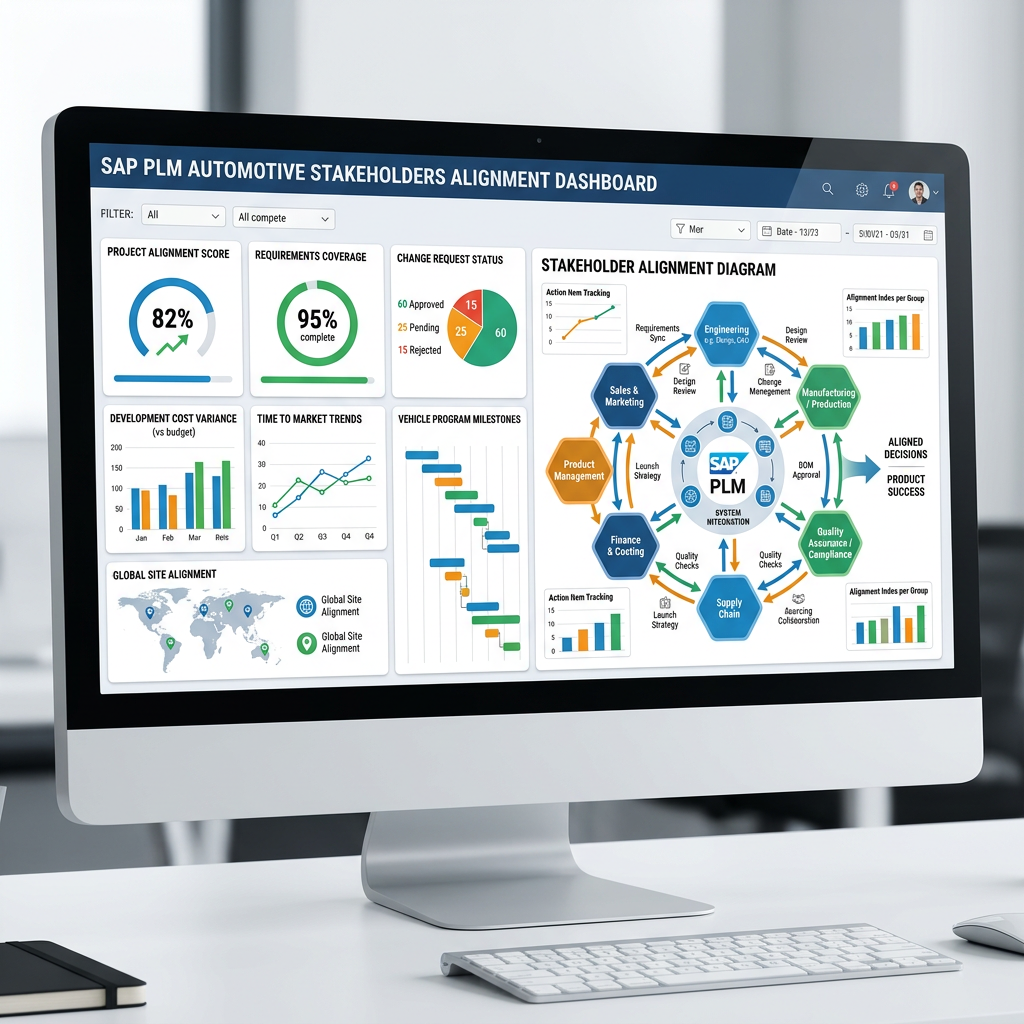
Introduction: Why KPI Design Matters in SAP PLM Programs
For Tier 1 automotive suppliers implementing SAP and PLM, KPIs should not be treated as simple project progress metrics. Instead, they must serve as aligned indicators of business value realization.
In TOGAF® Phase A, KPIs are defined alongside the Architecture Vision, ensuring alignment with value propositions and securing agreement from sponsors and key stakeholders. These KPIs are then embedded into the Statement of Architecture Work (SoAW), forming the foundation for transformation governance.
Why Define KPIs in Phase A
SAP and PLM implementation is not merely an IT upgrade. It represents a business transformation connecting engineering, procurement, production preparation, mass production, and change management.
SAP PLM aims to enhance:
- Speed
- Quality
- Compliance
- Profitability
This is achieved through product development digitalization and the establishment of a digital thread.
Similarly, TOGAF® defines Phase A as the stage where organizations establish a high-level vision of business value and capabilities to secure approval for execution.
Therefore, KPIs must measure whether the transformation delivers real business impact, not just project execution status.
How to Define KPIs
KPI design should start from business objectives and work backward.
In TOGAF® Phase A, the process includes:
- Identifying business goals
- Understanding business drivers
- Analyzing stakeholder concerns
- Defining value propositions
- Establishing KPIs
For SAP PLM programs, a practical approach is:
- Clarify business challenges
Example: Reduce development lead time, lower product cost, improve quality, strengthen audit readiness - Define transformation themes
Example: Engineering change management, BOM accuracy improvement, standardization of part approval processes - Translate into measurable KPIs
TOGAF emphasizes embedding performance metrics into enterprise architecture.
KPI Layering Model
A multi-layer KPI structure ensures consistency and alignment. For Tier 1 automotive SAP PLM programs, three levels are essential:
- Business Level
Examples: SOP lead time, cost impact of design changes, development cost, profit margin, audit findings - Transformation Level
Examples: Engineering change cycle time, ECR/ECO backlog days, BOM accuracy, drawing-to-material master consistency - Execution Level
Examples: Master data compliance rate, data migration completion rate, system adoption rate, exception handling ratio
In Phase A, focus on high-level business and transformation KPIs. Detailed operational KPIs should be refined in later phases.
Stakeholder Alignment
KPIs must not be defined solely by the EA team.
TOGAF® requires:
- Stakeholder mapping
- Agreement on value propositions
- Alignment with corporate and line management
For SAP PLM, involve:
- Executive sponsor (business or corporate leadership)
- PM, EA, business and IT owners
- Representatives from engineering, quality, manufacturing engineering, production control, procurement, costing, IT
- Finance, internal control, and global site leaders as needed
A practical model:
- EA drafts KPI structure
- PM integrates into execution plan
- Business validates relevance
- Sponsor approves
Optimal Number of KPIs
More KPIs do not mean better outcomes.
In practice:
- 1–3 KPIs per value proposition
- 5–10 KPIs overall
Too many KPIs dilute focus and reduce usability in decision-making.
In Phase A, prioritize a small, high-impact set that supports executive decisions.
KPI Governance and Operations
KPIs must be operationalized, not just defined.
TOGAF® recommends embedding KPIs into the SoAW and tracking them throughout the ADM cycle.
A standard governance cycle:
- Review KPIs monthly or quarterly
- Compare baseline vs target
- Analyze root causes of gaps
- Define corrective actions in EA governance forums
- Adjust KPIs if necessary
Separate:
- Project management meetings
- Business transformation governance meetings
KPI reviews should include business owners to ensure relevance and accountability.
Organizational Model for KPI Management
Clear role definition is critical:
- EA: KPI design principles and alignment with architecture
- PM: Integrated management of schedule, risks, and KPI progress
- Business Owners: Performance tracking and improvement actions
- IT: Data collection, system integration, visualization
- Sponsor: Prioritization and final decision-making
In TOGAF®, Architecture Vision must be supported by sponsors before progressing. KPI governance should function as a decision-making system, not just monitoring.
Relationship Between KGI and KPI
KGI represents the final business outcome, while KPI measures progress toward it.
Example:
- KGI: Reduce new product launch delays by 50%
- KPIs:
- Engineering change approval lead time
- BOM completion rate
- First-time drawing approval rate
SAP PLM enables this linkage through digital thread integration, connecting leading indicators (KPIs) with final outcomes (KGI).
Common Pitfalls in KPI Design
Avoid these common mistakes:
- Over-focusing on system metrics (e.g., uptime)
- Fragmented KPIs across departments
- Metrics that cannot be influenced operationally
- Undefined calculation methods or data sources
- Over-detailing KPIs too early in Phase A
KPIs must be business-driven and stakeholder-aligned.
Conclusion
The true objective of SAP and PLM implementation is not system deployment, but standardizing product development and production readiness processes to deliver business outcomes.
Defining KPIs in TOGAF® Phase A ensures:
- Alignment across business, transformation, and execution layers
- Shared success criteria among stakeholders
- A strong foundation for value-driven transformation
For Tier 1 automotive suppliers, success begins with KPI design that is:
- Focused and minimal
- Connected to business value
- Built on stakeholder alignment
- Designed for operational governance
References (English)
- SAP PLM (R&D Engineering): https://www.sap.com/japan/products/scm/plm-r-d-engineering.html
- What is Product Lifecycle Management (SAP): https://www.sap.com/japan/resources/what-is-product-lifecycle-management
- TOGAF® Standard — Introduction
This is the primary official source for ADM Phase A, Architecture Vision, KPIs, and the Statement of Architecture Work. - A. Architecture Vision
Useful for confirming what Phase A is intended to define. - PLM (Product Lifecycle Management) System
This source supports the SAP PLM context, including digital product development and the digital thread. - What is Product Lifecycle Management? – SAP
Useful for a basic definition of PLM.
Disclaimer
Parts of this article were developed with reference to generative AI suggestions and were reviewed, refined, and supplemented based on the author’s professional expertise and judgment.

Leave a Reply