Introduction
Large-scale SAP implementations rapidly expand in complexity, involving business processes, data structures, application landscapes, and cross-organizational governance. When it is unclear who manages what information and where it is stored, issues such as duplication, inconsistencies, unclear impact scope, and chaotic change management inevitably arise.
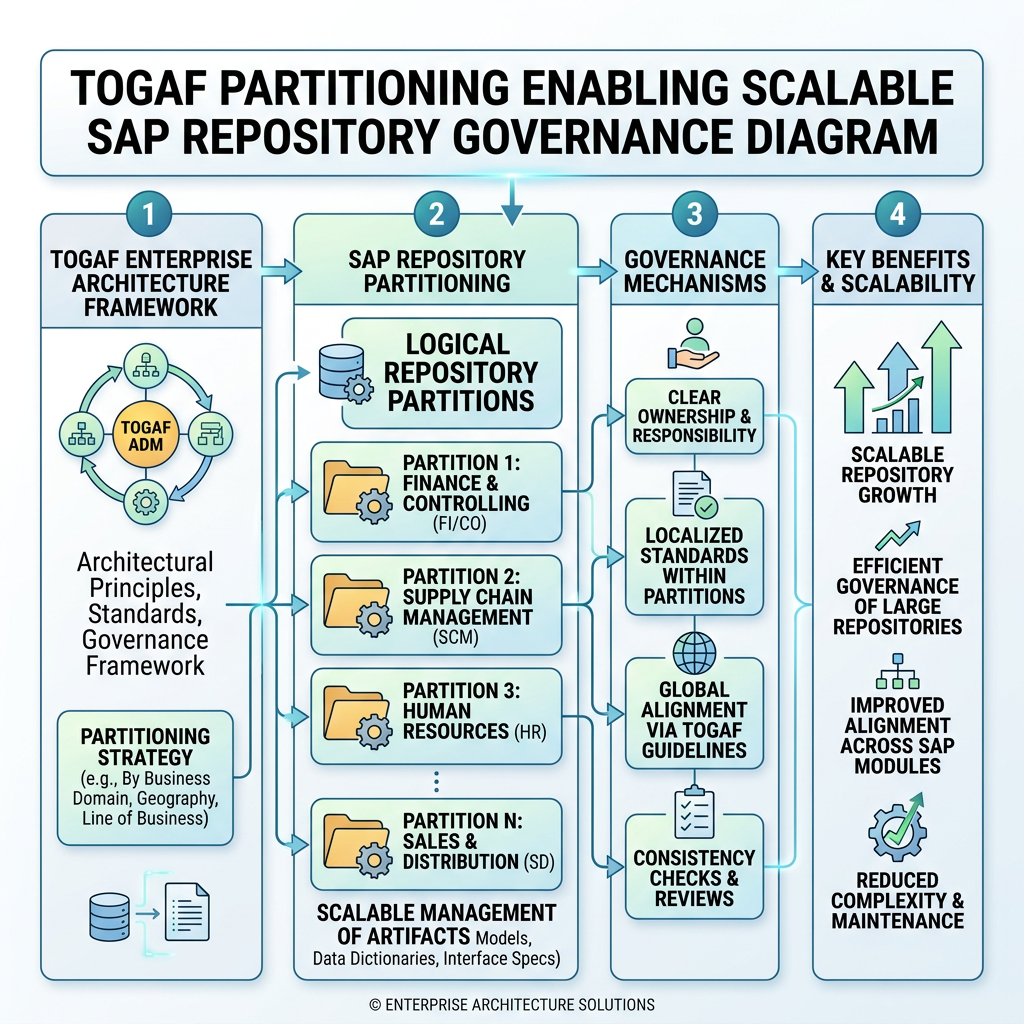
The TOGAF® Architecture Repository, along with its core concept of Architecture Partitioning, provides a practical and scalable framework to address these challenges. This article explains how to design and implement partitioning specifically for SAP environments.
What Is Architecture Partitioning?
Architecture Partitioning is the practice of logically and physically segmenting enterprise architecture assets to clarify scope, ownership, lifecycle, and access control.
Key objectives:
- Scalability: Manage large volumes of artifacts in structured units
- Ownership clarity: Define responsibility and accelerate decision-making
- Reusability: Promote reuse of shared assets across the organization
- Change isolation: Limit impact scope and reduce risk
- Compliance: Enable easier governance aligned with regulatory requirements
Key Components of TOGAF® Architecture Repository
- Reference Library: Standards, reference models, best practices (e.g., SAP standard configurations)
- Metamodel: Rules defining architecture entities and attributes
- Artifacts: Diagrams, models, documents, and Architecture Decision Records (ADR)
- Repository Management: Access control, versioning, metadata management
- Governance Information: Policies, approval records, decision logs
Practical Partitioning for SAP Implementation
Organizational Partitions
- Enterprise Partition
Includes: Group strategy, enterprise data models (e.g., master data policies), SAP S/4HANA standardization guidelines, integration contracts
Role: Maintain enterprise-wide principles and shared assets - Business Unit / Regional Partition
Includes: Local requirements, custom developments (Z-transactions, ABAP), regulatory compliance
Role: Align localization with enterprise standards - Project / Solution Partition
Includes: Module-level designs (FI, SD, MM), configuration documents, migration scripts, test artifacts
Role: Maintain implementation-level traceability - Operations / Runbook Partition
Includes: SOPs, SLA definitions, incident workflows, patch plans
Role: Centralize operational knowledge
Cross-Domain Partitions
- Data: Master data, transactional models, data dictionary
- Process: Order-to-Cash, Procure-to-Pay workflows
- Application: SAP module integrations, custom apps (including Fiori)
- Infrastructure: Cloud setup, network design, S/4HANA infrastructure
- Security: Authentication, authorization, encryption policies
- SAP-specific Objects: BAPI, IDoc, RFC, BADI, Enhancement Spots, Fiori apps
Lifecycle and Versioning
Artifacts are managed across phases:
Requirements → Design → Build → Test → Migration → Production
Versioning enables tracking differences during upgrades and patches while limiting impact scope.
Access and Responsibility
Assign clear ownership per partition:
- Enterprise Architect
- Business Owner
- Project Manager
- Operations Lead
Define approval workflows, RACI models, and change request processes.
Repository Design Considerations (SAP-Focused)
Metadata Design (Required Fields)
- Module (FI, SD, MM)
- Transaction code
- Table name
- Interface name
- BAPI / IDoc name
- Version
- Status (Draft / Approved / Retired)
- Dependencies
Reusable Asset Catalog
Tag reusable assets such as:
- Master data (customer, product)
- Standard processes (Order-to-Cash)
This improves scalability and governance.
Integration
Integrate with:
- ALM/ITSM (Jira, ServiceNow)
- CMDB
- Test management tools (SAP Solution Manager, etc.)
Enable API-based traceability.
Security and Compliance
- Encrypt sensitive partitions
- Enforce strict access control
- Maintain audit logs and change history
Traceability
Link:
Change Request → Impact Analysis → Approval → Implementation
Governance Best Practices
- Define ownership and RACI clearly
- Standardize templates, naming conventions, tagging rules
- Conduct regular architecture reviews
- Record key decisions using ADR
- Provide onboarding and training materials
Example Scenario
Global S/4HANA Implementation
- Enterprise Partition: Master data strategy, SAP standardization policy
- Regional Partition: Tax rules, invoice formats, localization specs
- Project Partition: Migration plans, cleansing strategy, test cases
Outcome: Enables parallel project execution while maintaining global consistency.
Pre-Implementation Checklist
- Are partition scopes and owners clearly defined?
- Are metadata standards and templates prepared?
- Is integration with ALM/ITSM/CMDB planned?
- Are governance processes practical and enforceable?
- Are reusable assets and reference libraries established?
Summary
Applying TOGAF® Architecture Partitioning organizes and localizes complexity in SAP implementations, improving reusability, traceability, and governance.
Please refer to this article for topics related to Enterprise Architecture (EA).
Enterprise Architecture – Insight Arc | SAP, Enterprise Architecture & Supply Chain Strategy
Reference Links
- The Open Group — TOGAF Standard:
https://www.opengroup.org/togaf - TOGAF Architecture Repository (overview):
https://pubs.opengroup.org/architecture/togaf9-doc/arch/chap41.html - TOGAF Architecture Partitioning (concepts and guidance):
https://pubs.opengroup.org/architecture/togaf9-doc/arch/chap42.html - SAP S/4HANA Product Documentation:
https://help.sap.com/viewer/product/SAP_S4HANA - SAP Community — Architecture and Implementation Articles:
https://community.sap.com - ServiceNow — CMDB Product Information (for integration scenarios):
https://www.servicenow.com/products/cmdb.html - Atlassian — Jira Product Information (ALM/ITSM integration):
https://www.atlassian.com/software/jira - Configuration Management (general explanation):
https://en.wikipedia.org/wiki/Configuration_management
Disclaimer
Parts of this article were developed with reference to generative AI suggestions and were reviewed, refined, and supplemented based on the author’s professional expertise and judgment.

Leave a Reply