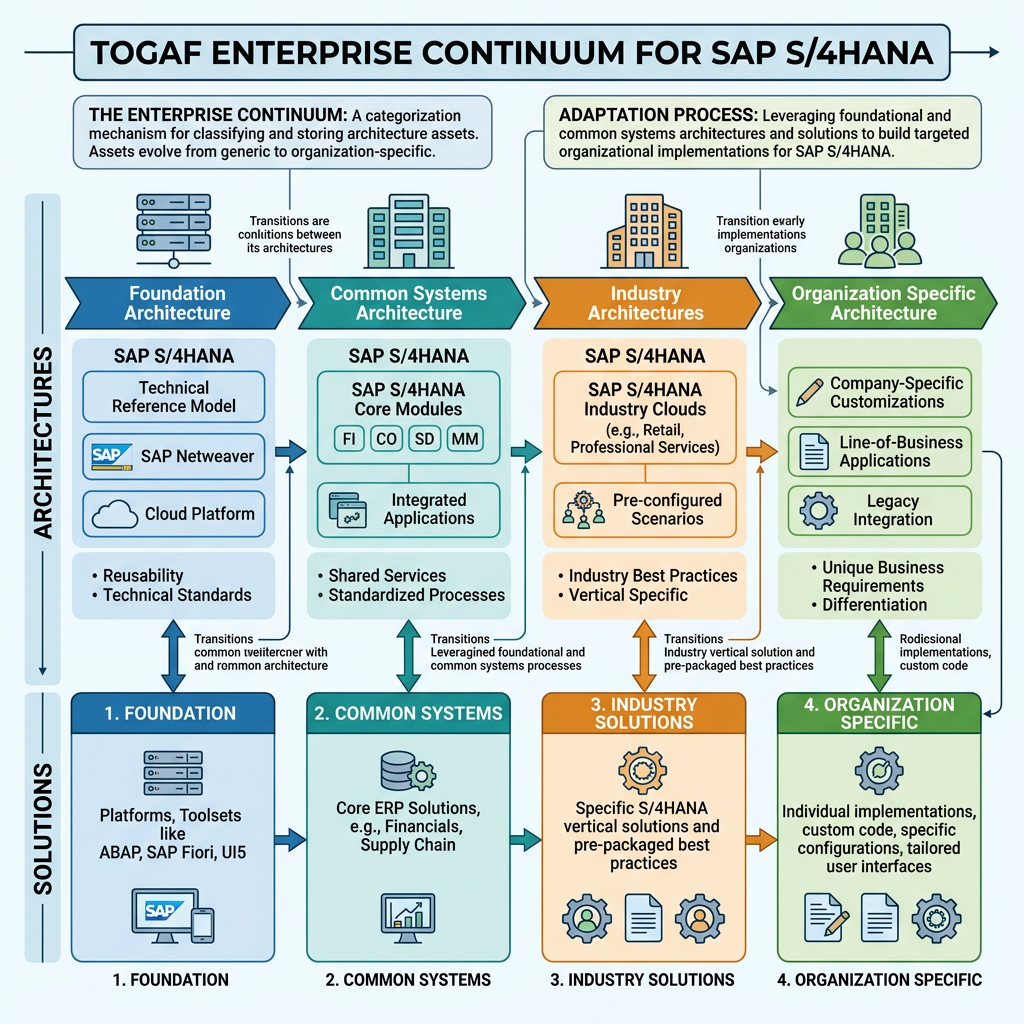
TOGAF® Enterprise Continuum provides a powerful framework for SAP S/4HANA implementations, enabling centralized management of “standard best practices” and “organization-specific requirements” while optimizing scope, Fit/Gap analysis, and governance. This article delivers actionable methodologies that Enterprise Architects can leverage in real-world SAP projects.
What is Enterprise Continuum?
Enterprise Continuum is a conceptual continuum that organizes all enterprise architecture assets—including models, patterns, standards, and solutions—along dimensions of “abstraction level” and “genericity”. It positions everything from the most generic foundation architectures through industry-common and common systems to organization-specific architectures and concrete solutions as a unified spectrum
TOGAF® defines Enterprise Continuum as a “virtual repository of reusable architecture assets that exist within the enterprise and across the broader IT industry”. Rather than being an actual tool, it serves as a “classification framework and organizing principle” encompassing assets such as TOGAF’s Technical Reference Model (TRM), industry reference models, vendor standard solutions, and deliverables from past projects.
Two Constituent Elements: Architecture Continuum and Solutions Continuum
Enterprise Continuum consists of two complementary perspectives: Architecture Continuum and Solutions Continuum.
Architecture Continuum
Architecture Continuum organizes “architectural descriptions themselves” along an axis from high abstraction to low abstraction:
- Foundation Architecture: The most generic technology and principles foundation, such as TOGAF® TRM
- Common Systems Architecture: Architecture for cross-cutting common functions like security, integration, and monitoring
- Industry Architecture: Architecture incorporating industry-specific processes and information models for manufacturing, finance, retail, etc.
- Organization-Specific Architecture: Business processes, organizational structures, and information/application/technology architectures unique to individual enterprises
This structure enables easy tracing of “which layer architectures inherit from what, and how far they specialize for the organization”.
Solutions Continuum
Solutions Continuum organizes “implemented solutions and products” along an axis from generic to customer-specific:
- Foundation Solutions: Foundation technology stacks, infrastructure, middleware, etc.
- Common Systems Solutions: Generic solutions such as authentication infrastructure, common integration platforms, monitoring infrastructure
- Industry Solutions: Industry-specific packages, sector templates, solutions aligned with industry best practices
- Organization-Specific Solutions: Complete systems configured, extended, or custom-developed for specific enterprises
The relationship operates where Architecture Continuum provides “design guidelines” while Solutions Continuum arranges “systems as tangible entities”.
Definition, Purpose, and Overview
Definition
Enterprise Continuum is a conceptual framework and virtual repository model that classifies and organizes enterprise architecture assets as a continuum from generic to organization-specific.
Primary Objectives
- Promote Reuse: Systematically organize past projects and external reference models to enhance reusability
- Provide Common Language: Deliver a shared framework for business, IT, and vendors to communicate “what level of assets are being used”
- Standardization and Governance: Visualize the breakdown from generic-level standards and principles to organization-specific designs and solutions, maintaining consistency
- Evolution Management: Track the “evolutionary pathway” from abstract references to concrete solutions, facilitating future transformation planning
Conceptual Image
Envision two parallel bands (Architecture / Solutions) extending from left (abstract/generic) to right (concrete/specific), serving as a “map” for arranging enterprise-wide architecture assets while maintaining awareness of the correspondence between both dimensions.
Practical Application of Enterprise Continuum
From an Enterprise Architect perspective, here’s how to “use” Enterprise Continuum in practice:
Asset Inventory and Classification
Identify past EA deliverables, non-SAP system architectures, industry reference models, and vendor-provided architectures, determining where each positions on the Architecture Continuum. Organize packaged products, platforms, common infrastructure, and SAP templates on the Solutions Continuum, clearly indicating “what level of generic solution” each represents.
Clarify Reuse Strategy and Standards
Define “upper-level assets” to reference in each ADM phase, and establish project reuse policies (e.g., maximize industry template usage, minimize organization-specific design). Define principles at the foundation architecture level (e.g., cloud-first, API-first, standard best practice priority) as Foundation/Common Systems layers within Enterprise Continuum.
Gap Analysis and Roadmap Development
Survey current architecture from the perspective of “what level assets does it depend on” within the Continuum, and identify gaps against the target state (e.g., “industry standard + minimal organizational variance”). Incorporate into roadmaps decisions about “what level assets to newly acquire” and “what to retire/standardize” to close gaps.
Common Framework with Vendors and SIs
Position vendor-presented reference architectures and solutions on Enterprise Continuum, visualizing “where generic assets end and organization-specific development begins”. This enables discussions about customization scope, operational burden, and future upgrade impacts using a common organizing axis.
Specific Application Examples in SAP S/4HANA Implementation Projects
Here’s how to specifically leverage Enterprise Continuum in SAP S/4HANA implementation projects:
Positioning SAP Reference Models and Fit-to-Standard
SAP S/4HANA provides abundant standard content including best practices, reference processes, and industry solutions. These can be positioned as Industry Architecture (industry-specific standard processes) and Common Systems Architecture (common business functions) level assets within Architecture Continuum.
When adopting a Fit-to-Standard approach, Enterprise Architects can organize as follows:
- “SAP Best Practices for S/4HANA (industry templates)” → Adopt as Industry Architecture / Industry Solutions level assets
- Organization-specific business requirements deviating from standard processes → Manage as Organization-Specific Architecture / Solutions level additions/modifications
This classification makes it easier to explain to business stakeholders “which requirements align with standards versus which represent organization-specific cost and risk factors”.
Organizing Add-on Development and Extension Strategy
In SAP S/4HANA implementations, the appropriateness and methods of extensions and add-on development (In-App / Side-by-Side / BTP utilization, etc.) become major discussion points. Using Enterprise Continuum enables systematic separation of “which requirements can be absorbed within Industry Solutions or Common Systems Solutions scope” versus “what constitutes add-on targets as Organization-Specific Solutions.”
For example, organize as follows:
- Generic approval workflows and notifications: Absorb with common solutions (Common Systems Solutions), addressing with standard functions + configuration
- Special industry regulatory compliance or proprietary pricing calculations: Address as organization-specific solutions (Organization-Specific Solutions) through BTP extensions or add-on development
This distinction provides decision criteria to minimize add-on scope and mitigate future release upgrade impacts.
Overall Architecture with Peripheral Non-SAP Systems
Many enterprises deploy SAP S/4HANA as the ERP core while combining separate solutions for HR, CRM, SCM, and data analytics in hybrid configurations. Using Enterprise Continuum to survey the application landscape including non-ERP components from the perspective of “which parts are industry standard solutions” versus “what is organization-specific” clarifies integration and standardization priorities.
Specifically, classify from perspectives such as:
- Foundation Solutions: Cloud infrastructure (e.g., SAP HANA Enterprise Cloud or IaaS foundation), network, security infrastructure
- Common Systems Solutions: API gateway, identity management, monitoring infrastructure, log management—cross-cutting foundations common to SAP and non-SAP
- Industry Solutions: SAP industry solutions, industry-specific external SaaS
- Organization-Specific Solutions: Proprietary portals, analytics applications using custom algorithms, supplementary systems for organization-specific processes
This organization positions SAP S/4HANA implementation not merely as ERP renewal but as a starting point for enterprise-wide standardization and modernization.
Roadmap and Architecture Governance
TOGAF® ADM recommends considering utilization of Enterprise Continuum assets in each phase. When drawing multi-phase roadmaps for SAP S/4HANA implementation (core deployment → peripheral renewal → advanced data utilization, etc.), define “what level assets to utilize/newly acquire/retire” in each phase using Enterprise Continuum as the axis.
For example, consider a phased migration approach with policies such as:
- Phase 1: For ERP core renewal, configure primarily around Industry Solutions and SAP Best Practices, limiting organization-specific elements
- Phase 2: Standardize common infrastructure (identity, integration, monitoring) as Common Systems Solutions, converging to the same foundation regardless of SAP/non-SAP
- Phase 3: For analytics and data utilization domains, leverage Industry/Common analytics templates while adding organization-specific models
Define these as architectural principles and standards, controlling deviations during reviews from the perspective of “which Enterprise Continuum layer should the requested solution belong to.”
Critical Implementation Points for Enterprise Architects
Here are key points for Enterprise Architects leveraging Enterprise Continuum in SAP S/4HANA implementation projects:
A Tool for Demonstrating “What Not to Build from Scratch”
Visualize which layers can reuse external reference models, SAP standard content, and past organizational assets to suppress project reinvention.
Common Axis for Separating “Standard” from “Organization-Specific”
Enable management, business, IT, and SIs to discuss “how far to adhere to standards” in Fit-to-Standard discussions and add-on necessity decisions using the same framework.
Consistency Checks Across the Entire Landscape
Organize not only SAP systems but also peripheral systems and infrastructure by “what level solutions” are adopted, preventing sprawl from local optimization.
Narrative Framework for Transformation Stories
Enhance persuasiveness with executive leadership by explaining the migration story from current fragmented proprietary solution collections to future standardized landscapes as position shifts within Enterprise Continuum.
Summary
TOGAF® Enterprise Continuum provides a powerful framework for visualizing the relationship between “standard best practices” and “organization-specific requirements” in SAP S/4HANA implementations, strategically advancing reuse and standardization. By organizing assets along the two axes of Architecture Continuum and Solutions Continuum, you can execute Fit-to-Standard decisions, add-on development scope optimization, peripheral system integration design, and multi-phase roadmap development within a consistent framework.
Enterprise Architects can leverage Enterprise Continuum as “asset inventory,” “reuse strategy clarification,” “gap analysis,” and “common language with vendors” to suppress project reinvention and accelerate consensus-building among management, business, IT, and SIs. Enterprise Continuum becomes an indispensable tool for positioning SAP S/4HANA implementation not merely as system renewal but as a starting point for enterprise-wide standardization and modernization.help.
Please refer to this article for topics related to Enterprise Architecture (EA).
Enterprise Architecture – Insight Arc | SAP, Enterprise Architecture & Supply Chain Strategy
Reference Links
- TOGAF Enterprise Continuum – Visual Paradigm:
https://togaf.visual-paradigm.com/ - TOGAF Official Documentation – The Open Group:
https://www.opengroup.org/ - Enterprise Continuum Overview – Sparx Systems:
https://sparxsystems.com/ - Architecture Continuum Explained – LinkedIn Learning:
https://linkedin.com/learning/ - Solutions Continuum Framework – Bizzdesign:
https://bizzdesign.com/ - SAP S/4HANA Best Practices – Edge Work:
https://edge-work.com/ - SAP Business Technology Platform (BTP) Guide:
https://sap.com/btp/ - Enterprise Architecture with SAP – JSOL Promotion:
https://promotion.jsol.co.jp/ - LeanIX Enterprise Architecture Management:
https://leanix.com/
Disclaimer
Parts of this article were developed with reference to generative AI suggestions and were reviewed, refined, and supplemented based on the author’s professional expertise and judgment.

Leave a Reply