Introduction
An SAP S/4HANA implementation is not simply an ERP replacement. It is an enterprise-wide transformation that changes business processes, data, organization structures, governance, applications, and technology at the same time.
Many SAP programs use SAP Activate as their implementation methodology but lack a clearly defined Enterprise Architecture approach above the project level. Individual workstreams may progress according to plan while alignment with enterprise strategy, cross-business standardization, investment priorities, and the transition to the target architecture remain unclear.
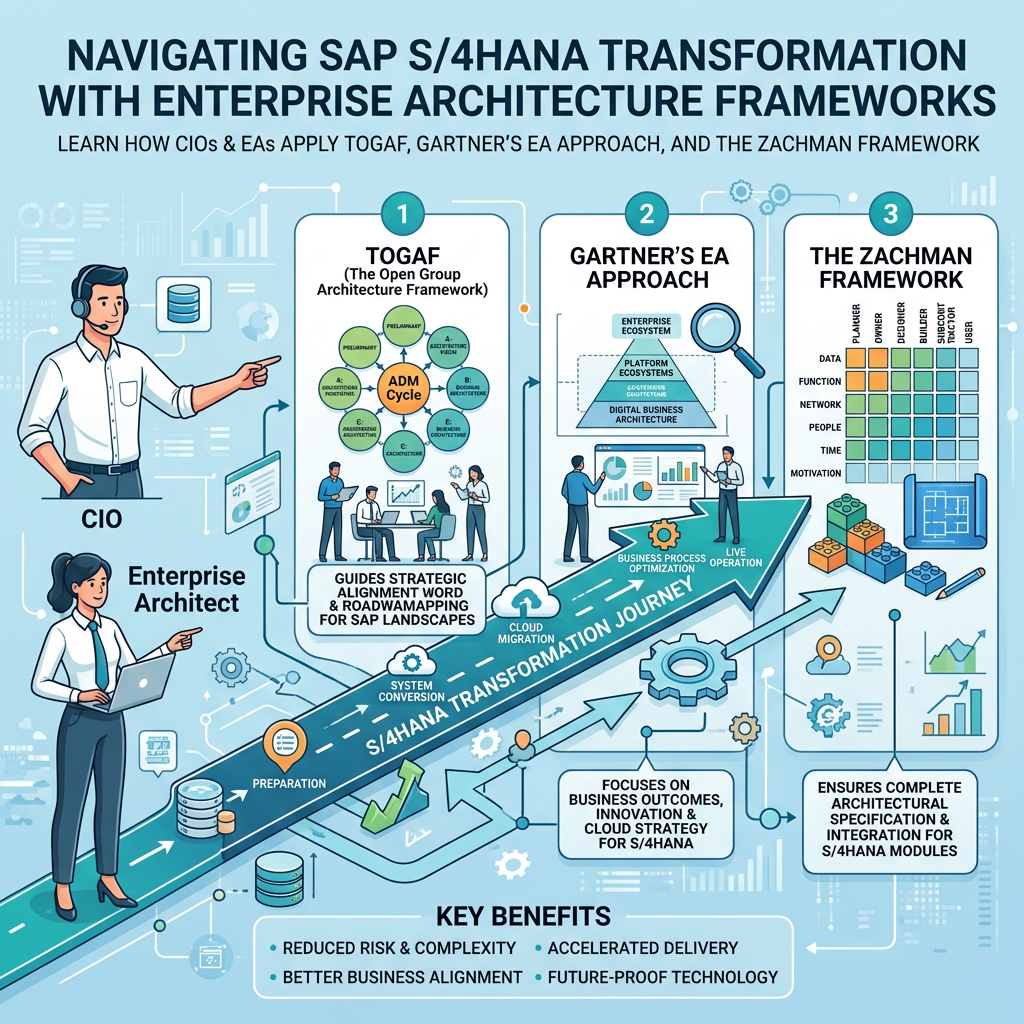
TOGAF®, Gartner’s Enterprise Architecture approach, and the Zachman Framework are often considered potential solutions. However, they are not competing frameworks designed to solve the same problem.
Their roles can be summarized as follows:
- TOGAF®: How should the enterprise define, approve, execute, govern, and maintain the architecture for its SAP transformation?
- Gartner’s EA approach: How should SAP investments be connected to business outcomes and executive decisions?
- Zachman Framework: Have all relevant aspects and stakeholder perspectives of the SAP transformation been described?
This article explains how CIOs and enterprise architects can use these approaches individually and together during an SAP implementation or global rollout.
Why SAP Transformation Needs Enterprise Architecture
The difficulty of an SAP implementation does not come from technology alone. The more fundamental problem is that multiple decision-making layers exist between corporate strategy and project delivery, creating a high risk of local optimization.
For example, executives may decide to establish a global template, but the program still needs to answer difficult questions:
- Which processes should be globally standardized?
- Which country or business-unit differences qualify as legitimate local requirements?
- How should Clean Core principles be balanced with extensions that provide competitive differentiation?
- In what order should ECC systems, satellite applications, and data platforms be migrated?
- Should the company adopt one global SAP instance or a multiple-instance model?
- Where should the boundaries between SAP standard functionality, SAP BTP extensions, and non-SAP solutions be drawn?
- How should transformation success be measured beyond go-live dates and budget performance?
These questions cannot be resolved through individual Fit-to-Standard workshops alone. The organization needs an EA capability that connects business outcomes to the target architecture, transformation roadmap, architecture principles, and exception governance.
TOGAF®: Making SAP Transformation Governable
The Open Group describes TOGAF® as a standard approach for developing, approving, using, and maintaining Enterprise Architectures. It is based on an iterative process model supported by best practices and reusable architecture assets (The Open Group, TOGAF Pocket Guide).
At the center of TOGAF® is the Architecture Development Method, or ADM. In an SAP transformation, ADM should not replace the detailed SAP implementation methodology. Instead, it should operate as the higher-level architecture lifecycle that connects multiple programs and workstreams with enterprise strategy.
Applying TOGAF® ADM to SAP Transformation
The TOGAF® ADM phases can be mapped to SAP transformation activities as follows:
| TOGAF® ADM phase | Primary SAP transformation concerns |
| Preliminary Phase | Establish the EA organization, Architecture Board, principles, standards, and exception process |
| Phase A: Architecture Vision | Define the value hypothesis, scope, stakeholders, and direction of the Target Operating Model |
| Phase B: Business Architecture | Design value streams, business capabilities, standard processes, organizations, and roles |
| Phase C: Information Systems Architectures | Define target master data, analytical data, and SAP and non-SAP application architectures |
| Phase D: Technology Architecture | Define the S/4HANA deployment model, BTP, Integration Suite, cloud, infrastructure, and security architecture |
| Phase E: Opportunities and Solutions | Define transformation initiatives, work packages, and transition architectures |
| Phase F: Migration Planning | Set the rollout sequence, dependencies, investment plan, and migration roadmap |
| Phase G: Implementation Governance | Conduct solution architecture reviews and manage principle compliance, exceptions, and technical debt |
| Phase H: Architecture Change Management | Continuously update the architecture for SAP roadmaps, mergers, regulation, AI, and business change |
SAP Business Cases Best Suited to TOGAF®
TOGAF® is especially useful for long-running transformations involving multiple organizations:
- A global S/4HANA template deployed across countries and business units
- Consolidation of multiple SAP instances and legacy landscapes
- A manufacturing architecture spanning SAP, PLM, MES, SCM, and data platforms
- Post-merger integration of processes, data, and applications
- Enterprise governance for Clean Core, SAP BTP extensions, and APIs
Applying every TOGAF® artifact mechanically can create unnecessary documentation and governance overhead. An organization should select the artifacts required for investment and design decisions while avoiding duplication with SAP Activate deliverables.
Gartner: Connecting SAP Investment to Business Outcomes
Gartner describes the evolution of EA from traditional methods to Business-Outcome-Driven Enterprise Architecture, or BODEA, and then toward an Internal Management Consultancy model. Gartner argues that EA leaders need a portfolio of services that adapts to the changing needs of stakeholders (Gartner, Enterprise Architecture Services Predictions).
Gartner’s approach should not be treated as the same type of publicly standardized process as TOGAF®. Its primary strength lies in designing an EA practice around the value it delivers to management rather than around the comprehensive production of architecture artifacts.
Applying BODEA to an SAP Program
An SAP program using BODEA should not begin with the system objective “implement S/4HANA.” It should start by defining the outcomes the business expects to achieve.
| Business challenge | Target business outcome | EA decision support | Example SAP initiative |
| Excessive inventory | Reduce days in inventory and stockout rates | Supply chain capability map and process-data dependencies | Integrate S/4HANA, SAP IBP, and SAP MDG |
| Slow financial close | Shorten the monthly close cycle | Finance target architecture and standardization roadmap | Universal Journal and Group Reporting |
| Limited product profitability insight | Improve product- and customer-level margin visibility | Information architecture and KPI model | Margin Analysis, Datasphere, and SAP Analytics Cloud |
| Rising application costs | Reduce TCO and change lead time | Application portfolio, technical debt, and migration scenarios | Retire ECC, adopt Clean Core, and use SAP BTP |
| Fragmentation after an acquisition | Accelerate integration and establish common management measures | Capability gaps and transition architecture | Two-tier ERP or a phased template rollout |
Under this approach, EA deliverables are evaluated by their contribution to decisions, not by their size or completeness. Instead of reporting that an application landscape was documented, the EA team should explain how its analysis enabled the company to retire redundant applications and reduce operating costs.
EA Services CIOs Should Expect
When applying Gartner’s principles to an SAP program, the EA team should not operate only as a design-review function. It should provide decision-oriented services such as:
- Business capability planning: Determine which capabilities should receive SAP investment
- Investment advisory: Compare investment options, dependencies, risks, and expected outcomes
- Roadmap orchestration: Coordinate migration sequencing across SAP and non-SAP initiatives
- Architecture decision support: Guide choices involving public cloud, private cloud, SAP BTP, and non-SAP SaaS
- Value realization review: Verify business outcomes after go-live and update the roadmap
This approach is particularly useful when executives do not understand the value of EA or when an SAP program has become too focused on technical replacement.
Zachman Framework: Preventing Design Gaps
Zachman International defines the Zachman Framework as an ontology for describing an enterprise rather than as an implementation methodology. Its official explanation explicitly distinguishes a framework as a structure from a methodology as a process (Zachman International, About the Zachman Framework).
The Zachman Framework cannot independently determine the sequence or roadmap for an SAP implementation. Its value lies in classifying architecture content and identifying missing concerns, stakeholder perspectives, and deliverables.
Applying the Six Questions to SAP
| Question | SAP transformation subject | Typical artifacts |
| What | Products, customers, suppliers, materials, accounts, and assets | Data models, master data ownership, and migration policies |
| How | Order-to-Cash, Plan-to-Produce, Record-to-Report, and other processes | Value streams, process models, and Fit-to-Standard results |
| Where | Headquarters, plants, warehouses, sales offices, and cloud regions | Location models, deployment models, and network architecture |
| Who | Business units, global process owners, data owners, and IT operations | Organization models, RACI matrices, and authorization design |
| When | Planning cycles, financial close events, interfaces, and rollout waves | Business event models, batch schedules, and deployment plans |
| Why | Business goals, policies, KPIs, principles, and regulatory requirements | Motivation models, architecture principles, and business outcome maps |
An SAP program may have detailed process and application designs while lacking clear data ownership, plant and warehouse deployment decisions, or business principles governing exceptions. The Zachman questions can reveal these architecture gaps before they become implementation problems.
SAP Business Cases Best Suited to Zachman
- Defining the deliverable structure for a global SAP template
- Organizing design documents produced by multiple implementation partners
- Finding gaps between business, data, application, organization, and technology designs
- Assessing acquired companies using a common architecture classification
- Designing an EA repository that will remain useful after the program ends
The objective should not be to populate all 36 Zachman cells in exhaustive detail. Architects should identify the cells with the greatest decision risk and document them at the level necessary to support action.
Combining the Three Approaches
Large SAP transformations do not need to select only one of the three approaches. Each answers a different question and can play a complementary role.
| Framework or approach | Question answered in SAP transformation | Recommended role |
| TOGAF | How should the architecture be developed, approved, governed, and maintained? | Enterprise architecture lifecycle |
| Gartner | Which business outcomes and executive decisions should EA support? | EA services, investment decisions, and value measurement |
| Zachman | What should be described, and from whose perspective? | Artifact classification, completeness, and traceability |
| SAP Activate | How should the SAP solution be designed, built, and deployed? | Product and implementation delivery |
A practical integrated model consists of four steps.
- Define outcomes using BODEA principles.
Establish management measures such as inventory days, close-cycle duration, on-time delivery, TCO, and time to market. - Structure the transformation using TOGAF ADM.
Manage the Architecture Vision, baseline, target state, gaps, transition architectures, roadmap, and governance. - Use Zachman to check design completeness.
Confirm coverage of data, processes, locations, organizations, events, motivations, and stakeholder perspectives. - Implement the solution using SAP Activate.
Translate the approved target architecture into an SAP solution through Fit-to-Standard, Explore, Realize, Deploy, and related delivery activities.
This separation avoids unnecessary duplication between TOGAF® and SAP Activate while adding business value orientation and architecture completeness.
A Phase-by-Phase Operating Model
Strategy and Investment Decision
Begin by defining business outcomes and executive KPIs using BODEA principles. Use TOGAF® Phase A to establish the Architecture Vision and scope, and use Zachman’s Why, Who, and What questions to confirm the purpose, ownership, and subject of the transformation.
At this stage, the CIO should approve more than a product selection. The decision should also cover expected outcomes, architecture principles, decision rights, and the direction of the Target Operating Model.
Target Architecture Design
Use TOGAF® Phases B through D to develop the Business, Data, Application, and Technology target architectures. Decide which capabilities will use SAP standard processes, which provide strategic differentiation, and which should be retired.
Use Zachman to check whether one architecture domain is advancing without the required supporting decisions. Before finalizing an application design, for example, confirm that process owners, data owners, KPIs, and business events have also been defined.
Roadmap and Rollout Planning
Use TOGAF® Phases E and F to define transition architectures and the migration roadmap. Determine rollout waves using business capabilities, data readiness, organizational change readiness, and legacy lifecycle constraints rather than country or company code alone.
Apply business outcome evaluation to show which benefits each wave will deliver. This enables the company to sequence the rollout according to value and risk, not only technical convenience.
Implementation Governance
Apply TOGAF Phase G through an Architecture Board or Design Authority. Governance should not become a slow approval mechanism.
Preapproved standard patterns should move quickly, while only material exceptions require deeper review. Zachman-based traceability can help identify how an exception affects business goals, processes, data, organizations, and technologies.
Post-Go-Live Value Realization
Go-live is not the end of an SAP transformation. Use TOGAF® Phase H to update the architecture and roadmap, and use business outcome measures to assess realized value.
An S/4HANA system may go live on schedule without improving inventory levels or the financial close. In that case, the transformation outcome has not yet been realized. Analyze the combined effects of process design, data quality, organizational authority, and KPI governance, and feed the findings into the next improvement backlog.
CIO and Enterprise Architect Checklist
Business Outcomes
- Is the purpose of the SAP program defined as measurable business outcomes rather than as a system replacement?
- Is each transformation initiative linked to a business KPI?
- Has a value owner been assigned for the period after go-live?
Target Architecture
- Is there an integrated target architecture covering Business, Data, Application, and Technology?
- Can the boundary between standardization and business differentiation be explained by business capability?
- Are decision principles defined for Clean Core, SAP BTP extensions, and non-SAP solutions?
Roadmap
- Are transition architectures and dependencies clearly defined?
- Is rollout sequencing based on business value, risk, and data readiness?
- Does EA manage conflicts and duplicate investments across programs?
Governance
- Is the decision scope of the Architecture Board clear?
- Are principles, standards, exceptions, and technical debt governed consistently?
- Does the organization measure both decision speed and architecture quality?
Deliverables and Traceability
- Can the organization trace business goals through processes, data, applications, and technology?
- Are executive, business, design, implementation, and operations perspectives clearly separated?
- Is ownership for maintaining EA artifacts after the project clearly assigned?
Conclusion
The wrong question is, “Which Enterprise Architecture framework is best for SAP?” The more useful question is, “Which problem should each framework solve in our SAP transformation?”
- TOGAF provides a repeatable process for shaping and governing the transformation.
- Gartner’s EA approach connects SAP investment to business outcomes and executive decisions.
- The Zachman Framework helps prevent gaps in enterprise descriptions and architecture deliverables.
- SAP Activate implements the approved architecture as an SAP solution.
For a CIO, the ultimate goal is not simply to bring S/4HANA live on time. It is to establish a sustainable capability for transforming business operations, data, decisions, and enterprise capabilities through SAP.
A practical model is to use TOGAF® for process, Gartner for value, Zachman for structure, and SAP Activate for implementation.
Suggested Call to Action
When reviewing your SAP roadmap, assess the current architecture deliverables through the lenses of TOGAF®, Gartner, and Zachman. Identifying gaps in process, business outcomes, and design completeness is the first step toward turning an ERP implementation into an enterprise transformation.
References and Further Reading
- The TOGAF® Standard: The Open Group
- TOGAF Architecture Development Method: The Open Group
- Gartner Enterprise Architecture: Insights and Tools
- The Gartner Enterprise Architecture Services Predictions for 2025 and Beyond
- About the Zachman Framework: Zachman International
- SAP Activate: Accelerate SAP Cloud ERP Deployment
Disclaimer
Parts of this article were developed with reference to generative AI suggestions and were reviewed, refined, and supplemented based on the author’s professional expertise and judgment.

Leave a Reply