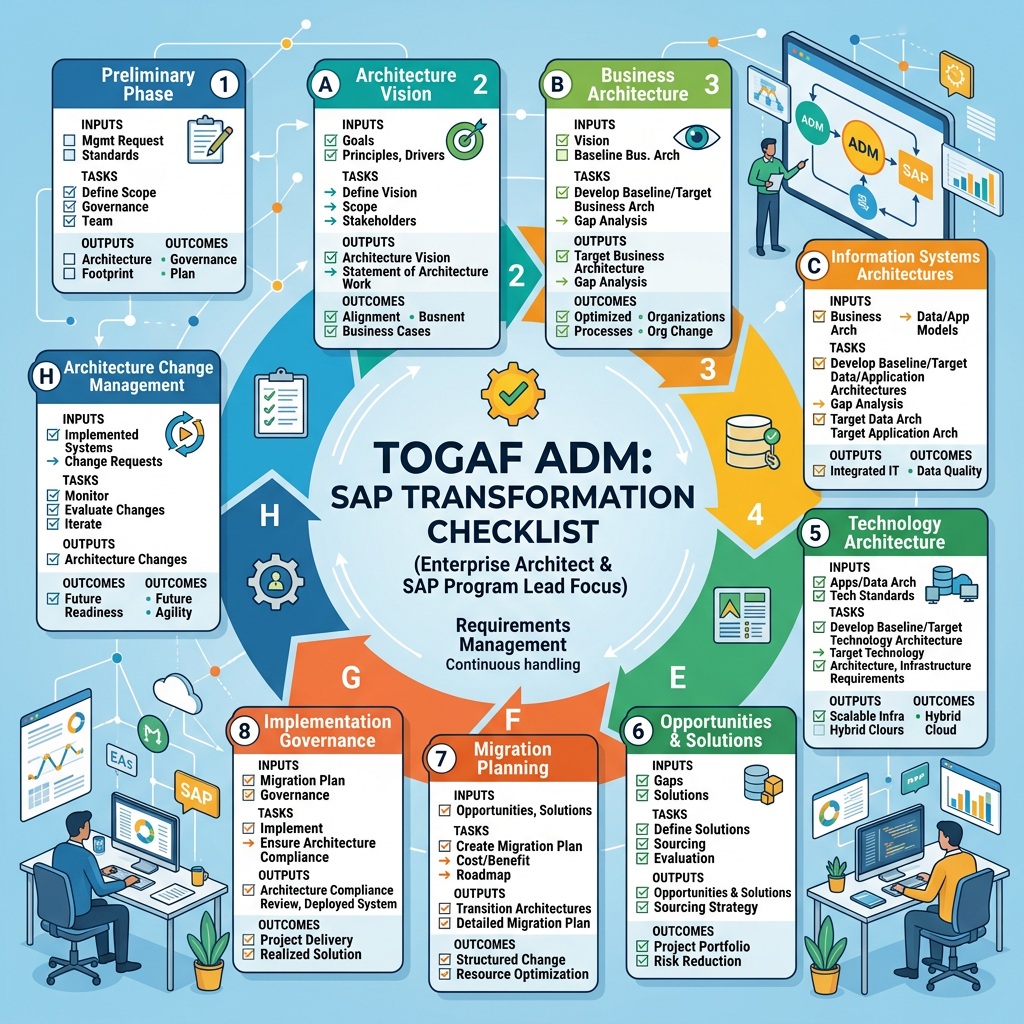
Textbook descriptions of the TOGAF® Architecture Development Method (ADM) present it as a cyclical methodology built around nine phases plus a continuous Requirements Management process.The Open Group On real programs, though, the official Objectives/Steps/Inputs/Outputs structure only becomes useful once teams translate it into a simple, repeatable question for every phase: what do we need before we start, what do we actually do, what must we produce, and what result are we really trying to achieve? This article reframes the official ADM definitions into a practical Input–Task–Output–Outcome checklist that enterprise architects and SAP program leads can apply directly on transformation projects.
Why Reframe ADM as Input, Task, Output, and Outcome?
The TOGAF® Standard defines each phase through its Objectives, Steps, Inputs, and Outputs.The Open Group For day-to-day program use, it helps to translate these four elements as follows:
- Input – what must already be in hand before the phase can start
- Task – the concrete activities performed during the phase (the official Steps)
- Output – the deliverables that must exist when the phase closes
- Outcome – the actual state or result the phase is meant to achieve
One important caveat: the TOGAF® Standard does not define “Outcome” as a formal, standalone category. In this article, “Outcome” is our practical stand-in for each phase’s stated Objectives.The Open Group Producing an output and achieving an outcome are not the same thing, and keeping that distinction visible in phase reviews materially improves governance quality.
Phase-by-Phase Practical Checklist
| Phase | Key Inputs | Practical Tasks | Required Outputs | Target Outcome |
|---|---|---|---|---|
| Preliminary | Business strategy, existing governance, existing frameworks | Stand up the EA organization and governance, define principles, select tools | EA organizational model, tailored framework, architecture principles | An operating capability exists to sustain architecture work |
| A. Architecture Vision | Request for Architecture Work, business goals/drivers, existing repository | Confirm stakeholders, scope, and principles; develop the vision; secure approval | Approved Statement of Architecture Work, Architecture Vision | Leadership agrees on why the initiative matters and what it targets |
| B. Business Architecture | Architecture Vision, business principles, approved work statement | Develop baseline/target business architecture, run gap analysis | Business architecture definition, candidate roadmap components | The business side agrees on the target state and the gaps to close |
| C. Information Systems Architectures | Business architecture, data/application principles | Develop baseline/target data and application architecture, run gap analysis | Data and application architecture definitions | IT’s target state and constraints are clearly defined |
| D. Technology Architecture | Upstream architectures, technology principles, product information | Develop baseline/target technology architecture | Technology architecture definition, candidate roadmap components | The enabling infrastructure and products are concretely defined |
| E. Opportunities and Solutions | Consolidated gap analysis from Phases B–D | Break work into deliverable packages, identify Transition Architectures | Initial Architecture Roadmap | Agreement on what gets tackled first |
| F. Migration Planning | Initial roadmap, cost/benefit and risk data | Prioritize work packages, finalize the migration plan | Detailed Implementation and Migration Plan, finalized roadmap | Investment decisions and the execution plan are locked at executive level |
| G. Implementation Governance | Migration plan, Architecture Contract | Conduct compliance reviews, support deployment, run post-implementation review | Signed Architecture Contract, compliance assessments | The live implementation stays conformant with the architecture |
| H. Architecture Change Management | Post-go-live performance data, change requests | Monitor value realization, manage risk, handle change requests | Architecture updates, new Requests for Architecture Work | The architecture keeps pace with real-world change |
| Requirements Management | Requirements from every phase, requirements impact statements | Identify, track, and prioritize requirements across the cycle | Version-controlled requirements specification | Requirement origin and rationale for change are traceable at any point |
Source: The Open Group, TOGAF Pocket Guide
Mapping ADM to an SAP Implementation Program
For an SAP S/4HANA transformation, the ADM phases typically map onto real program workstreams like this:
- Preliminary → Program charter and EA/CoE stand-up – lock in the global template strategy and decision-making structure.
- Phase A → Business case and executive vision deck – the vision and KPIs used to secure sponsorship.
- Phases B–D → Fit-to-Standard workshops – progressively defining target-state business, data, application, and technology architecture.
- Phases E–F → Migration roadmap and cutover planning – Transition Architectures correspond to phased, multi-region rollout waves.
- Phase G → Post-go-live compliance review – this is effectively your hypercare-period governance checkpoint.
- Phase H → Continuous change management – the ongoing process for managing post-go-live requirements and upgrades from an EA standpoint.
Three Pitfalls That Trip Up Real Programs
- Mistaking output completion for outcome achievement. Teams often produce the documents or architecture diagrams (outputs) without actually securing leadership alignment or business buy-in (outcomes). Every phase-exit review should be judged against the outcome, not just deliverable completeness.
- Treating Requirements Management as a standalone phase. Requirements Management runs continuously across the entire ADM cycle rather than being a single, discrete phase.The Open Group A requirements change surfaced in Phase B needs to be checked against Phase A and Phase D deliverables every time, not just noted and forgotten.
- Forcing the phases into a fixed, waterfall sequence. The TOGAF Standard itself states that phase sequencing and execution should be adapted to the situation at hand, and does not mandate a waterfall approach.The Open Group Program governance needs to explicitly allow for iteration and parallel execution across phases.
Conclusion: Your Next Action
The real value of the ADM’s Objectives/Steps/Inputs/Outputs structure comes from converting it into a standing operating discipline: at the start of every phase, verify the inputs are in hand; at the close of every phase, verify the outputs exist and the outcome was actually achieved. Use the table above as your gate-review checklist at the next program milestone.
Reference Links
- The Open Group, “The TOGAF Architecture Development Method,” TOGAF Pocket Guide: https://pubs.opengroup.org/pocket-guides/togaf-pocket-guide/main/chap06.html
- The Open Group, TOGAF Standard, Version 10, ADM: https://pubs.opengroup.org/togaf-standard/adm/
Disclaimer
Parts of this article were developed with reference to generative AI suggestions and were reviewed, refined, and supplemented based on the author’s professional expertise and judgment.

Leave a Reply