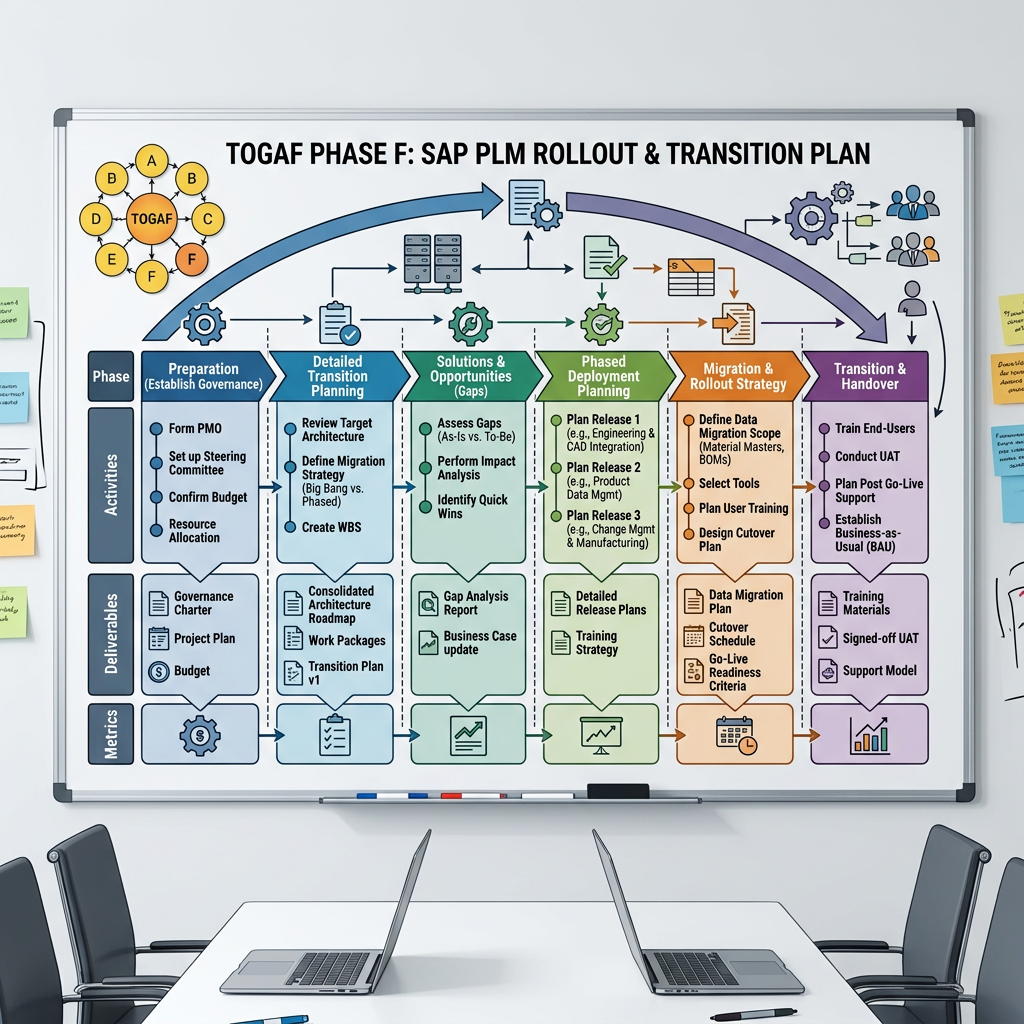
Focus Keyword: TOGAF® ADM Phase F SAP rollout
Successfully implementing SAP ERP, PLM, and surrounding systems requires more than managing individual projects effectively. What ultimately determines success—both domestically and globally—is the ability to design Migration Planning at the enterprise level: deciding which capabilities to deploy, to which locations, and in what sequence.
TOGAF® ADM Phase F focuses precisely on this challenge. It defines how to prioritize implementation initiatives, structure a roadmap, and develop a concrete Implementation and Migration Plan.
Why SAP Programs Require a Phase F Perspective
Typical SAP projects follow a linear structure: requirements, design, build, test, and go-live. However, from an enterprise architecture (EA) perspective, this is insufficient.
In reality, SAP does not operate in isolation. It must be implemented alongside PLM, MDM, BI, EDI, WMS, MES, and other systems, all with complex interdependencies. These must be deployed across multiple migration waves.
SAP best practices emphasize early business process visualization, data quality assessment, and realistic roadmap design. This aligns directly with TOGAF® Phase F, which addresses:
- Which projects should be implemented
- In what order
- Through which transition architectures
Migration Planning vs. Project Planning
A key distinction often overlooked in IT organizations is the difference between Migration Planning and individual project planning.
Migration Planning defines the enterprise-level transformation sequence—what to implement first, where to deploy, and how to transition across architectures. In contrast, project planning focuses on executing a specific implementation within scope, time, and budget.
In practical terms:
- EA and IT strategy teams design “what to move, where, and in what order”
- Project managers focus on “how to deliver the solution”
Case 1: Headquarters-Led Global Template
A common approach is to establish an SAP S/4HANA template at headquarters and roll it out globally.
In one example, a Japan-based company deployed ERP at headquarters, then rolled out a global template to nine overseas locations while simultaneously developing operational capabilities.
The critical Phase F decision here is defining:
- What should be standardized (finance, procurement, inventory, cost, approval workflows, master data)
- What should remain local
Headquarters implementation should not be treated as a standalone project, but as a template-building phase for global deployment.
Case 2: S/4HANA Public Cloud Rollout to Overseas Entities
Global rollout introduces greater complexity in balancing standardization and localization.
A case involving overseas rollout using SAP S/4HANA Public Cloud highlights a key insight: rollout is not about copying templates. It is about redesigning business processes based on a To-Be model.
Migration waves should therefore be defined based on:
- Business maturity
- Regulatory complexity
- Local IT readiness
- Training requirements
A typical strategy is to start with less complex regions and expand to more complex ones.
Case 3: Global Rollout with Cost Management Transformation
Rollouts become significantly more complex when they include management accounting transformation.
In one case, SAP S/4HANA was deployed across six countries and nine sites alongside a new production cost model.
Here, success required alignment of:
- Cost calculation logic
- Profitability management structure
- Product-level financial visibility
- Financial closing processes
Migration Planning must therefore include when to standardize management accounting policies and data definitions, not just system deployment order.
Case 4: Data Visibility First Approach
ERP-first is not always optimal.
In a manufacturing case, companies first integrated overseas SAP data into a centralized BI system, enabling real-time visibility into previously opaque operations.
This also led to standardization of:
- Material codes
- Chart of accounts
This approach demonstrates a Migration Planning pattern where:
- Data standardization and visualization come first
- Operational integration follows
This is particularly effective for complex multi-entity environments.
Case 5: PLM-Centric Rollout Strategy
In manufacturing, ERP rollout alone is insufficient if engineering data remains fragmented.
The key issue is ensuring seamless, real-time integration between design and manufacturing data.
Critical decisions include:
- Whether PLM or ERP owns BOM, item master, and change history
- How cost and approval data are governed
For example:
- PLM-first approach works well when design complexity is high
- ERP-first approach is viable when item governance is already strong
Separating PLM and ERP rollout without clear ownership leads to major inconsistencies later.
Case 6: Overseas Sites as Pilot Locations
Although headquarters-first is common, some organizations use overseas sites as pilot environments.
In one example, a manufacturer deployed SAP across 50 global locations, starting with overseas sites and later rolling out to domestic factories.
Benefits include:
- Testing template effectiveness in lower-risk environments
- Validating training, operations, and cutover processes
- Avoiding legacy constraints from headquarters
From a TOGAF perspective, this represents validating Transition Architectures in low-risk environments.
Is Migration Planning Needed for a Single Project?
Even if an organization appears to have only one SAP project, Migration Planning remains essential.
In practice, most implementations involve multiple phases:
- Master data standardization
- Core module deployment
- Integration with surrounding systems
- Expansion to subsidiaries or global sites
- Post-go-live stabilization
Phase F provides a framework to design these stages, reduce risk, and accelerate value realization.
Key Planning Points for IT Organizations
When designing SAP and PLM rollout strategies, IT organizations should define:
- What to standardize vs. localize
- Rollout sequence across sites
- Priority of ERP, PLM, BI, MDM, and integrations
- Timing of data and cost structure standardization
- Training, authorization, and hypercare planning
Crucially, “system go-live” does not equal “business adoption.” Migration Planning must include the path to operational self-sufficiency.
Conclusion
Treating SAP ERP and PLM implementation as isolated projects makes it difficult to achieve global optimization.
The key is to design rollout as an enterprise-level Migration Planning problem—defining what to deploy, where, in what order, and through which transition states.
Real-world patterns include:
- Headquarters-led templates
- Overseas-first pilots
- Cost transformation-driven rollouts
- Data-first strategies
- PLM-integrated deployments
The ability to design the right migration waves for your organization is what ultimately determines success.
Reference Links
TOGAF® Phase F references
- TOGAF Phase F: Migration Planning (The Open Group / OpenGroup)
- Use this for the purpose of Phase F, prioritization of implementation projects, dependencies, cost/benefit evaluation, and risk assessment.
- Phase F: Migration Planning (QualiWare Center of Excellence)
- Use this for the role of the Implementation and Migration Plan, Architecture Roadmap, Transition Architectures, and portfolio coordination.
- TOGAF ADM Phase F: Migration Planning – A Complete Guide (Visual Paradigm)
- Use this for explaining the move from Baseline Architecture to Target Architecture and the sequencing of change.
SAP implementation and rollout references
- ERP implementation best practices – SAP
- Use this for ERP implementation best practices, common pitfalls, and phased adoption guidance.
- 2024 Case Studies | JSUG – Japan SAP Users’ Group
- Use this as a gateway to SAP implementation case studies in Japan.
- SAP S/4HANA Public Cloud rollout for overseas sites (JSUG case)
- Use this for an overseas rollout example.
- SAP S/4HANA expansion to overseas sites for global management strengthening (ITmedia)
- Use this for overseas expansion, global management, and cost management context.
- SAP S/4HANA deployment to 9 sites in 6 countries (NTT DATA GSL)
- Use this for multi-country rollout and global management consolidation.
- SAP system case studies | SCSK
- Use this for global template rollout, overseas rollout, and workforce enablement.
- Global SAP rollout case study
- Use this for multi-site global deployment and lead-time reduction.
- SAP solution case study for manufacturing company A
- Use this for overseas data visibility and BI integration.
- OPTEX SAP solution case study
- Use this for long-term, large-scale rollout experience.
PLM and integration references
- Global deployment example | Windchill PLM solution
- Use this for the flow of information between design and manufacturing and for overseas PLM deployment.
- Global centralized management of product design information
- Use this for global PLM consolidation and design information governance.
Disclaimer
Parts of this article were developed with reference to generative AI suggestions and were reviewed, refined, and supplemented based on the author’s professional expertise and judgment.

Leave a Reply