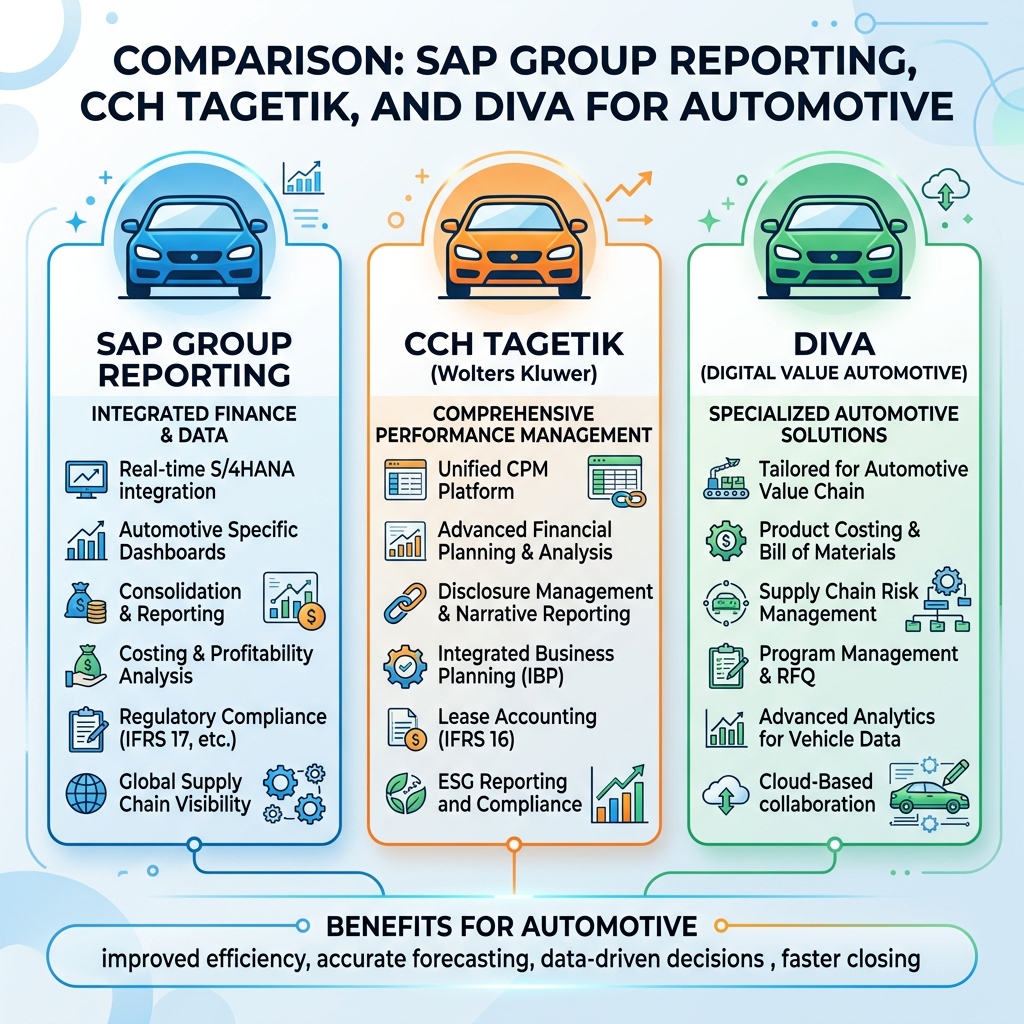
For Tier 1 automotive suppliers rolling out SAP globally, the selection of a consolidation solution should not be driven by feature richness alone. The real question is which architecture best aligns ERP standardization with integrated financial and management control.
SAP S/4HANA Group Reporting is embedded within S/4HANA, DIVA specializes in financial consolidation and disclosure, and CCH Tagetik is positioned as a CPM/EPM platform that extends beyond consolidation into planning and analytics.
Why Tier 1 Companies Must Redesign Consolidation Now
Tier 1 automotive suppliers face simultaneous complexity: multiple regulatory environments, currencies, intercompany transactions, transfer pricing, and profitability management by product and customer.
Traditional financial consolidation alone cannot keep pace with management speed. When deploying SAP S/4HANA Private or Public Cloud globally, the key success factor becomes how consistently local accounting data and group management accounting are integrated into a unified data model.
SAP states that Group Reporting supports both consolidation processes and analytical reporting on a single platform. It is also tightly integrated with Financial Accounting (FI), directly accessing the Universal Journal (ACDOCA), bringing ERP transactions and consolidation closer both logically and physically.
Positioning the Three Solutions
Understanding the design philosophy of each solution is essential:
- SAP Group Reporting: Embedded in S/4HANA, integrated with FI, directly accesses the Universal Journal.
- CCH Tagetik: An external CPM platform integrating SAP and non-SAP systems via connectors.
- DIVA: A specialized solution focused on consolidation and disclosure processes.
This distinction directly impacts IT architecture decisions. Companies standardizing SAP globally benefit from Group Reporting’s unified data model, while organizations with diverse systems or frequent M&A activity gain flexibility from Tagetik or DIVA.
Private Cloud vs Public Cloud Considerations
In Private Cloud Edition, organizations typically prioritize deep process alignment and legacy template continuity. This allows detailed integration between management accounting, costing, and statutory requirements, making Group Reporting a natural extension of ERP.
In Public Cloud Edition, the emphasis shifts to Fit-to-Standard and process harmonization. Here, alignment with standard functionality, upgradeability, and non-replicated analytics becomes critical.
SAP highlights that integration with SAP Analytics Cloud enables real-time analysis without data replication, which is particularly important for Public Cloud-oriented architectures aiming to avoid redundant data layers.
Key Comparison Dimensions for Tier 1
A practical evaluation framework includes five dimensions:
- ERP integration: Group Reporting is native to S/4HANA; Tagetik connects across systems; DIVA integrates externally.
- Non-SAP integration: Tagetik excels in multi-system environments; DIVA supports diverse subsidiaries; Group Reporting requires additional integration design.
- Management accounting linkage: Group Reporting aligns tightly with ERP; Tagetik spans planning and analytics; DIVA focuses primarily on consolidation.
- Disclosure capability: DIVA is strongest; Tagetik provides broad regulatory coverage; SAP relies on complementary tools.
- Implementation model: Group Reporting fits SAP global templates; Tagetik supports enterprise CPM transformation; DIVA aligns with Japanese-style consolidation operations.
When Group Reporting Is the Best Fit
Group Reporting is ideal when organizations:
- Roll out SAP S/4HANA globally (Private or Public Cloud)
- Standardize chart of accounts, company codes, profit centers, and segment reporting
- Aim to unify financial and management accounting
- Require fast, ERP-based reporting for global management decisions
For automotive suppliers, profitability tracking by OEM, platform, and region requires consistent linkage between actuals, cost variances, intercompany transactions, and segment data—an area where embedded architecture provides a clear advantage.
When Tagetik Becomes Strategic
Tagetik is well suited for organizations that:
- Maintain heterogeneous systems due to M&A or regional requirements
- Need to integrate consolidation, planning, forecasting, and ESG reporting
- Require a unified CPM platform beyond ERP boundaries
However, companies must clearly define whether management accounting remains anchored in SAP or shifts toward the CPM layer.
When DIVA Is the Right Choice
DIVA remains a strong option for Japanese enterprises prioritizing:
- High-quality consolidation and disclosure processes
- Headquarters-driven financial governance
- Accelerated financial close cycles
While highly effective for disclosure, it typically requires separate design considerations for global management accounting integration.
Recommended Architecture for Tier 1
For Tier 1 automotive suppliers pursuing SAP S/4HANA Private or Public Cloud as a global backbone, the most consistent architecture is:
SAP S/4HANA as the ERP core, with SAP Group Reporting as the standard consolidation platform.
This enables:
- Master data standardization
- Unified chart of accounts
- Consistent intercompany control
- Integrated segment profitability management
Alternative scenarios:
- Use Tagetik if long-term multi-system coexistence is unavoidable
- Use DIVA if consolidation and disclosure excellence is the top priority
- Use Group Reporting if ERP-integrated management accounting is the priority
Design Message
The objective is not to optimize a standalone consolidation system, but to integrate global ERP, management accounting, business visibility, and governance.
If a company can standardize on SAP S/4HANA globally, SAP Group Reporting offers the highest architectural consistency. If not, Tagetik and DIVA remain valid and valuable alternatives.
Ultimately, the decision should be based not on which product is superior, but on which architecture best aligns with the future global management accounting model.
Summary
For Tier 1 automotive suppliers, consolidation is no longer just a financial reporting function. It is a core component of enterprise architecture that directly impacts management speed, visibility, and governance. Aligning consolidation with ERP and management accounting strategy is the key to achieving true global business integration.
Reference Links
SAP S/4HANA Group Reporting
- SAP S/4HANA for Group Reporting (SAP Community)
https://pages.community.sap.com/topics/s4hana-group-reporting - SAP Help Portal: Group Reporting
https://help.sap.com/docs/SAP_S4HANA_CLOUD/90c07e91c7a64f328be3fd6b48955b13/c27c73226dac4e07ac8aa59a45f92fd8.html - SAP Help Portal: Group Reporting for SAP S/4HANA and SAP S/4HANA Cloud
https://help.sap.com/docs/SAP_ANALYTICS_CLOUD/42093f14b43c485fbe3adbbe81eff6c8/0ffeedc55a89450ebb35c39e1ad5876e.html - SAP Help Portal: Group Reporting Data Collection User Guide
https://help.sap.com/docs/SAP_Group_Reporting_Data_Collection/637f05a918e4402e965dfc719046fbc8/afc1ef76e617476e9c542c1a173903aa.html - SAP S/4HANA Finance for Group Reporting
https://www.sap.com/products/financial-management/s4hana-financial-consolidation.html
CCH Tagetik
- CCH Tagetik for SAP HANA
https://www.wolterskluwer.com/en/solutions/cch-tagetik/technology-integrations/sap-hana - CCH Tagetik Financial Close and Consolidation
https://www.wolterskluwer.com/en/solutions/cch-tagetik/financial-close-consolidation - CCH Tagetik: The Unified Platform That Transforms Finance
https://www.wolterskluwer.com/en/solutions/cch-tagetik - CCH Tagetik SAP HANA Brochure
https://assets.contenthub.wolterskluwer.com/api/public/content/8de949c53e4248b781f70c2ea562953f
DIVA
- DIVA Official Website
https://www.diva.co.jp/ - Products and Services | DIVA Consolidation System and Closing Operations Outsourcing
https://www.diva.co.jp/products_services/ - DivaSystem LCA: Consolidation Accounting and Financial Closing System
https://www.diva.co.jp/products_services/lca/
Disclaimer
Parts of this article were developed with reference to generative AI suggestions and were reviewed, refined, and supplemented based on the author’s professional expertise and judgment.

Leave a Reply