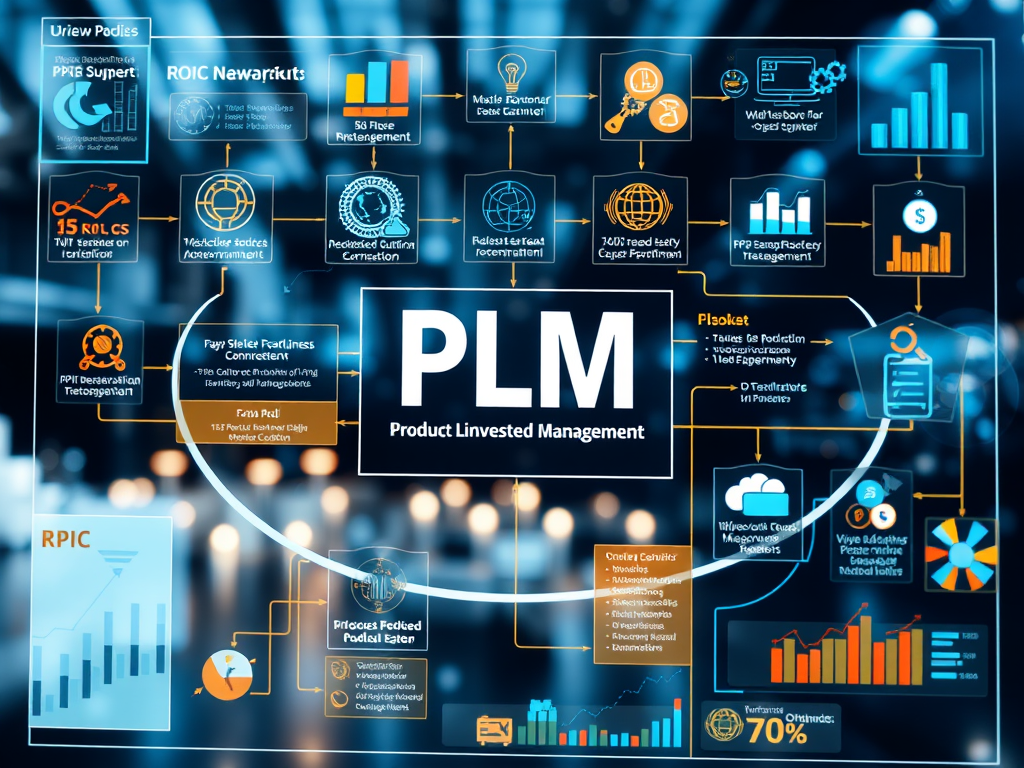
How PLM Drives Better ROIC and Smarter Value Creation
Welcome back to the second part of this series on Product Lifecycle Management (PLM).
This time, let’s dig into how PLM contributes to ROIC (Return on Invested Capital) — not just as a system, but as a strategic management approach that shapes how your business creates value. Understanding Why PLM is essential in this context.

To better understand ROIC, please refer to the overview below.
ROIC-Driven Management to Enhance Business Value
1. PLM Is Core to Business Strategy
When you connect PLM-related KPIs to the ROIC tree, one realization stands out:
PLM isn’t just about managing product data — it’s a strategic engine for business performance.
In its broader meaning, PLM is about managing the entire product lifecycle — from concept and design to manufacturing, sales, and disposal — as one integrated value creation process.
By doing so, PLM helps improve the key drivers of ROIC:
- Increasing revenue and profit margins
- Boosting capital efficiency and asset turnover
For industries like automotive, where compliance and quality standards grow stricter every year, PLM has become a critical enabler of competitiveness and innovation.
2. The Real Leverage Comes Early
If you want to boost ROIC, focus on the early stages — product development and pre-production.
That’s where PLM has the biggest impact.
By tracking the right KPIs in these phases and turning insights into action, companies can shorten development lead time and get products to market faster, at the right cost and quality.
The earlier PLM is applied, the bigger the business payoff.
3. PLM Is a Company-Wide Effort
PLM only works when everyone’s involved.
Ownership doesn’t sit with one team or department — it’s an enterprise-wide challenge that connects engineering, production, procurement, quality, and even finance.
In the past, teams often worked in silos, optimizing their own processes. But markets move fast now, and companies must respond to customer needs in real time.
That means market changes, design changes, and production changes all need to flow smoothly across the organization.
PLM enables exactly that — breaking down organizational walls and building one connected value chain.
Setting the Right KPI Ownership
Here’s a key success factor that often gets overlooked: defining KPI ownership.
A KPI owner isn’t just someone who measures results — they’re responsible for driving improvement.
Here are a few simple but powerful guidelines:
- Give ownership to decision-makers. Choose people who can take action, not just collect data.
- One KPI, one owner. When accountability is shared, progress slows down.
- Define ownership by process, not department. Many KPIs in PLM (like development lead time or ramp-up delays) are cross-functional — assign a business leader or project manager as the main owner, with engineering, manufacturing, and procurement as supporting owners.
- Create a clear ownership hierarchy. For example:
- R&D efficiency → under the CTO
- New product sales and target cost achievement → under the Business Unit Head
- Inventory, shortages, or audit issues → under Plant Manager, SCM, or Quality Head
- R&D efficiency → under the CTO
When responsibility is structured this way — aligned with the ROIC framework — PLM becomes far more effective and actionable across the enterprise.
In a Nutshell
- PLM isn’t just data management — it’s a strategic approach to value creation.
- The biggest impact on ROIC happens in the development-to-launch phase.
- Success requires whole-company involvement and clear KPI ownership to align goals and actions.
Next Article Preview
Next time, we’ll look at how SAP adds value to PLM from a business perspective — stay tuned!
References:
You may also find the following articles helpful:
Overview of PLM
What Is PLM? Understanding Product Lifecycle Management
How PLM Contributes to Business Performance
Why PLM Enhances ROIC for Better Business Outcomes
Reference Links
- SIEMENS
💡 What is PLM? A guide on Product Lifecycle Management - ATLASSIAN
PLM: Product Lifecycle Management Guide & Best Practices | Atlassian - WARFIGHTING ACQUISITION UNIVERSITY
Product Lifecycle Management (PLM) | www.dau.edu - SAP
PLM: The Future of Product Development | SAP - How to Calculate ROI in Project Lifecycle Management (PLM) – XD Innovation
Calculating ROI in Product Lifecycle Management (PLM) – XDInnovation - CONTENT SQUARE
6 Stages of the Product Development Lifecycle - monday blog
Product Lifecycle Management (PLM): Complete Guide For 2026 - v + d (virtual and digital) blog
Measuring PLM Success: Top 20 KPIs, from Implementing to Using PLM Solutions – virtual+digital - NEEL SMARTEC CONSULTING
Elevate with PLM: Key KPIs for Superior Results | Neel SMARTEC - GOCIOUS blog
The Role of Product Operations in Manufacturing | What is Product Ops | Gocious - Square
PLMとは?製品ライフサイクルの管理でビジネスの利益と価値を最大化する方法 - PTC
PLM(製品ライフサイクル管理)とは?必要な理由や導入メリット、PDM との違いについてわかりやすく解説 | ブログ | PTC (JA) - HACOBU
ROICとは?計算式や目安、物流領域における重要性と改善点を解説 - AI経営総合研究所
ROIC経営とは?企業価値を高める実践ステップと改善ポイントをわかりやすく解説 – AI経営総合研究所 - 製造業におけるROIC経営 – NECネクサソリューションズ
資本生産性向上により企業価値を高める – コラム | NECネクサソリューションズ
Disclaimer
Parts of this article were developed with reference to generative AI suggestions and were reviewed, refined, and supplemented based on the author’s professional expertise and judgment.

Leave a Reply to What Is BOP? Key to Enhancing Manufacturing QualityCancel reply