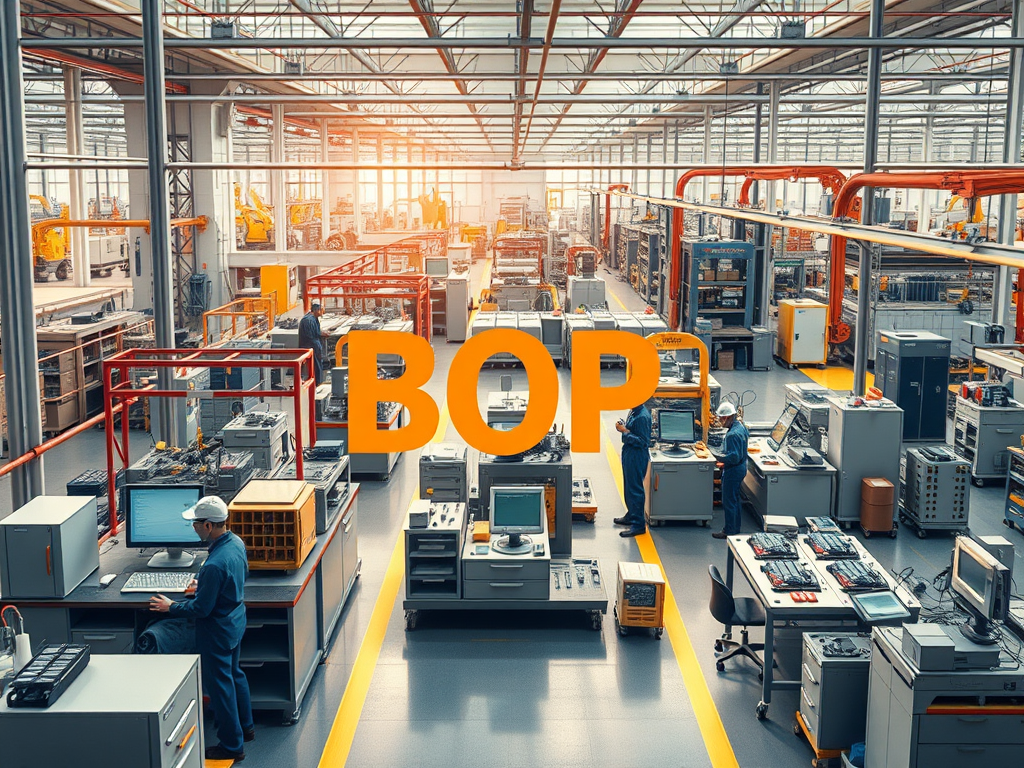
Master “How to Build” and You Master Manufacturing
Most professionals in manufacturing are familiar with the concept of a BOM.
But can you clearly explain BOP?
What is BOP?
If a BOM defines what a product is made of,
then BOP defines how it is made.
In this article (Part 1), we will clarify the concept, purpose, background, and value of BOP.
In Part 2, we will examine what corresponds to BOP within SAP’s architecture and explore how it is implemented in practice.
What Is BOP (Bill of Process)?
A Bill of Process (BOP) is a structured definition of how a product is manufactured.
It translates design intent into a repeatable, executable manufacturing process. In other words, it ensures that what engineering envisions can be consistently realized on the shop floor.
A BOP typically includes:
- Process hierarchy
- Operation sequence and branching
- Detailed work instructions
- Workstations, production lines, and facilities
- Equipment, tools, and jigs
- Required skills
- Standard times and workload
- Execution instructions
Simply put:
If the BOM represents the “structure of the product,”
the BOP represents the “structure of the process.”

The Purpose of BOP
Bridging Design Intent and Manufacturing Reality
The core objective of BOP is straightforward:
To ensure that product functionality defined in engineering is accurately reflected in manufacturing execution.
From this foundation, multiple operational benefits emerge.
1. Standardization of Manufacturing Processes
- Unified work procedures
- Stable and consistent quality
2. Optimization of Production Efficiency
- Reduced operation time
- Higher equipment utilization
3. Strengthened Quality Control
- Clearly defined inspection points
- Standardized quality criteria
4. Enhanced Cost Management
- Accurate process-level costing
5. Systematized Skill Transfer
- Standardization of expert know-how
- Efficient onboarding and training
BOP is not merely a routing sheet.
It is a structured mechanism for building repeatable competitive advantage.
Why BOP Matters More Than Ever
Evolution and Background
The importance of BOP has increased alongside the evolution of manufacturing.
1990s
PLM initiatives were primarily BOM-centric.
2010s and Beyond
Several forces accelerated the need for structured process definitions:
- Globalization
- Labor shortages
- Digital transformation (DX)
- High-mix, low-volume production
- Increasing quality requirements
In the era of mass production, simple procedural manuals were often sufficient.
Today, they are not.
As products diversify and design changes become more frequent, companies must update:
- Process plans
- MBOMs
- Work instructions
— simultaneously and consistently.
Manual synchronization introduces delays and errors, which can lead to:
- Extended production lead times
- Shipment delays
- Lost market opportunities
BOP serves as the structural foundation that maintains alignment in an increasingly dynamic environment.
The Value of BOP Through the QCDEF Lens
Let’s examine the value of BOP using the common manufacturing framework: QCDEF.
Q — Quality
- Standardized inspection items and acceptance criteria
- Embedded in-process quality control
- Continuous improvement based on process data
- Enhanced traceability
When “how to build” is defined in advance, quality becomes predictable and repeatable.
C — Cost
- Accurate process-level cost calculation
- Quantifiable ROI from improvement initiatives
- Reduced operational variability
- Bottleneck identification and optimization
- Improved equipment utilization
- More precise cost simulation
BOP makes hidden manufacturing costs visible and manageable.
D — Delivery (Lead Time)
- Shorter ramp-up time for mass production
- Faster global plant deployment
A standardized process structure accelerates industrialization and replication across sites.
E — Environment
- CO₂ visibility at the process level
- Environmentally conscious process design
- Support for ESG and regulatory compliance
Only when processes are structurally defined can environmental impact be systematically measured and managed.
F — Flexibility
- Improved alignment between design changes and process updates
- Reduced update omissions
- Mitigation of knowledge silos
- Institutionalization of manufacturing know-how
BOP creates a manufacturing system that is resilient to change.
Industries Where BOP Is Critical
BOP delivers particularly high value in industries characterized by:
- High product variety
- Frequent design changes
- Complex processes
- Process design as a source of competitive advantage
Automotive OEMs and Suppliers
Complex assembly processes and strict quality requirements demand detailed process governance.
Aerospace and Defense
High precision, regulatory compliance, and long product life cycles make structured process management essential.
Electronics and Semiconductor
Fine processing technologies and cleanroom environments require rigorous standardization.
Medical Devices
Regulatory requirements (e.g., FDA) and traceability demands necessitate detailed process control.
Heavy Industry and Industrial Machinery
Process variation and engineering depth are key competitive differentiators.
In these industries, process design itself is a strategic asset.
Conclusion: BOP Is the Blueprint of Manufacturing
If the BOM defines what to build,
the BOP defines how to build it.
And increasingly, competitive advantage lies not just in product design—but in process design.
BOP:
- Translates engineering intent into manufacturing execution
- Strengthens quality, cost, delivery, environmental performance, and flexibility
- Structures operational excellence into a repeatable system
Coming Up Next
In the future article, we will explore how BOP concepts map into SAP architecture—specifically, which SAP components correspond to BOP and how they are implemented in practice.
References:
You may also find the following articles helpful:
- Overview of PLM
What Is PLM? Understanding Product Lifecycle Management - How PLM Contributes to Business Performance
Why PLM Enhances ROIC for Better Business Outcomes
Reference Links
- Bill of process by Siemens
Bill of process | Siemens - PTC Manufacturing Process Management Domain
PTC Manufacturing Process Management Domain - Managing ETO change with BOP-driven process planning
Managing ETO change with BOP-driven process planning – Teamcenter Manufacturing - A highly efficient browsing and basic authoring of manufacturing process and routings to create and update manufacturing plans in a light, affordable web client on the 3DEXPERIENCE Platform
- Manufacturing Process Engineer DELMIA 3DEXPERIENCE Role
Disclaimer
Parts of this article were developed with reference to generative AI suggestions and were reviewed, refined, and supplemented based on the author’s professional expertise and judgment.

Leave a Reply