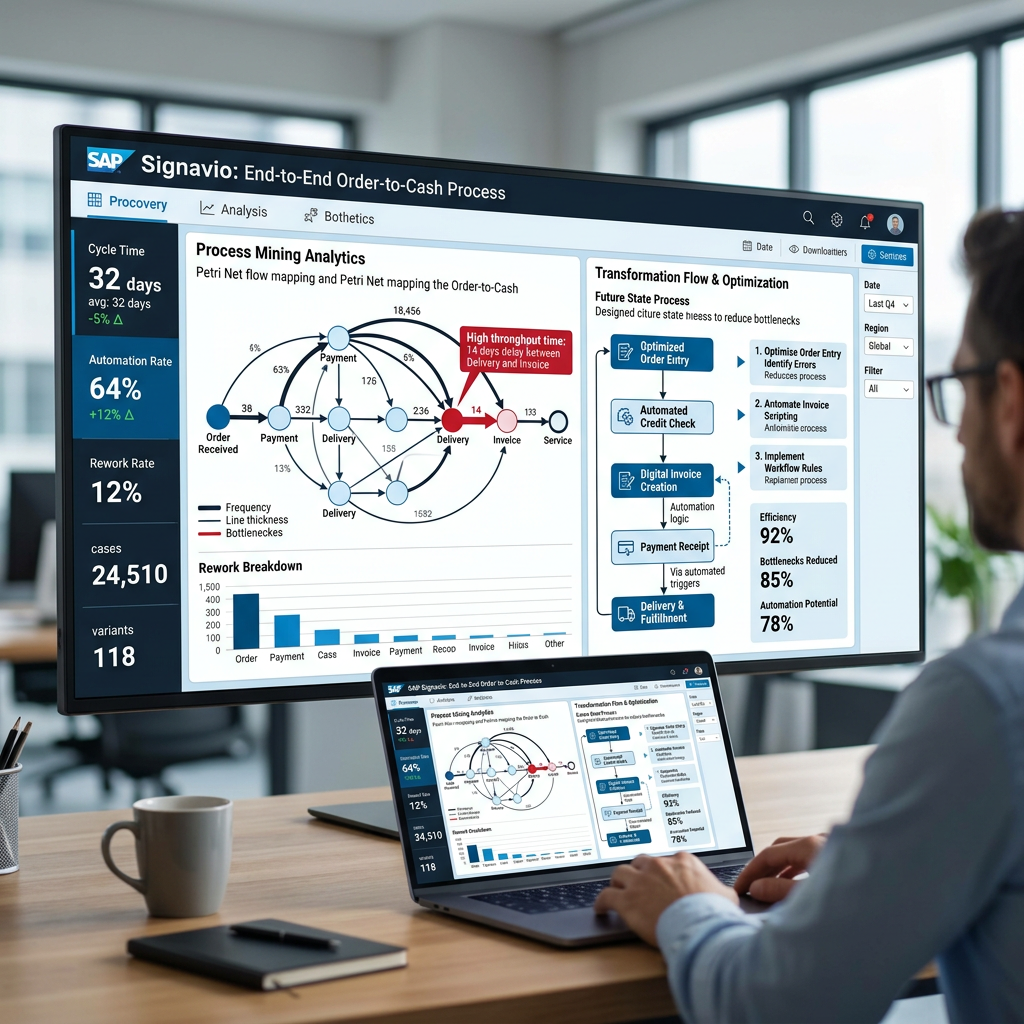
The Reality of the Business Process Transformation Platform Every SAP Project Manager Should Understand
Introduction: SAP Implementation Is Not a System Project—It Is a Process Transformation Journey
In many SAP implementation projects, discussions often focus first on system-related topics such as requirements definition, Fit-to-Standard analysis, and customization decisions.
However, the real determinant of project success lies elsewhere: deciding how business processes should change, where standardization should occur, and where differentiation should remain to preserve competitive advantage.
One of the biggest challenges for project managers is that business processes are often poorly understood or undocumented, making it difficult to prioritize improvements based on objective data.
SAP’s answer to these challenges is SAP Signavio, a business process transformation platform designed to make processes visible, measurable, and continuously improvable.
What Is SAP Signavio? Understanding the Business Process Transformation Suite
SAP Signavio is a cloud-based business process management suite that helps organizations visualize, analyze, standardize, and continuously improve business processes.
Integrated with SAP S/4HANA and other enterprise applications, Signavio supports organizations across the full transformation lifecycle—from automatically discovering current-state processes to designing future-state processes and institutionalizing continuous improvement.
Its major components include:
Process Manager / Process Modeler
A BPMN 2.0–based modeling environment used to document and design As-Is and To-Be processes while establishing enterprise process standards.
Process Collaboration Hub
A collaboration platform where stakeholders across the organization can share, review, comment on, and align around standardized processes.
Process Insights
A process diagnostic engine that connects to SAP systems and rapidly analyzes operational processes to identify improvement opportunities and inefficiencies.
Process Intelligence
A process mining and analytics platform that reconstructs actual process flows using transaction logs, enabling deeper analysis of bottlenecks, variants, and exception patterns.
From a project manager’s perspective, SAP Signavio can best be understood as:
A common language for process transformation and a foundation for data-driven decision-making across the entire SAP program.
Business Value for Executives: Visibility and Prioritization of Digital Transformation Investments
For executive leadership, SAP Signavio provides an enterprise-wide view of process performance across functions such as finance, manufacturing, quality, maintenance, procurement, and billing.
Organizations gain visibility into questions such as:
- Which processes have the longest lead times?
- Where are exceptions occurring most frequently?
- Which business units are generating the most rework?
This visibility significantly improves prioritization of transformation initiatives.
Signavio also helps organizations quantify ROI by comparing process KPIs before and after transformation efforts, enabling leadership teams to answer questions such as:
- How many days was financial close reduced after S/4HANA implementation?
- How much inventory turnover improved?
- Which process improvements generated measurable business outcomes?
For global enterprises, process variation across locations can also be monitored, strengthening governance and compliance management.
Value for Business Teams: Creating a Common Language Through Processes
For business users, SAP Signavio serves as a platform to visualize workflows and discuss improvement opportunities using objective data.
By leveraging BPMN-based process visualization, teams can identify:
- Cross-functional handoff issues
- Exception handling complexity
- Bottlenecks and inefficiencies
- Non-value-added activities
Furthermore, operational system logs provide evidence-based answers to questions such as:
- Which activities consume the most time?
- Which customers generate the highest exception rates?
- Which products require disproportionate manual intervention?
As a result, process standardization discussions become less dependent on opinions and more driven by data and process models.
Value for Operations Teams: Clear Standards and Evidence-Based Workload Reduction
For frontline teams, SAP Signavio provides two critical capabilities:
- Easy-to-understand operational standards
- Visibility into workload distribution and inefficiencies
Through Collaboration Hub, employees can easily access the processes relevant to their roles and connect them directly with procedures, work instructions, and checklists.
Process mining also enables organizations to identify:
- Where overtime work concentrates
- Which tasks overload specific individuals
- Which approval steps create unnecessary delays
This allows operational teams to support improvement initiatives with evidence rather than assumptions.
Practical Benefits for Tier 1 Automotive Suppliers
Tier 1 automotive suppliers face challenges driven by:
- High product variation
- OEM-specific requirements
- Global manufacturing footprints
SAP Signavio provides a foundation for balancing global process standardization with local operational realities while enabling continuous improvement.
Example 1: End-to-End Visibility from Order to Shipment
Organizations can model end-to-end processes including:
- OEM EDI orders
- Frequent quantity changes
- MRP recalculations
- Shop floor instructions
- Shipping and ASN integration
Process Insights can then analyze lead times and exception handling to identify:
- Bottlenecks by OEM
- Site-level inefficiencies
- Process-specific delays
This enables PMs to prioritize initiatives based on evidence rather than intuition.
Example 2: Standardizing Quality Complaint Processes
Organizations can standardize quality workflows covering:
Complaint Intake → Containment Actions → Permanent Countermeasures → Effectiveness Verification
Monitoring KPIs such as:
- Time to containment completion
- Time to permanent corrective action
- Site-level process variance
This strengthens readiness for OEM audits and IATF compliance activities.
Example 3: Improving Indirect Functions for Enterprise Optimization
Procurement
Visualize approval loops and master data issues to reduce unnecessary workflow complexity.
Finance
Reduce reconciliation and financial closing lead times to improve reporting speed and cost accuracy.
Maintenance
Identify equipment with frequent breakdowns and processes prone to incomplete records, enabling a shift toward preventive maintenance.
How SAP Project Managers Should Position SAP Signavio
Project managers should avoid viewing Signavio as merely another tool.
Instead, it should be positioned as the process foundation for the entire transformation program.
Strategy & Assessment Phase
Use Process Insights to diagnose current processes and identify improvement themes and KPIs.
Requirements and Fit-to-Standard Phase
Use Process Manager to design To-Be processes and support Fit/Gap decisions.
Template Design and Rollout Phase
Use Collaboration Hub to distribute global standards and manage localization gaps.
Go-Live and Continuous Improvement Phase
Use Process Intelligence to continuously analyze operational data and sustain process optimization.
When project managers embed this lifecycle into project planning, SAP implementations become more than technology deployments—they become true business transformation programs.
Conclusion
SAP implementations succeed or fail based on process decisions—not system configurations alone.
SAP Signavio provides organizations with the visibility, governance, and analytical capabilities needed to transform processes continuously and systematically.
For project managers, executives, business teams, and operations alike, Signavio serves as the bridge between strategy, execution, and measurable business value.
- SAP Signavio Official Website: https://www.signavio.com
- SCSK SAP Signavio Resources: https://www.scsk.jp/en/
- TIS Corporate Information: https://www.tis.com
- JFE Systems Corporate Site: https://www.jfe-systems.com/en/
- ZDNET Japan Enterprise Technology Articles: https://japan.zdnet.com/
Reference Links
Official product pages
- SAP Signavio – Global product overview
https://www.signavio.com/
(Official product site for the SAP Signavio Business Process Transformation Suite, including portfolio overview, value proposition, and product documentation.) - SAP Signavio – Japanese product overview
https://www.signavio.com/jp/
(Japanese landing page; useful when you want to show that SAP Signavio is officially positioned as a “business process transformation suite” for the Japanese market as well.) - Get started with SAP Signavio solutions
https://www.signavio.com/jp/get-started-with-sap-signavio-solutions/
(Onboarding and “getting started” resources for SAP Signavio solutions, including guidance on how to accelerate value realization from process observability.)
SAP official articles and news
- SAP Japan – Introduction to SAP Signavio (webinar asset)
https://www.sap.com/japan/assetdetail/2026/04/c8a3068e-4d7f-0010-bca6-c68f7e60039b.html
(Japanese SAP asset that explains how BPM, enhanced by digital and AI, underpins enterprise-wide DX, and how SAP Signavio provides a collaborative BPM platform.) - SAP News Japan – SAP Signavio Process Explorer announcement
https://news.sap.com/japan/2023/03/0313_signaviope-sap-signav/
(Press release describing SAP Signavio Process Explorer, including more than 7,000 process models, business function maps, industry‑specific value accelerators, and process KPIs, which you can reference when you discuss best‑practice content.) - SAP News Japan – SAP Signavio and experience data for process analytics
https://news.sap.com/japan/2022/04/sap-signavio%E3%80%81%E3%82%A8%E3%82%AF%E3%82%B9%E3%83%9A%E3%83%AA%E3%82%A8%E3%83%B3%E3%82%B9/
(Explains how SAP Signavio combines experience data (X‑data) with operational data (O‑data) in process analytics, and how SAP positions Signavio as part of the RISE with SAP offering.) - SAP Japan blog – “Strengthening Japan’s competitiveness with SAP Signavio”
https://news.sap.com/japan/2024/09/lifesap-japan-vol-30/
(Interview with the SAP Signavio lead in Japan, useful for quoting strategic intent and describing the role of SAP Signavio in Japanese companies’ competitiveness.)
Product‑specific capabilities (Insights, Manager, etc.)
- SAP Signavio Process Insights
https://www.signavio.com/products/process-insights/
(Global product page for Process Insights: explains how it connects to SAP ERP, analyzes core business processes, identifies improvement and automation opportunities in SAP‑centric landscapes.) - SAP Signavio Process Insights – Japanese page
https://www.signavio.com/jp/products/process-insights/
(Japanese version of the Process Insights page; useful when you want to show that data‑driven process diagnostics is officially available for Japanese SAP customers.) - SAP Community blog – “Manage business processes with SAP Signavio Process Manager”
https://community.sap.com/t5/technology-blog-posts-by-sap/sap-signavio-process-manager-%E3%81%A7-%E3%83%93%E3%82%B8%E3%83%8D%E3%82%B9%E3%83%97%E3%83%AD%E3%82%BB%E3%82%B9%E3%82%92%E7%AE%A1%E7%90%86/ba-p/13572135
(Technical blog explaining SAP Signavio Process Manager, language settings, and how it is used to manage business processes; useful when you describe modeling and governance aspects.)
Thought leadership and portfolio explanation
- SAP Signavio Blog – Thought leadership
https://www.signavio.com/jp/blog/thought-leadership/
(Thought‑leadership articles around process mining, process transformation, and SAP Signavio’s positioning as a leader in SPARK Matrix and other analyst reports.)- SAP Signavio Blog (Japanese top)
https://www.signavio.com/jp/blog/
(Collection of Japanese blog posts about process mining, process transformation, and practical use cases; useful as supporting material when you discuss continuous improvement and DX.) - SAP Signavio portfolio – Introduction for large enterprises (Japanese video)
https://www.signavio.com/jp/video/sap-signavio-portfolio-an-introduction-for-a-large-enterprise-japanese-video/
(Video that introduces SAP Signavio portfolio and the types of business problems it solves for large enterprises; you can reference this as a high‑level portfolio overview.)
Partner articles and case‑style content
- TIS – “What is SAP Signavio? Visualize and improve processes to drive business transformation”
https://www.tis.jp/service_solution/tis-sap-solution/content/signavio-col-7/
(Japanese partner article that concisely explains the definition, characteristics, and solution structure of SAP Signavio; helpful as a neutral explanation when targeting Japanese readers.) - B-EN-G – “Visualizing operations and continuous process improvement with SAP Signavio”
https://column.b-en-g.co.jp/signavio
(Japanese column explaining how SAP Signavio supports process visualization, AI‑driven improvement and continuous process optimization; good source for examples and wording around “visibility” and “continuous improvement”.) - Focus Systems – “From business process visualization to automation with SAP Signavio”
https://bberc.focus-s.com/erp/sap/signavio/
(Japanese partner page that positions SAP Signavio as a tool to support digitalization and growth strategy, covering the end‑to‑end story from visualization to automation.) - SCSK – “Add‑Value for SAP Signavio”
https://www.scsk.jp/sp/sap/add-value/signavio/
(Describes a service offering that leverages SAP Signavio to support continuous process improvement on SAP systems, focusing on TCO reduction and DX enablement.)
Example customer story
- ZDNET Japan – Kao adopts SAP Signavio
https://japan.zdnet.com/article/35230860/
(Article describing how Kao uses SAP Signavio to support global process efficiency and cost reduction; you can use this as a concrete example of a large Japanese enterprise adopting SAP Signavio.)
Disclaimer
Parts of this article were developed with reference to generative AI suggestions and were reviewed, refined, and supplemented based on the author’s professional expertise and judgment.

Leave a Reply