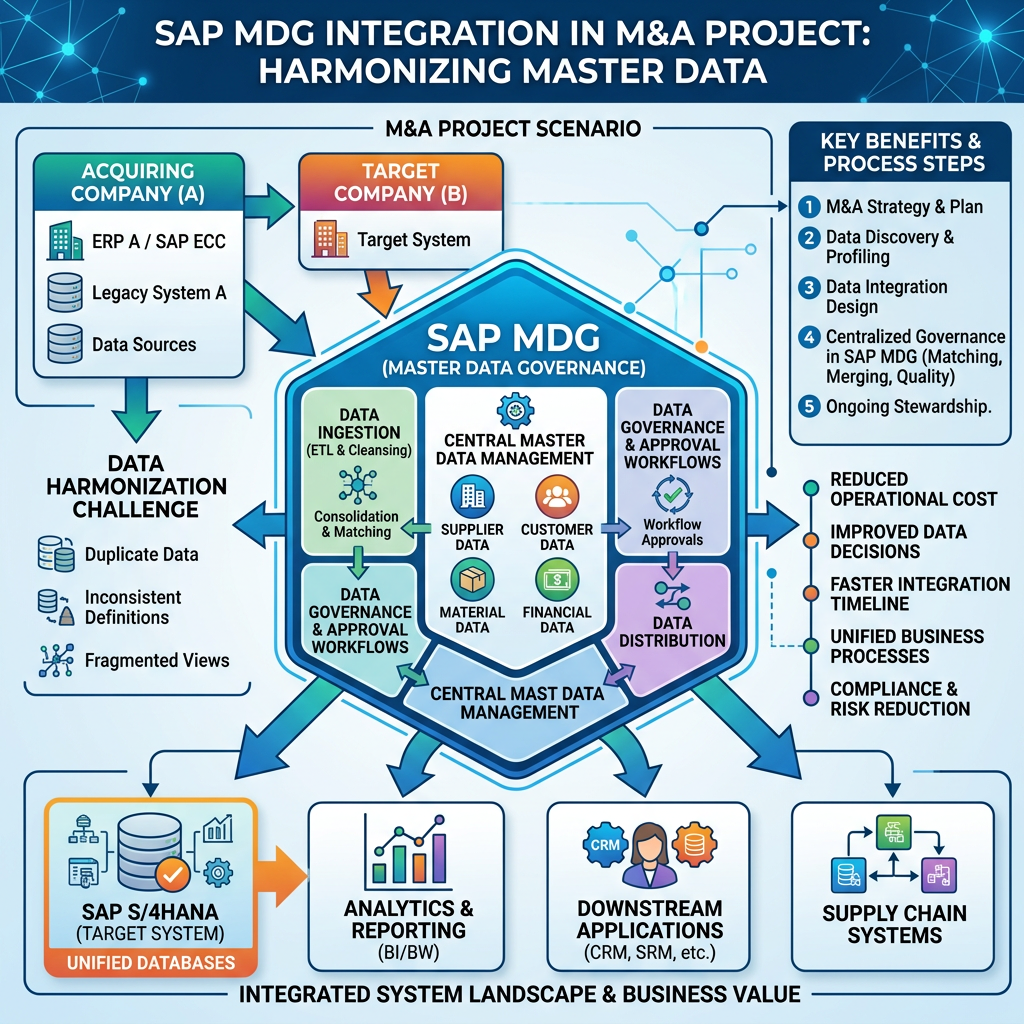
Practical Implementation and Operational Guidelines for SAP Master Data Governance
One of the most persistent and underestimated challenges in enterprise integration projects is master data.
In many projects, organizations prioritize application integration or S/4HANA transformation, leaving Master Data Management (MDM) as an afterthought. The result is often significant rework costs during testing or after go-live—an issue repeatedly observed in real-world implementations.
This article outlines key implementation and operational considerations for SAP Master Data Governance (SAP MDG) from the perspective of project managers and IT architects, assuming the following scenario:
- Company A and Company B both partially use SAP
- The companies are merging and aim to transition to a unified S/4HANA-based ERP
- Master data integration and governance must be established during the integration
1. Why Master Data Becomes a Critical Risk in M&A
1.1 Common Master Data Issues in Integration Projects
The following master data domains almost always create issues:
- Customer and Business Partner Data
- Duplicate records due to naming inconsistencies
- Different codes across branches causing reconciliation challenges
- Material Master (Products and Components)
- Inconsistent coding structures and granularity
- Discrepancies in suppliers, costing, and valuation methods
- Logistics Master (Plants, Warehouses, Transportation)
- Misaligned structures preventing logistics optimization
These issues lead to a negative spiral:
- Inability to aggregate KPIs (sales, margin, inventory, lead time)
- Proliferation of Excel-based shadow systems
- Lack of trust in system data post go-live
Master data must be treated not as a side effect of integration, but as a foundational element designed from the start.
1.2 Key Questions for Project Leaders
- Is MDM/MDG explicitly included in the project WBS?
- Are data owners clearly defined in both organizations?
- Is there a future-state master data model aligned with S/4HANA?
- Is there a roadmap for integration timing and completion?
If these are unclear, MDM is likely underdefined or unmanaged.
2. Positioning SAP MDG as the Master Data Hub
2.1 Explaining SAP MDG in Simple Terms
SAP MDG is a centralized platform for managing core master data such as:
- Business partners
- Materials
- Financial data
Its role can be summarized as:
- A single entry point for standardized master data
- A workflow-driven governance system
- A distribution hub for approved master data
It is not just a data cleansing tool—it is a governance platform for maintaining data quality through standardized processes.
2.2 Architecture Patterns for Integration
Three typical phases:
- Consolidation
- Create unified reporting via golden records
- Hub-and-Spoke
- Use MDG as the central distribution hub
- Central Governance
- Fully centralize master data creation and change
Define clear scope per phase to avoid MDG becoming a bottleneck.
3. SAP MDG Implementation Phases
Phase 1: Strategy and Scoping
- Define target master domains
- Identify organizational scope
- Prioritize based on business impact
- Align with overall integration strategy
MDM must be positioned as a business-critical capability, not an IT add-on.
Phase 2: Fit/Gap and Design
Key areas:
- Data Model Mapping
- Business Rules and Validation
- Workflow and Governance
Balance standard SAP functionality and custom extensions carefully.
Phase 3: Build and Test
Typical activities:
- Data model extensions
- Business rule implementation (BRF+)
- UI optimization (Fiori)
- System integrations
Testing must include end-to-end business scenarios, not just MDG functions.
Example: Customer creation → Order → Delivery → Billing
Phase 4: Migration and Cutover
Critical decisions:
- Data cleansing strategy
- Migration approach (big bang vs phased)
- Cutover planning
This phase carries the highest project risk.
Phase 5: Operations and Continuous Improvement
Key success factors:
- Defined data ownership and stewardship
- Data quality KPIs
- Regular governance reviews
- Integration with future business processes
4. Lessons from Successful Projects
4.1 Focused Domain Approach
A global manufacturer:
- Started with material master only
- Standardized global coding
- Expanded gradually
Key takeaway: Do not attempt everything at once
4.2 PoC-Driven Rollout
Another enterprise:
- Conducted pilot before full rollout
- Measured improvements (lead time, errors)
- Secured executive buy-in
This approach is highly effective in M&A scenarios.
5. Common Failure Patterns and How to Avoid Them
Typical Failures
- IT-driven approach without business involvement
- Overly broad scope
- Lack of standard definitions
- Missing operational governance
Checklist for Project Leaders
- MDM stream exists in WBS
- Data owners and stewards are assigned
- Standard definitions and code structures are defined
- Phased rollout strategy exists
- Data quality KPIs are monitored
- MDG is aligned with S/4HANA roadmap
Conclusion: MDG is a Prerequisite, Not a Byproduct
Master data management is not optional—it is essential.
SAP MDG is a powerful enabler, but success depends on:
- Clear positioning within the integration strategy
- Phased implementation
- Strong business governance
Reference Links
- SAP Master Data Governance – Product overview
https://www.sap.com/products/data-management/master-data-governance.html - SAP Master Data Governance named a leader in a Forrester Wave for Master Data Management
https://news.sap.com/2023/07/sap-master-data-governance-leader-forrester/ - SAP Master Data Governance – high‑level explanation and glossary style overview
https://www.sap.com/products/data-management/master-data-governance.html - SAP S/4HANA ERP data migration and the role of MDM / MDG
https://www.stibosystems.com/blog/sap-s-4hana-erp-data-migration-stibo-systems - Q&A style article on how to start Master Data Management initiatives
https://jp.drinet.co.jp/blog/seminar_qa_mdm2 - Article (in Japanese) explaining why poorly governed master data undermines DX and analytics
https://note.com/kurihara_y_dyla/n/n958b3b3621f9 - Recommended books for learning Master Data Management (MDM) concepts
https://data-viz-lab.com/mdm-3 - Overview of three main MDM architecture patterns (consolidation, hub, central governance)
https://www.firstdigital.co.jp/magazine/1137/ - Case story: achieving global data excellence with SAP MDG in a large manufacturing/pharma‑like environment
https://fusion-consulting.com/en/success-story/global-pharmaceutical-company-master-data-enhancement-with-mdg-material/
Disclaimer
Parts of this article were developed with reference to generative AI suggestions and were reviewed, refined, and supplemented based on the author’s professional expertise and judgment.

Leave a Reply