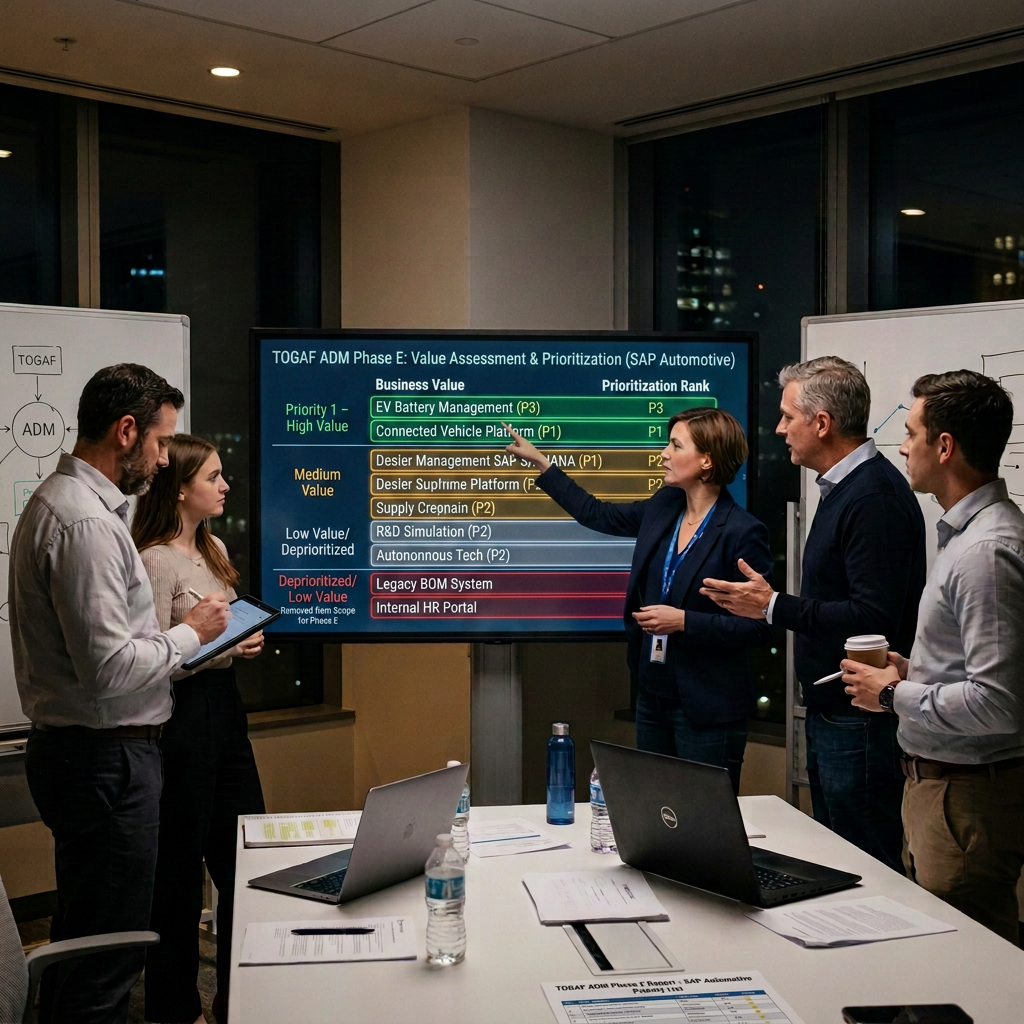
Which work package should we tackle first? Where should a limited budget actually go? If you’re a PM or Enterprise Architect leading a global SAP S/4HANA rollout, you’ve probably been cornered by these questions in a steering committee meeting at least once.
Programs where priorities are decided by whichever site director speaks loudest — or has the most political capital — almost always lose their way somewhere in the middle. TOGAF’s Architecture Development Method (ADM) offers a technique built specifically to confront this problem head-on: the Business Value Assessment Technique.
This article lays out the technique’s original definition and intent, backed by primary-source citations, and then walks through a concrete example of applying it to an SAP implementation program for an automotive parts Tier 1 supplier.
1. What Is the Business Value Assessment Technique?
This technique is defined in Part III of the TOGAF® ADM, “ADM Guidelines and Techniques,” as one of the Migration Planning Techniques. It appears as Section 28.5 in the legacy TOGAF 9.1 and as Section 6.5 in the current TOGAF® Standard, with identical content in both, and it is primarily applied during Phase E (Opportunities & Solutions) through Phase F (Migration Planning).
The TOGAF® Standard defines it this way:
“A technique to assess business value is to draw up a matrix based on a value index dimension and a risk index dimension… The value index should include criteria such as compliance to principles, financial contribution, strategic alignment, and competitive position. The risk index should include criteria such as size and complexity, technology, organizational capacity, and impact of a failure.”
— The Open Group, TOGAF Standard 6.5 Business Value Assessment Technique
At its core, this is simple: plot every project and work package onto a two-axis matrix built from a Value Index and a Risk Index. But behind that simplicity sits a discipline that PMs and EAs frequently overlook.
2. Why Should PMs and EAs Care? (The Purpose Behind It)
The technique lives inside Phase F step “14.4.2 Assign a Business Value to Each Work Package,” which states its intent as follows:
“Establish and assign business values to all of the work packages. The intent is to first establish what constitutes business value within the organization, how value can be measured, and then apply this to each one of the projects and project increments.”
— TOGAF 9.1, Phase F: Migration Planning 14.4.2
The key detail is the sequence: first define what business value means, then apply that definition to individual projects. In most SAP programs, the order runs backward — projects get decided first, and a “value” justification gets bolted on afterward. That approach only ever benefits whichever department has the loudest voice.
The same section goes further, making clear that this assessment isn’t just a visualization exercise — it feeds directly into real budget decisions:
“Business value will be used by portfolio and capability managers to allocate resources and, in cases where there are cutbacks, business value in conjunction with return on investment can be used to determine whether an endeavor proceeds, is delayed, or is canceled.”
— TOGAF 9.1, Phase F: Migration Planning
For the automotive industry — where the shift to EVs and the reshaping of parts supply networks can suddenly tighten investment budgets — this is exactly the kind of thinking needed right now.
3. Inside the Technique: The Value Index vs. Risk Index Matrix
Here are the specific assessment criteria the technique uses:
| Axis | Representative Criteria |
| Value Index | Compliance to principles, financial contribution, strategic alignment, competitive position |
| Risk Index | Size and complexity, technology, organizational capacity, impact of a failure |
Each criterion is assigned a weight, and the weighted score determines where a work package lands on the matrix. The single most important line in the standard is this one:
“Each criterion should be assigned an individual weight. The index and its criteria and weighting should be developed and approved by senior management. It is important to establish the decision-making criteria before the options are known.”
— The Open Group, TOGAF Standard 6.5
Establish the decision-making criteria before the options are known. That’s the heart of the technique. By getting the axes and weights approved by senior management up front, you close the door on after-the-fact political reprioritization. For PMs and EAs running a PMO or steering committee, this is also a powerful defensive tool.
4. Applying the Technique to an Automotive Tier 1 SAP S/4HANA Rollout
Consider a Japan-headquartered Tier 1 parts supplier rolling out, in phases, across multiple sites (Japan, ASEAN, North America): S/4HANA on a global template, MDG (Master Data Governance), Ariba procurement integration, JIT/kanban EDI connectivity with OEMs, and PLM-ERP engineering change synchronization (ECM/BOM). This is not a specific published case study — it’s an illustration of how the technique’s logic applies in practice.
Breaking the program into work packages (WPs) in Phase F and mapping them against the Value and Risk indices produces something like this:
| WP | Description | Value Index (example) | Risk Index (example) |
| WP1 | Global finance & costing core template | Compliance to principles = High (“one instance, one template” principle); Financial contribution = High | Size/complexity = Medium |
| WP2 | MDG (material & BOM master data governance) | Strategic alignment = High (foundation for data governance strategy) | Organizational capacity = Medium (data ownership structure still immature) |
| WP4 | Production planning & MES integration (JIT/kanban) | Financial contribution = High (fewer shortages, less expedited freight); Competitive position = High (OEM responsiveness) | Impact of a failure = Very High (line-stop risk); Technology = High |
| WP8 | PLM-ERP engineering change integration | Competitive position = High (design-change turnaround speed = ability to win new business) | Technology = High; Size/complexity = High |
| WP6 | Pilot site rollout | Financial contribution = Medium (learning value prioritized) | Size/complexity = Low to Medium (single site) |
This matrix drives three practical outcomes:
① Objectifying priorities. WP2 (MDG) lands in the “high value, medium risk” quadrant, and because most other work packages (WP1, WP4, WP8) depend on clean master data, tackling it first is justified by criteria senior management has already signed off on — not by getting dragged into a tug-of-war between site directors.
② Deliberately phasing high-risk areas. WP4 (JIT/kanban integration) sits among the highest-value work packages, but it also carries the highest failure impact (a line stop). Following the principle of “establish criteria before the options are known” naturally leads to validating it at a single pilot site before full deployment — directly addressing the risk pattern behind so many failed Tier 1 SAP programs that attempt a big-bang global go-live.
③ Defensible decisions when budgets shrink. If external conditions force cutbacks, pre-approved scores let you say “WP6 (the pilot, valuable as a foundational proof point) continues, while WP7 for the next site is deferred” — a decision grounded in criteria, not emotion.
5. A Practical Checklist for PMs and EAs
- Have senior management approved the assessment axes (Value Index / Risk Index) and each criterion’s weighting before individual projects are put on the table?
- Does the Value Index explicitly include “compliance to principles” (such as the global template principle) — not just “strategic alignment”?
- Does the Risk Index explicitly include “organizational capacity” (the field’s tolerance for change) — not just “technology risk”?
- Are the matrix’s results directly feeding decisions on site rollout sequencing and budget allocation?
- Is the matrix built to be reused as the go/delay/cancel criteria whenever a budget review comes up?
Summary
TOGAF’s Business Value Assessment Technique is anything but an academic exercise. Simply respecting the sequence — define the criteria first, evaluate the projects second — structurally prevents the classic failure patterns of global automotive Tier 1 SAP programs: letting the loudest site win priority, or rolling out high-risk areas all at once without realizing it.
The next time you’re about to debate work package priorities in a steering committee, start by locking down this matrix’s axes and weights first.
References
- The Open Group, TOGAF Standard — 6.5 Business Value Assessment Technique
- TOGAF 9.1 — Phase F: Migration Planning
- TOGAF 9.1 — 28.5 Business Value Assessment Technique
Disclaimer
Parts of this article were developed with reference to generative AI suggestions and were reviewed, refined, and supplemented based on the author’s professional expertise and judgment.

Leave a Reply