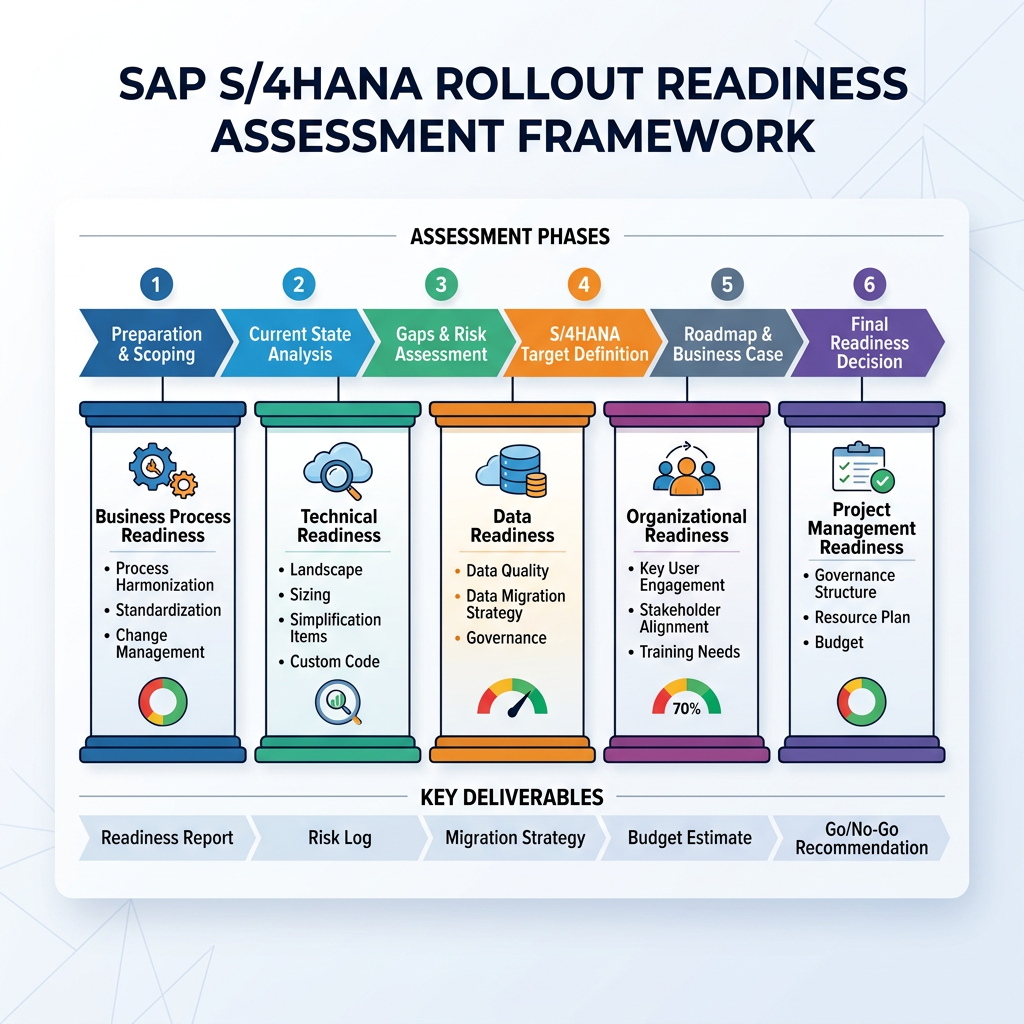
How Tier 1 automotive suppliers can test the feasibility of change before implementation
In an SAP S/4HANA global rollout, attention often centers on template design, Fit-to-Standard workshops, data migration, and interface development. Yet the causes of implementation delay and post-go-live operational strain are often not technical. They stem from whether the organization is genuinely ready to execute and embed the change.
This is particularly true for Tier 1 automotive suppliers. Differences in customer- and site-specific processes, product-launch schedules, quality assurance requirements, close coordination across procurement, production, and logistics, and the integration of acquired companies or regional entities all converge. If an SAP global rollout is treated simply as an IT replacement, a substantial gap can emerge between the global standard and the organization’s ability to execute it locally.
The TOGAF® Business Transformation Readiness Assessment (BTRA) is a practical technique for making that gap visible early. This article translates the assessment into concrete evaluation areas, workshops, transition gates, and deliverables that IT, corporate planning, and Enterprise Architecture (EA) teams at Tier 1 automotive suppliers can use from initial concept through rollout.
“A Business Transformation Readiness Assessment can be used to evaluate and quantify the organization’s readiness to undergo a change.”
The TOGAF® Standard describes BTRA as a technique for evaluating and quantifying an organization’s readiness to undergo change. Source: The Open Group, TOGAF Standard — ADM, Phase A
BTRA Is a Shared Language for Executive, Business, and IT Decisions
BTRA does not answer the technical question, “Can we implement SAP?” Its purpose is to determine whether the organizational capabilities required to realize the Target Architecture are sufficient today and, where they are not, what must be put in place by when.
For a Tier 1 manufacturer’s SAP global rollout, a BTRA is valuable whenever even one of the following questions cannot be answered clearly:
- Who approves local exceptions to the global template, and against which criteria?
- Do regional business leaders truly accept the changes in authority and work that standardization will bring?
- Are data owners clearly assigned for materials, bills of materials, routings, business partners, costs, and quality information?
- Have the conditions for training, business testing, master-data quality, and operational acceptance been defined before production migration?
- After go-live, who among the global CoE, regional IT, plants, and external partners resolves which issues?
TOGAF® positions BTRA results as an input to the Capability Assessment, shaping the architecture scope, the activities required, and the risk areas to address. BTRA is therefore not a retrospective risk register. It is an input to designing the architecture and implementation strategy. Source: The Open Group, TOGAF Standard — ADM, Phase A
Where BTRA Fits in the TOGAF® ADM
A BTRA should not be treated as a one-time diagnostic event. If it ends there, changes in organizational conditions after implementation begins will be missed. TOGAF® 10th Edition distributes the assessment, its reflection in the roadmap, the detailed planning, and the monitoring during execution across several ADM phases.
| ADM Phase | BTRA Activity | Typical Decision in a Tier 1 SAP Global Rollout |
| Phase A: Architecture Vision | Conduct the primary readiness assessment. Define organizational capabilities, transformation risks, and required activities at an initial level. | Which plants and regions should be included in Wave 1? What should be the principles for standardization and the treatment of exceptions? |
| Phase E: Opportunities & Solutions | Revisit Phase A results and determine their impact on the roadmap and Transition Architectures. | Which deployment approach is realistic: big bang, pilot, regional waves, or phased deployment by business domain? |
| Phase F: Migration Planning | Embed improvement actions in implementation and migration plans with budgets, owners, due dates, and dependencies. | Which work packages should deliver data governance, training, CoE setup, and the availability of local resources? |
| Phase G: Implementation Governance | Monitor readiness factors and correct for changed risks. | Should a deployment gate be passed or delayed because of key-user attrition, reorganization, deteriorating data quality, or unresolved exceptions? |
Phase E of TOGAF® 10th Edition explicitly calls for reviewing the BTRA findings produced in Phase A and determining their impact on the Architecture Roadmap and Implementation and Migration Strategy. Source: The Open Group, TOGAF Standard — ADM, Phase E
TOGAF® also calls for readiness factors to be continuously monitored as part of the Implementation and Migration Plan in Phase G, with rapid corrective action through governance. Source: The Open Group, TOGAF Standard — ADM Techniques, Business Transformation Readiness Assessment
The 12 Readiness Factors Tailored for Tier 1 Automotive Suppliers
TOGAF® provides 12 illustrative BTRA readiness factors. They are not a fixed questionnaire. TOGAF® itself recommends using them as a starting point from which workshop participants can reuse, remove, add, or replace factors. Source: The Open Group, TOGAF Standard — ADM Techniques, Section 8.2
The following translates these 12 factors into evaluation questions and evidence for an SAP global rollout at a Tier 1 automotive supplier.
Strategy and Executive Commitment
| Readiness Factor | Question to Assess | Typical Evidence and Decision Inputs |
| Vision | Can the business capabilities and management value to be achieved through a global ERP be explained in the same language to regions, plants, and functions? Are the scope of standardization and the outcome KPIs clear? | Architecture Vision, executive messages, global process principles, KPI tree, and target scope. |
| Desire, Willingness, and Resolve | Are executives and business functions willing to accept fewer local exceptions, changed roles, data remediation, and time for training? | Steering Committee minutes, resource commitments, and change-acceptance assessments by function. |
| Need | Are the business risks of not transforming and the value of transforming clear? Do frontline teams understand why the change is needed now? | Current-state issues, business plan, customer, quality, and supply requirements, cost of inaction, and success conditions. |
| Business Case | Are benefits, investment, timing of realization, benefit owners, and measurement methods defined? Is the case justified by more than IT cost? | Approved business case, benefits-realization plan, financial model, and KPI owners. |
| Funding | Beyond implementation cost, is funding secured for training, data remediation, business SMEs, migration support, hypercare, and operational handover? | Multi-year budget, regional cost allocation, contingency policy, and resource plan. |
Governance and Accountability
| Readiness Factor | Question to Assess | Typical Evidence and Decision Inputs |
| Sponsorship and Leadership | Who leads the transformation and can arbitrate conflicts across functions and regions? Will the sponsor remain engaged throughout the program? | Sponsor appointment, executive governance forums, decision-escalation process, and executive attendance record. |
| Governance | Are decision rights clear for global standards, local exceptions, investments, priorities, and design decisions? | Governance Charter, Architecture Board, Design Authority, exception-approval process, and decision SLAs. |
| Accountability | Is one final accountable owner assigned for processes, data, benefits, risks, and go-live decisions? | RACI, and appointments of Global Process Owners, Data Owners, Benefit Owners, and Risk Owners. |
Execution and Sustained Adoption Capability
| Readiness Factor | Question to Assess | Typical Evidence and Decision Inputs |
| Workable Approach and Execution Model | Are the implementation approach, standardization principles, testing, training, change management, quality gates, and deployment model aligned? | Fit-to-Standard policy, template policy, wave plan, test strategy, and Change Management Plan. |
| IT Capacity to Execute | Are the skills, organization, and partner strategy in place to deliver SAP, data, integration, security, testing, infrastructure, and operational handover? | Skills matrix, organization chart, external partner plan, environment plan, and track record in comparable programs. |
| Enterprise Capacity to Execute | Can business functions in plants, regions, and headquarters devote the time needed for design, testing, data remediation, and training while sustaining day-to-day operations? | SME capacity plan, decision SLAs, test plan, training plan, and functional-leader commitments. |
| Enterprise Ability to Implement and Operate | Can the organization deploy the new processes and system, then operate them stably and improve them continuously after go-live? | Operating model, CoE design, L1/L2/L3 organization, SLAs, work procedures, and support-acceptance criteria. |
These factors are based on the TOGAF® BTEP example. TOGAF® describes Vision; Desire, Willingness, and Resolve; Need; Business Case; Funding; Sponsorship and Leadership; Governance; Accountability; Workable Approach and Execution Model; IT Capacity to Execute; Enterprise Capacity to Execute; and Enterprise Ability to Implement and Operate as representative transformation-readiness factors. Source: The Open Group, TOGAF Standard — ADM Techniques, Section 8.2
Do Not Stop at a Five-Level Maturity Score
A radar chart is useful in an executive discussion, but it is not enough to change a deployment plan. TOGAF® calls for each factor to state the current and target condition, importance, urgency, difficulty of improvement, risk, and improvement actions.
“The assessment should address three things, namely: Readiness Factor Vision; Readiness Factor Rating; Readiness Factor Risks & Actions.”
Source: The Open Group, TOGAF Standard — ADM Techniques, Section 8.4
In practice, create one row in an assessment sheet for each readiness factor, as illustrated below.
| Assessment Field | Example: Governance |
| Scope | APAC Wave 1: procurement, production, and cost management. |
| Baseline Facts | Local exceptions are decided individually by country leaders; approval criteria and lead times are undefined. |
| Baseline Maturity | 2 / Fair |
| Target State | The Global Design Authority makes decisions within the defined time frame using exception criteria and process and cost impacts. |
| Next Transition Target | Before Fit-to-Standard is complete, put into operation an exception-request form, assessment criteria, decision RACI, and a five-business-day decision SLA. |
| Readiness Status | Fair |
| Urgency | High |
| Difficulty to Fix | Moderate |
| Risk | Uncontrolled local exceptions enter design and development, expanding template divergence, test scope, and operating cost. |
| Improvement Action | Establish the Design Authority, define exception governance, and conduct a weekly review of the exception register. |
| Owner | Global Process Owner, CIO, and Regional Business Lead. |
| Deployment Gate | A mandatory condition for Fit-to-Standard sign-off. |
| Residual Risk | Medium. The Steering Committee decides whether to accept it. |
The TOGAF readiness-rating scheme uses Low, Fair, Acceptable, Good, and High to assess readiness, and No Action Needed, Easy, Moderate, and Difficult to assess the difficulty of improvement. Factors with High urgency require action before the transformation initiative begins. Source: The Open Group, TOGAF Standard — ADM Techniques, Section 8.4.2
How to Start a 90-Minute BTRA Workshop
TOGAF® recommends a facilitated workshop with participants from multiple functions. An IT-only assessment may overestimate technical feasibility while overlooking common causes of failure, including decision-making, frontline capacity, training, and operational handover. Source: The Open Group, TOGAF Standard — ADM Techniques, Sections 8.2–8.4
Participants
- An executive sponsor or corporate planning leader
- The CIO or global IT leader
- Global Process Owners
- Plant and regional business leaders
- PMO, change-management, and HR representatives
- Data-governance, security, EA, and SAP architecture representatives
- Deployment and operations leaders
Suggested Workshop Flow
- Align on the transformation premise. In 10 minutes, confirm the Target Architecture, in-scope regions and plants, global-standardization principles, planned waves, and principal business outcomes.
- Assess the 12 factors individually. Each participant assesses the current state, target state, evidence, concerns, and required actions before or during the workshop. Ask for the basis of every rating; do not finalize scores on impression alone.
- Identify factors with the largest gap. Overlay three conditions: a large Baseline-to-Target gap, High urgency, and Difficult improvement. This identifies factors requiring executive intervention.
- Translate risks into implementation-plan language. Do not stop with an abstract finding such as “sponsorship is weak.” State a specific risk event: “Because regional presidents do not participate in exception decisions, design approvals exceed the deadline.”
- Turn improvement actions into work packages. Assign owners, budgets, due dates, completion criteria, and dependencies. Do not make actions dependent on individual goodwill; embed them in the Implementation and Migration Plan.
Four Transformation Gates to Establish Before Go-Live
For an SAP global rollout at a Tier 1 manufacturer, it is risky to make deployment decisions solely on the basis of successful technical testing. The following four gates should operate as executive and business gates linked to the BTRA.
Global Template Gate
Confirm that the Global Process Owner, Design Authority, and exception-approval mechanism are operating. If many local exceptions remain unresolved, the template should not be frozen, even if configuration and development appear to be on schedule.
Data Ownership Gate
Confirm that global owners, regional stewards, quality standards, correction responsibilities, and migration-acceptance criteria are defined for critical master data. The decision is not based on the number of migrated records; it is based on data quality fit for business use and clear ownership.
People and Business Acceptance Gate
Confirm that key users, frontline managers, and operations personnel understand the new processes and roles and have completed the required training and exercises. In plant production, quality, procurement, and logistics in particular, validate the impact of disruption and the contingency procedures.
Operational Handover Gate
Confirm who will handle post-go-live incidents, access, master data, inquiries, and change requests, and under which SLAs. Define the L1/L2/L3 split between the CoE, regional IT, plant IT, and SAP partners, as well as the hypercare exit criteria.
Five Common Failure Patterns
“We will organize local requirements later.”
Starting requirements gathering without exception-management governance allows local requirements to accumulate without limit. Use BTRA to assess Governance and Accountability first, then define rules for decisions on standards and exceptions in Phase A.
Judging business participation by attendance alone
Having SMEs attend meetings does not raise Enterprise Capacity to Execute. Confirm decision rights, release from routine work, time for training and testing, and backfill arrangements.
Treating training as a task immediately before go-live
Insufficient training is a compound risk spanning business acceptance, data quality, and operational adoption. TOGAF notes that there is no point in deploying new IT capability if employees are not trained to use it and support staff are not ready to sustain it. Source: The Open Group, TOGAF Standard — ADM Techniques, Section 8.5
Ending BTRA with a Phase A report
Readiness changes with key-user attrition, plant restructuring, acquisitions, customer-program changes, and budget reviews. Incorporate assessment results into the roadmap, risk register, deployment gates, and the recurring Steering Committee agenda, and keep them updated through Phase G.
Showing executives only the scores
“Governance scored 2.5” does not drive a decision. For executives, summarize the risk event, the affected wave, the decision needed, the accountable executive, the deadline, and the consequence of no decision on one page.
A One-Page Summary for the Executive Meeting
An executive BTRA summary should prioritize the information needed for business decisions rather than detail on all 12 factors. The following structure turns it from an IT progress report into a business-transformation decision document.
- Decision required now: For example, whether to start APAC Wave 1 on schedule or postpone it by eight weeks until data-governance setup is complete.
- Top three critical readiness gaps: For example, data governance, regional sponsorship, and the availability of plant key users.
- Business impact: For example, template divergence, cutover quality, customer-supply risk, and timing of benefits realization.
- Options and recommendation: For example, reduce pilot scope, reorder regional waves, or bring forward training and data cleansing with additional funding.
- Executive action required: For example, delegate authority for exception approval, assign regional personnel full time, or decide whether to accept residual risk.
Summary: Sequence SAP Deployment by the Organization’s Ability to Change
For Tier 1 automotive suppliers, the technically shortest path for an SAP global rollout is not necessarily the safest or most valuable path. If decision-making capability, data accountability, frontline execution capacity, and the ability to transition into operations are ignored, the global template may be deployed, but the business transformation will not take root.
TOGAF BTRA is a technique for structuring these less visible conditions for transformation and reflecting them in the Architecture Roadmap and the Implementation and Migration Plan. The assessment starts in Phase A, informs Transition Architectures in Phase E, is embedded in execution planning in Phase F, and is continuously monitored in Phase G. Source: The Open Group, TOGAF Standard — ADM Techniques, Sections 8.1 and 8.5
The success of an SAP global rollout is not measured solely by meeting the go-live date. A global template becomes valuable as Enterprise Architecture only when standard processes, data, organization, and operations work as one and the company has acquired a repeatable capability to deploy the next plant or region.
Next Action
At your next SAP global-template meeting or Steering Committee, assess only four of the 12 factors first: Governance, Accountability, Enterprise Capacity to Execute, and Enterprise Ability to Implement and Operate. Even this focused assessment can reveal organizational bottlenecks in the current roadmap and issues that require an early executive decision.
Reference Links
- The Open Group. TOGAF Standard, 10th Edition: ADM, Phase A — Architecture Vision
- The Open Group. TOGAF Standard, 10th Edition: ADM, Phase E — Opportunities & Solutions
- The Open Group. TOGAF Standard, 10th Edition: ADM Techniques, Business Transformation Readiness Assessment
Disclaimer
Parts of this article were developed with reference to generative AI suggestions and were reviewed, refined, and supplemented based on the author’s professional expertise and judgment.

Leave a Reply