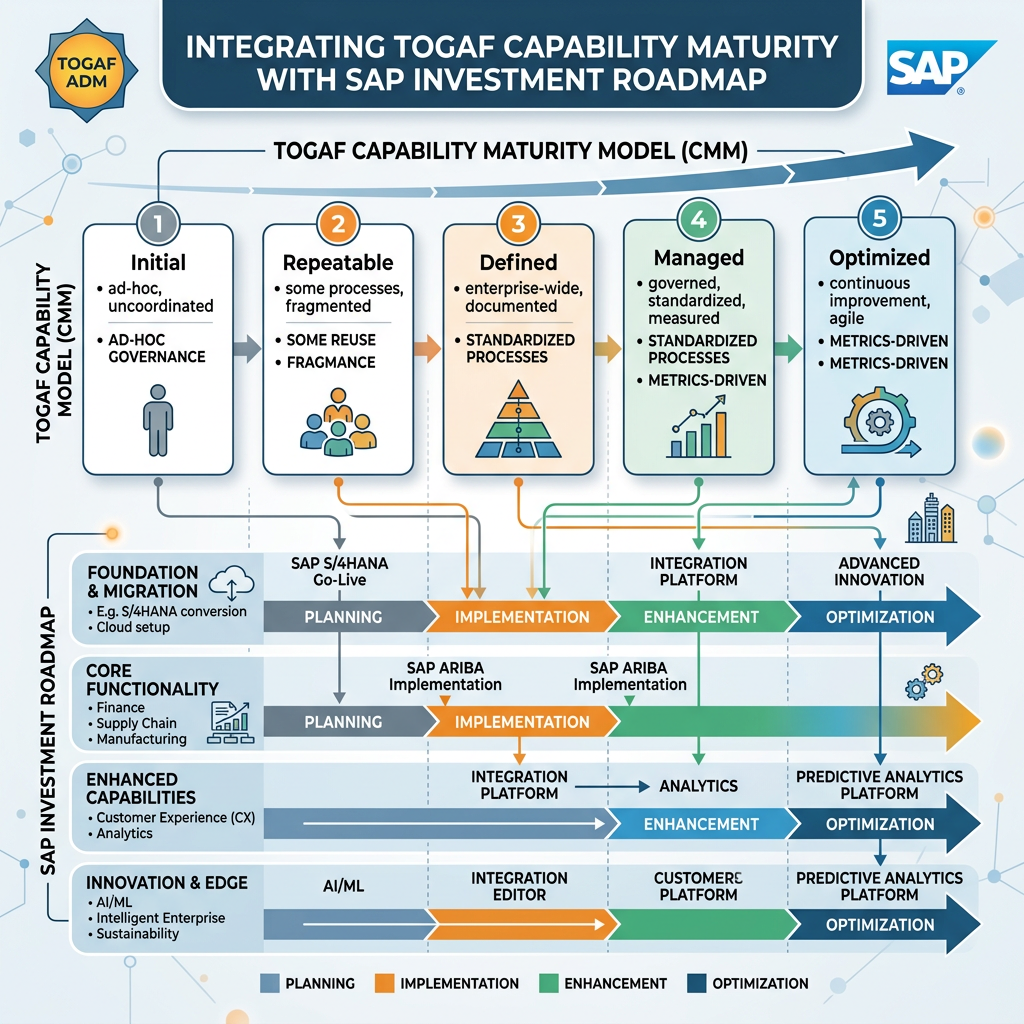
When organizations begin ERP transformation, discussions often start with “which product to implement.” This approach typically devolves into feature comparisons rather than strategic decision-making.
TOGAF® Enterprise Architecture offers a more effective method: define Business Capabilities first, assess their maturity and strategic importance, and then determine the implementation sequence for SAP S/4HANA Private Cloud, PLM, MES, and surrounding systems.
TOGAF® explains Capability-Based Planning as follows:
“Capability-based planning focuses on the planning, engineering, and delivery of strategic business capabilities to the enterprise.”
(Source: https://pubs.opengroup.org/architecture/togaf9-doc/m/chap28.html)
In other words, investment decisions should be driven not by system features, but by the capabilities an enterprise needs to achieve business outcomes.
For Tier 1 automotive suppliers, capabilities such as cost management, demand responsiveness, production quality, engineering change integration, traceability, and global governance directly impact profitability and delivery performance. This makes objective Business Capability maturity assessment essential for prioritizing investments effectively.
The Role of Business Capability in TOGAF®
In TOGAF®, Capability-Based Planning focuses on designing and delivering the capabilities required to achieve business outcomes.
A Business Capability is not:
- A specific application function
- A department on an organization chart
Instead, it represents the enterprise’s ability to consistently deliver outcomes.
In this context, systems such as SAP S/4HANA, PLM, MES, WMS, EDI, and quality management platforms are not the goal—they are enablers of capabilities.
Therefore, implementation priority should not be based on which system is newer, but on:
- Which capability has the largest maturity gap
- Which capability has the highest business impact
Core Dimensions for Capability Maturity Assessment
In practice, Business Capability evaluation becomes clearer when structured across three primary dimensions:
- Strategic Importance
- Current Maturity
- Target Maturity
SAP LeanIX and Bizzdesign further emphasize adding a fourth dimension:
- Adaptability (change responsiveness)
These dimensions help organizations identify:
- Capabilities that are critical but immature
- Capabilities that are critical but difficult to change
This creates a clear, defensible basis for prioritizing SAP and PLM investments.
Key Evaluation Dimensions
- Strategic Importance
Impact on revenue, cost, quality, delivery, customer requirements, and regulatory compliance. Higher importance increases priority. - Current Maturity
How consistently and reliably the capability is executed today. Lower maturity indicates greater improvement potential. - Target Maturity
The required level to support future business models. Larger gaps indicate stronger investment candidates. - Adaptability
How quickly processes and systems can respond to change. Lower adaptability increases urgency.
Objective Maturity Assessment Criteria
To avoid subjective judgment, maturity must be assessed using evidence across five perspectives:
Evaluate whether processes are:
1. Process Standardization
- Ad hoc and dependent on individuals
- Partially standardized with frequent exceptions
- Fully documented and consistently applied
- Governed with KPIs and controls
- Continuously improved
Example: If procurement or production planning varies significantly across plants, maturity should be rated low.
2. Data Quality and Governance
Assess whether:
- Master data (materials, BOM, suppliers, cost elements) is fragmented
- Governance roles and update processes are unclear
- Data definitions and ownership are standardized
- Data quality is continuously monitored
- End-to-end data consistency exists across PLM, ERP, and quality systems
In Tier 1 environments, inconsistencies between PLM BOMs and ERP data are a common indicator of low maturity.
3. Organization and Decision-Making
Evaluate:
- Clarity of decision authority
- Defined roles (e.g., RACI)
- Cross-functional governance
- Speed and consistency of decisions
Even with strong systems, unclear accountability reduces capability maturity.
4. KPI and Visibility
Assess whether:
- KPIs exist and are standardized
- Performance is reviewed regularly
- KPIs drive corrective actions
- Predictive indicators are used
Key examples include cost variance, delivery performance, defect rates, inventory turnover, and engineering change lead time.
5. System Support and Integration
Evaluate:
- Reliance on Excel and manual processes
- Fragmented systems with redundant data entry
- Core processes executed in ERP
- Integration across ERP, PLM, MES, and analytics
- Real-time, optimized data and process integration
Recommended Scoring Method
A practical approach is to score each capability on a 5-point scale and apply weighted scoring:
- Strategic Importance: 40%
- Current Maturity: 30%
- Gap to Target: 20%
- Adaptability: 10%
Example:
- Cost Management & Profitability Analysis
High importance, low maturity → prioritize ERP (SAP S/4HANA) foundation - Engineering Change Management
High importance, low maturity → prioritize PLM-ERP integration - Demand Planning & Inventory Optimization
Moderate maturity → phased ERP and planning system rollout
This approach shifts the discussion from “which system to implement” to “which capability to improve.”
Priority Areas for Tier 1 Automotive Suppliers
Typical high-priority capabilities include:
- Cost management and profitability visibility by product and plant
- Engineering change integration between PLM and ERP
- Demand and supply planning optimization
- Quality assurance and traceability
- Master data governance across BOM, materials, suppliers, and costing
Example:
If cost visibility is weak, prioritizing SAP S/4HANA integration is logical.
If engineering change delays are critical, PLM-ERP integration should come first.
How to Define Implementation Sequencing
A structured approach:
- Create a Capability Map aligned to business outcomes
- Assess each capability across importance, maturity, target, and adaptability
- Identify high-impact, low-maturity capabilities
- Map capabilities to processes, data, applications, and technologies
- Develop a roadmap for SAP S/4HANA, PLM, MES, analytics, and supporting systems
Investment Prioritization Logic
- Fragmented cost, inventory, and production data
→ Prioritize SAP S/4HANA ERP integration - Engineering change delays and BOM inconsistencies
→ Strengthen PLM and ERP integration - Lack of real-time shop floor visibility
→ Implement MES - Weak traceability and quality tracking
→ Enhance quality management systems - Slow, manual decision-making
→ Build analytics and management reporting platforms
Practical Tips for Project Managers
Project managers should position initiatives not as system implementations, but as Capability Improvement Programs.
Key practices:
- Base assessments on evidence, not intuition
- Visualize differences across plants and functions
- Always pair maturity with strategic importance
- Prioritize based on capability gaps, not system age
- Integrate process, data, and system design in the roadmap
Key Quotes for Reference
“Capability-based planning focuses on the planning, engineering, and delivery of strategic business capabilities to the enterprise.”
https://pubs.opengroup.org/architecture/togaf9-doc/m/chap28.html
“Business capability assessment is the process of evaluating what your organization needs to be able to do to achieve its strategic objectives.”
https://www.leanix.net/en/wiki/ea/business-capability-assessment
“To effectively assess Capabilities and execute Capability-Based Planning it’s important to define three dimensions: Strategic Importance, Capability Maturity, and Adaptability, and to measure them.”
https://bizzdesign.com/blog/how-to-measure-business-capability-aspects/
Conclusion
By applying TOGAF® Business Capability assessment, organizations can prioritize SAP S/4HANA Private Cloud, PLM, and related systems based on capability maturity gaps rather than product features.
For Tier 1 automotive suppliers, evaluating cross-functional capabilities such as cost management, engineering change, demand planning, quality, and master data governance enables the creation of a high-impact investment roadmap.
For project managers, the key is to objectively assess capabilities and use those insights to define the implementation sequence across ERP, PLM, MES, analytics, and supporting systems. This approach elevates decision-making from fragmented requirements to enterprise-wide competitive advantage.
Reference links
- TOGAF foundation of Capability-Based Planning and Business Capability thinking
TOGAF Capability-Based Planning[pubs.opengroup] - SAP LeanIX Business Capability modeling guidelines
SAP LeanIX Business Capability Modeling Guidelines[help.sap] - How SAP LeanIX uses Business Capability in Application Portfolio Assessment
SAP LeanIX Application Portfolio Assessment[help.sap] - Capability-based planning and investment prioritization
Bizzdesign Capability Based Planning[bizzdesign] - Three dimensions for Business Capability assessment: Strategic Importance, Capability Maturity, and Adaptability
Bizzdesign Blog: How to measure Business Capability aspects[bizzdesign]
Disclaimer
Parts of this article were developed with reference to generative AI suggestions and were reviewed, refined, and supplemented based on the author’s professional expertise and judgment.

Leave a Reply