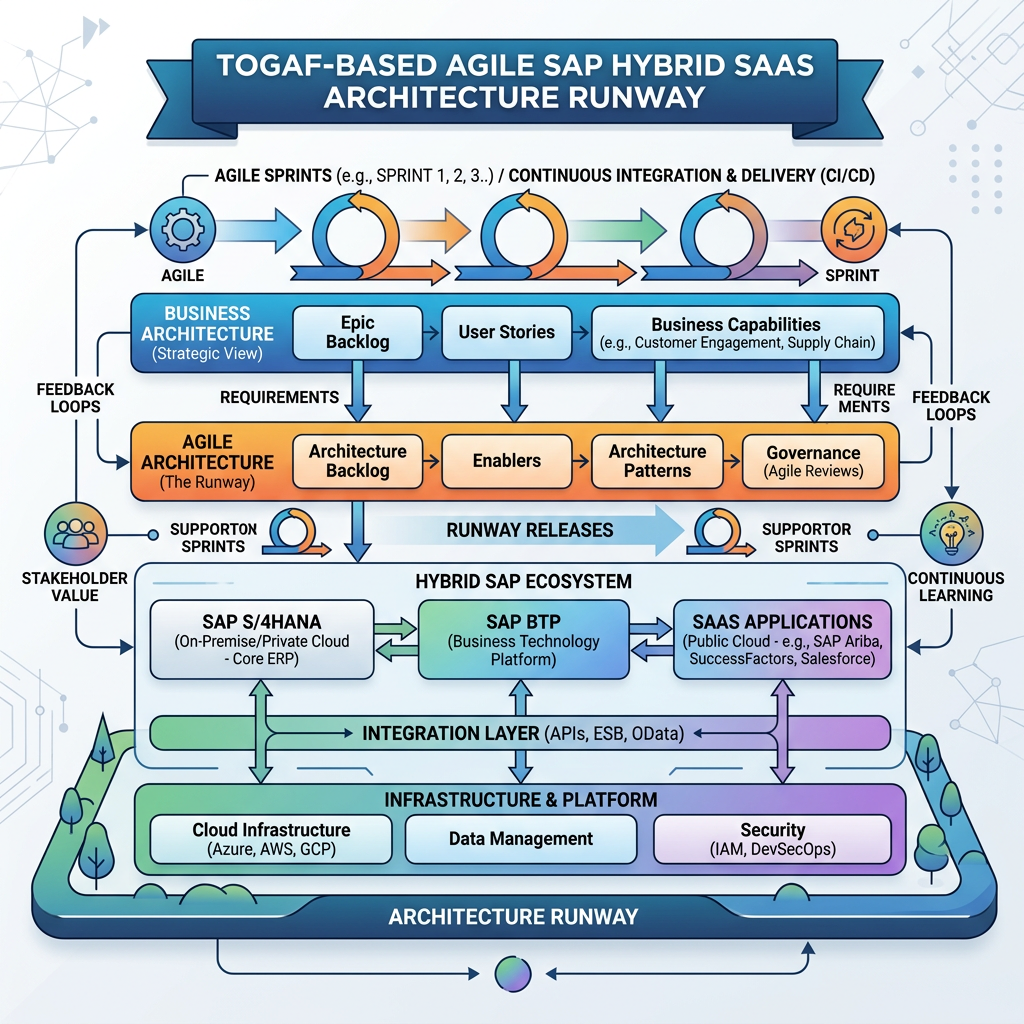
Why TOGAF® Still Matters in the Agile Era
As agile development continues to spread, many people still believe that “EA or TOGAF® is heavy and slows down delivery.” However, TOGAF® 10 and the guide The TOGAF® Framework – Enabling Enterprise Agility redefine Enterprise Architecture (EA) as an enabler of agility, positioning it as a framework for designing enterprise structures that are resilient to change.
Especially for enterprise platforms such as SAP, it is extremely difficult to frequently rebuild the core architecture once it is implemented, so both “design that can withstand change” and “governance that can manage change” become critical. TOGAF® connects long-term, enterprise-level architecture design with short, agile development and deployment cycles.
The Purpose of EA in an Agile Enterprise
In an agile enterprise, the purpose of EA is not only “standardization and optimization,” but also “creating loosely coupled structures that are resilient to change and keeping the organization in a state where business change can be reflected quickly.” This allows digital transformation and business model innovation to be executed as reusable, architecture-aligned initiatives, instead of one-off custom developments.
The main goals of EA in an agile enterprise can be summarized as follows.
- Maintain alignment between business strategy and IT without slowing down the pace of change.
- Avoid silos and drive enterprise-wide optimization through standards and governance.
- Increase agility and ease of change through loosely coupled business capabilities, applications, data, and technology structures.
In this sense, EA is redefined as the provider of a “safe sandbox with guardrails,” enabling agile teams to move fast without losing control.
Key Ideas from “Architecture in an Agile Enterprise”
The Open Group’s guide The TOGAF® Framework – Enabling Enterprise Agility outlines principles for treating EA and agile as complementary rather than conflicting. This guide emphasizes balancing “Intentional Architecture” and “Emergent Architecture.”
Key points include:
- Use long-term Intentional Architecture to define vision and guardrails.
- Continuously update EA by incorporating Emergent Architecture from short agile development cycles.
- Map EA and agile (such as SAFe and other scaled agile approaches) across portfolio, product, and team levels to ensure end-to-end alignment.
Through this approach, EA becomes a “living architecture” that evolves by absorbing agile changes, instead of a static document created once and then left untouched.
Running TOGAF® ADM in an Agile Way
The core TOGAF® process, ADM (Architecture Development Method), is an iterative cycle composed of Phases A through H. ADM is often misunderstood as waterfall-oriented, but it is originally designed to be iterative and can be aligned with agile cycles.
In an agile enterprise, the following time horizons are useful for operating ADM:
- Yearly: Use Preliminary, Phase A–E to define Intentional Architecture (target state and roadmap).
- Quarterly to half-yearly: Use Phase F–G for release planning, initiative selection, and implementation governance.
- Sprint level: Agile teams implement changes and feed outcomes and learnings back into Phase H (Architecture Change Management).
By layering the ADM loop on top of agile development cycles, EA no longer “suppresses change,” but instead “accelerates change safely.”
The Role of EA in SAP Implementation Projects
In SAP implementation projects, methodologies such as SAP Activate are commonly used. However, Activate does not cover the full scope of EA, as it focuses on the lifecycle of a specific solution implementation. Enterprise-wide portfolios and future business transformations still need to be designed and managed as EA.
The Enterprise Architect plays a key role in connecting the following two layers:
- Upper layer: Business capability maps, application portfolios, data and technology standards defined by EA and TOGAF®.
- Lower layer: Concrete requirements, configuration, development, and testing that progress through SAP Activate Fit-to-Standard workshops, backlogs, and sprints.
EA provides guardrails on topics such as “which areas should follow SAP standard,” “where to extend and integrate surrounding systems,” and “which APIs and data models should be standard for future digital transformation,” while the project team makes agile decisions within those guardrails.
Application Approach (1): Defining SAP Scope Based on Business Capabilities
In an agile SAP implementation, rather than trying to design a perfect end-to-end To-Be process upfront, it is more effective to define scope and priorities by “Business Capability.” Capability-based scoping aligns well with agile portfolio management approaches such as SAFe and makes it easier to plan releases that deliver business value incrementally.
The Enterprise Architect uses the TOGAF® Business Architecture phase to create a business capability map and classify “which capabilities should be standardized in SAP” and “which capabilities should be extended or implemented through surrounding systems for differentiation.” Based on this, SAP implementation scope and rollout roadmap are defined per capability and then broken down into agile initiatives.
Application Approach (2): Clarifying Foundational Architecture and Guardrails
For agile teams to operate autonomously, it is essential to clarify “foundational architecture” and “guardrails” upfront. The key is to define TOGAF® Technology, Data, and Application Architecture deliverables in a lightweight way, tailored to the SAP context.
Typical examples of guardrails in SAP implementations include:
- Extension principles: Prioritize SAP standard, use BTP and public APIs for extensions, and keep classic Z-customizations to a minimum.
- Integration principles: Use iPaaS or an API hub for core-to-core integration and avoid point-to-point connections.
- Data model principles: Maintain a single golden record for master data (including MDG), and unify code systems and key design.
- Security and compliance: Clarify standards for role design, data protection, and audit logs so that agile teams do not deviate on their own.
Instead of creating large, heavy design documents, these should be presented in compact forms such as “architecture principles,” “reference models,” and “standard pattern catalogs” that agile teams can use for day-to-day decisions.
Application Approach (3): Architecture Runway and Release Roadmap
SAFe introduces the concept of “Architecture Runway,” which recommends preparing technical foundations in advance for future capabilities. TOGAF’s Migration Planning (Phase F) and Implementation Governance (Phase G) directly support planning and overseeing this runway.
In SAP implementations, examples of architecture runway include:
- Finalizing common master data, organizational structures, and code systems prior to rollout and establishing them as a global template design.
- Preparing core infrastructure (network, identity federation, single sign-on, backup) in advance as a shared foundation for all subsequent rollouts.
- Standardizing the interfaces and data migration pipelines required for the first wave so that later waves can simply reuse the patterns.
From an EA perspective, the critical point is to clarify “what value each wave delivers” and “which parts of the runway must be in place by when to deliver that value,” and to reflect these in the business capability map and architecture roadmap and link them to overall project planning.
Practical SAP Example (1): Template Deployment and Agile Rollout
In a typical SAP global rollout, a “global template + local rollout” structure is applied. To run this structure in an agile way, EA has several important roles.
One possible approach is:
- Design the global template as Intentional Architecture using TOGAF® ADM Phases A–E (business capabilities, processes, application landscape, data standards, technical foundation).
- Run each rollout wave as an agile project based on the template and feed back learnings from Fit-to-Standard workshops into EA.
- When extending the template for local requirements, EA reviews against pre-defined guardrails (extension principles, data standards) and determines whether the pattern is acceptable.
Through this cycle, the template itself evolves in an agile manner and matures into a “learning architecture,” enabling smoother rollout in later waves.
Practical SAP Example (2): Hybrid Landscapes with Surrounding SaaS
In modern SAP implementations, S/4HANA is usually deployed as part of a hybrid landscape that includes surrounding SaaS solutions such as CRM, HR, PLM, and SCM clouds. To add or replace SaaS solutions in an agile manner, integration and API strategies at the EA level are critical.
Using TOGAF’s Application and Technology Architecture, architects can define guidelines such as:
- Group systems based on business capabilities and clearly define boundaries of loosely coupled “domains.”
- Use APIs or events for inter-domain integration, and minimize data duplication and point-to-point interfaces.
- Clarify SAP’s role as the “system of record” and “transaction system” and define responsibility boundaries with surrounding SaaS.
With this clarity, when new SaaS is added, decisions such as “which domain to connect to” and “which standard API or event to use” become straightforward, enabling reusable patterns aligned with EA instead of one-off custom integrations.
Practical SAP Example (3): EA Metrics and Continuous Improvement
In an agile enterprise, architecture itself should be a target of continuous improvement. TOGAF’s Architecture Change Management phase recommends monitoring architecture maturity and compliance and revisiting architecture when necessary.
In SAP programs, EA metrics such as the following help visualize architectural health:
- Standard process adherence (ratio of template changes and additions).
- Ratio of extension types (BTP extension, standard API usage, custom Z-development).
- Number of interfaces and ratio by pattern (API, file-based integration, point-to-point).
- Master data duplication and consistency indicators (such as golden record adherence).
By reviewing these metrics regularly and feeding the results back into standards, guardrails, and template improvements, EA itself can evolve in an agile manner.
Message to Enterprise Architects: Make TOGAF® a “Working Language” on the Ground
Enterprise Architects engaging in agile SAP implementations are not expected to simply “recite TOGAF®.” What is needed is the ability to “translate TOGAF® thinking into the decision-making language used on the ground.”
Important perspectives include:
- Mapping ADM and architecture domains to project phases, deliverables, and governance forums so that EA concepts naturally appear in daily discussions.
- Turning architecture principles and guardrails into checklists or decision flows that project managers, product owners, and development teams can easily understand.
- Designing reflection and feedback mechanisms that capture learnings from agile development cycles and feed them back into EA and templates.
By bringing the essence of “Architecture in an Agile Enterprise” into SAP delivery, Enterprise Architects can create “SAP foundations that are resilient to change” and provide real, ongoing value to the organization.
Please refer to this article for topics related to Enterprise Architecture (EA).
Enterprise Architecture – Insight Arc | SAP, Enterprise Architecture & Supply Chain Strategy
■ TOGAF, EA, and Agile
The TOGAF® Framework – Enabling Enterprise Agility(PDF)
http://www.enterprise-architecting.com/eaex/TOGAF%20-%20Integrating%20Enterprise%20Architecture%20and%20Agile%20Practices.pdf
Enabling Enterprise Agility(The Open Group TOGAF Series Guide)
https://pubs.opengroup.org/togaf-standard/guides/enabling-enterprise-agility/index.html
What is TOGAF? | The Definitive Guide to TOGAF – LeanIX
https://www.leanix.net/en/wiki/ea/togaf
TOGAF – Wikipedia
https://en.wikipedia.org/wiki/The_Open_Group_Architecture_Framework
Enterprise Architecture Meets Agile: Making TOGAF and SAFe Work Together
https://medium.com/@quanlinguo/enterprise-architecture-meets-agile-making-togaf-and-safe-work-together-faa724bae4b1
Top IT Professional Shares TOGAF10 Agile Planning Secrets(YouTube)
https://www.youtube.com/watch?v=hpb5BSfWoEs
■ SAP, EA, and Digital Transformation
SAP’s Enterprise Architecture Framework and TOGAF(LinkedIn article)
https://jp.linkedin.com/pulse/saps-enterprise-architecture-framework-togaf-10-common-sudhakar-jha?tl=ja
SAP Digital Transformation Methodologies(PDF)
https://news.sap.com/japan/files/2024/11/01/SAP-Digital-Transformation-Methodologies-revised-edition.pdf
SAP Certified Professional – Enterprise Architect exam experience(in Japanese)
https://qiita.com/tami/items/1eaa16627d56ccf6c43d
■ (Optional) Japanese resources you may still reference
Understanding Enterprise Architecture (EA) and TOGAF(Japanese)
https://guides.visual-paradigm.com/ja/understanding-enterprise-architecture-ea-and-togaf/
Overview of Enterprise Architecture and TOGAF(Japanese blog)
https://cano-pus.com/lab/2025/05/01/knowledge-enterprisearchitecture001/
Enterprise Architecture (EA) trends and ArchiMate overview(Japanese, PDF)
https://www.jri.co.jp/file/advanced/advanced-technology/pdf/15164.pdf
Disclaimer
Parts of this article were developed with reference to generative AI suggestions and were reviewed, refined, and supplemented based on the author’s professional expertise and judgment.

Leave a Reply