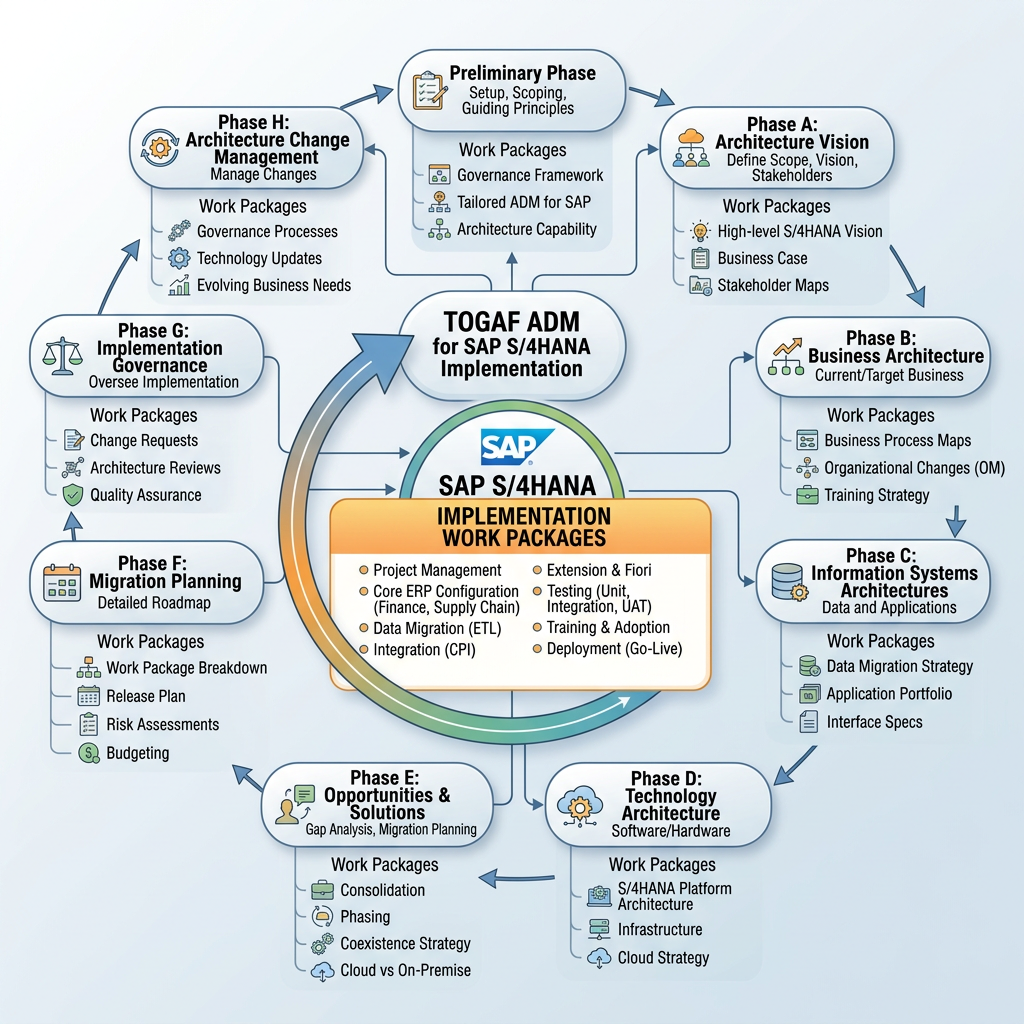
Introduction
In TOGAF® ADM, work packages are core deliverables that convert architectural gaps into executable transformation units, effectively bridging strategy and implementation.
In large-scale ERP implementations such as SAP S/4HANA, applying this concept enables organizations to structure business transformation, data governance, application design, and technology enablement into a unified roadmap.
Why Work Packages Matter in TOGAF® ADM
Within TOGAF® ADM Phase E, the following activities are defined:
- “Review and Consolidate Gap Analysis Results from Phases B to D”
- “Identify and Group Major Work Packages”
(Source: https://pubs.opengroup.org/togaf-standard/adm/)
These steps transform gaps identified across Business, Data, Application, and Technology Architectures into executable transformation initiatives.
The TOGAF® Practitioners’ Guide further describes the architectural flow as:
- “Develop Target, Baseline, and Gap”
- “Identify the Work to Reach the Target Considering Cost and Value”
(Source: https://governance.foundation/assets/frameworks/togaf/g186%20-%20A%20Practitioners%20Approach%20to%20Developing%20EA.pdf)
This clarifies that work packages are not just WBS elements—they are design units that connect architectural intent with execution planning, prioritized by value and cost.
How Work Packages Are Used in ADM
In ADM:
- Phases B–D define Baseline and Target Architectures and identify gaps
- Phase E groups these gaps into major work packages
- Phase F assigns business value, resources, and sequencing
In ERP programs, this means architects do not simply manage requirements lists. Instead, they bundle transformation efforts into structured execution units aligned with business objectives.
A practical way to organize work packages is across four architecture domains:
- Business Architecture: Standard process design, governance models, approval flows, organizational roles
- Data Architecture: Master data standardization (material, vendor, BOM, routing) and data quality improvement
- Application Architecture: SAP standard adoption scope, integration with surrounding systems, extension strategy
- Technology Architecture: Infrastructure, authentication, transport management, monitoring, security controls
Applying Work Packages in SAP S/4HANA Programs
The TOGAF® Practitioners’ Guide identifies four usage levels of Enterprise Architecture:
- Strategy
- Portfolio
- Project
- Solution Delivery
These map naturally to SAP ERP programs.
Practical Mapping in SAP Implementation
- Strategy
Define transformation objectives
Example: Global process standardization, management visibility, MDG establishment - Portfolio
Prioritize investment themes
Example: Manufacturing transformation, procurement optimization, financial integration - Project
Define scope, budget, dependencies
Example: Fit-to-Standard, global template design, data migration planning - Solution Delivery
Execute build and deployment
Example: MM/SD/PP/FI configuration, interfaces, authorization design, UAT, cutover
A common failure in SAP projects is structuring plans purely by modules, leading to fragmentation across business transformation, data, governance, and training.
Work packages solve this by organizing execution around business capabilities, such as:
- Order-to-Cash standardization
- Advanced production planning
- Cost management harmonization
Key Design Points for SAP-Oriented Work Packages
When defining work packages for SAP ERP:
- Work Package Name: Clearly reflects transformation intent
- Target Capability: Business capability being improved
- Related ADM Artifacts: Gaps, requirements, architecture principles
- SAP Scope: Modules, integrations, master data objects
- Value Metrics: Inventory reduction, lead time improvement, faster closing, profitability
- Execution Conditions: Dependencies, data readiness, organizational changes, training, testing
- Deployment Model: Phased rollout, pilot-first, global template
Example (Automotive Supplier – S/4HANA)
- Global material and BOM standardization
- Integrated demand and production planning
- Costing and profitability harmonization
- Plant-based rollout and transition planning
Summary
By structuring transformation initiatives as work packages, Enterprise Architecture evolves from documentation into a decision-making backbone for SAP programs. It ensures alignment between strategy, architecture, and execution while enabling value-driven prioritization across complex ERP implementations.
References Links
- TOGAF Standard ADM
https://pubs.opengroup.org/togaf-standard/adm/ - TOGAF ADM Practitioners’ Guide
https://governance.foundation/assets/frameworks/togaf/g186%20-%20A%20Practitioners%20Approach%20to%20Developing%20EA.pdf - TOGAF ADM Introduction
https://www.opengroup.org/architecture/0210can/togaf8/doc-review/togaf8cr/c/p2/p2_intro.htm
Disclaimer
Parts of this article were developed with reference to generative AI suggestions and were reviewed, refined, and supplemented based on the author’s professional expertise and judgment.

Leave a Reply