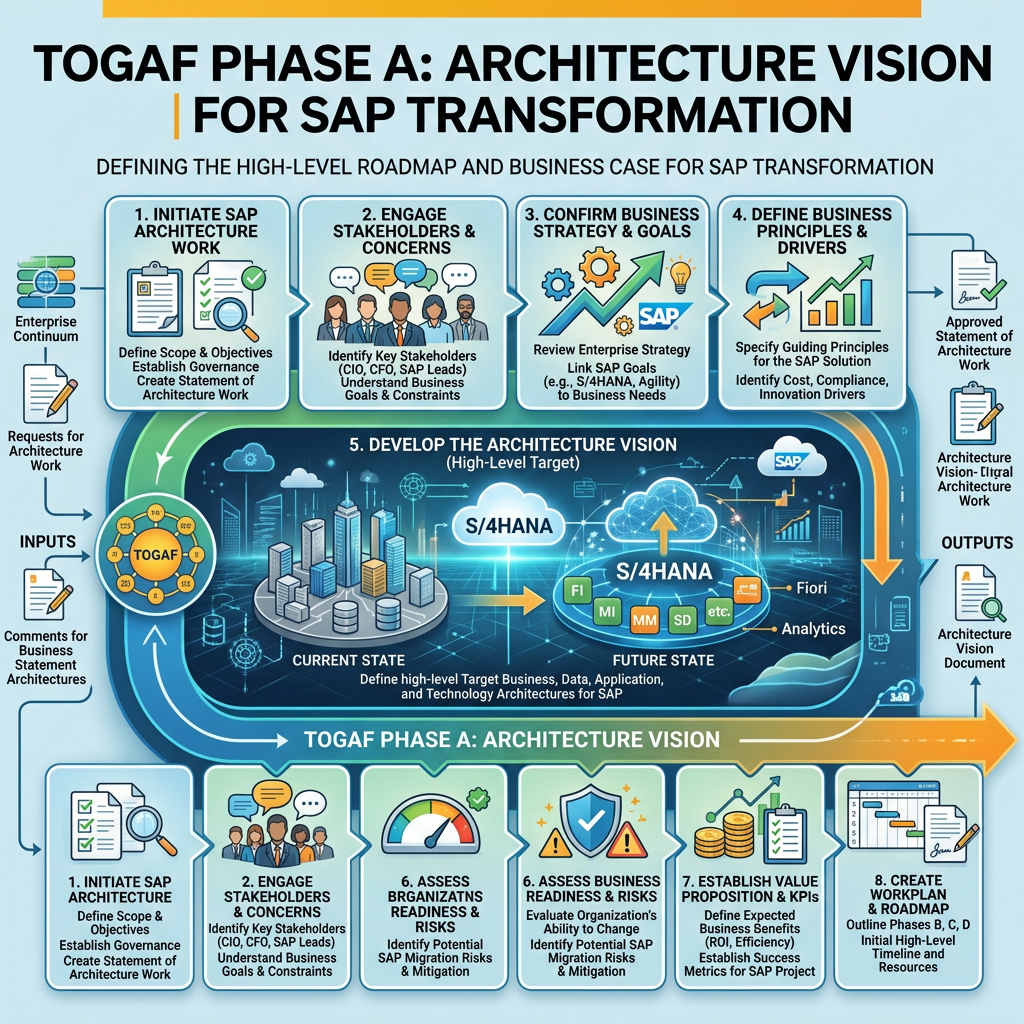
In large-scale SAP implementation projects, establishing a solid foundation from an Enterprise Architecture (EA) perspective is a critical success factor.
Phase A: Architecture Vision in the TOGAF (The Open Group Architecture Framework) Architecture Development Method (ADM) represents exactly this starting point.
This article provides a practical guide on how to apply Phase A effectively in SAP projects.
What is Phase A: Architecture Vision?
Phase A of the TOGAF ADM aims to develop a high-level, aspirational vision of the capabilities and business value that will be delivered by the proposed enterprise architecture.
This phase has a clear starting point:
the receipt of a Request for Architecture Work from the sponsoring organization.
It plays a crucial role in defining the overall direction of the project.
In SAP programs—such as S/4HANA transformations or Private Cloud adoption—Phase A serves as the foundation for aligning enterprise-wide vision and securing stakeholder agreement.
Key Objectives of Phase A
1. Define Scope and Constraints
Phase A focuses on setting:
- Scope
- Constraints
- Expectations
- Stakeholders
- Business context
In SAP projects, this includes:
- Defining implementation scope (global rollout vs. single instance)
- Identifying technical constraints (integration with legacy systems)
- Clarifying expected outcomes (efficiency gains, cost reduction)
2. Secure Approval of the Statement of Architecture Work
A key milestone is obtaining approval for the:
Statement of Architecture Work
This document defines the work program required to develop and deploy the architecture outlined in the Architecture Vision.
Approval ensures:
- Executive sponsorship
- Resource allocation
- Organizational commitment
The 11 Steps of Phase A Applied to SAP Projects
TOGAF defines 11 steps in Phase A. Below is how they translate into SAP implementation:
- Establish Architecture Project
→ Build SAP project governance and team structure - Identify Stakeholders, Concerns, and Requirements
→ Engage CIO, business units, and IT stakeholders - Confirm Business Goals, Drivers, and Constraints
→ Align SAP with digital transformation strategy - Evaluate Business Capabilities
→ Assess current systems and process maturity - Assess Readiness for Business Transformation
→ Evaluate organizational change readiness - Define Scope
→ Decide modules, regions, rollout phases - Define Architecture Principles
→ Establish global template and data governance principles - Develop Architecture Vision
→ Create high-level To-Be SAP architecture - Define Value Proposition and KPIs
→ Set ROI, TCO, and efficiency KPIs - Identify Risks and Mitigation Actions
→ Address data migration and business continuity risks - Develop and Approve Statement of Architecture Work
→ Obtain executive approval
Key Outputs in SAP Projects
Approved Statement of Architecture Work
A formal document including:
- Scope
- Architecture vision
- Project roadmap
- Deployment timeline
Architecture Vision
Includes:
- Problem statement
- Business scenarios
- Stakeholder requirements
- High-level transformation view
This visualizes the full business transformation enabled by SAP S/4HANA.
Capability Assessment
Assessment of:
- Technical capabilities
- Process maturity
- Organizational skills
Communications Plan
Defines how stakeholders will be engaged.
In global SAP programs, multilingual and cross-regional communication is essential.
Draft Architecture Definition Document
Version 0.1 baseline vs. target architecture:
- Business
- Data
- Application
- Technology
Expected Outcomes
Stakeholder Alignment
Consensus is achieved through a signed Statement of Architecture Work, aligning the entire organization.
Clear Business Value Definition
Clarifies how new capabilities:
- Support business goals
- Address stakeholder concerns
- Deliver measurable ROI
Risk Management Foundation
Early identification and mitigation of risks:
- Data migration risks
- Operational continuity risks
Required Skills for SAP Enterprise Architects
Business Skills
- Stakeholder engagement
- Requirement documentation
- Business scenario modeling
→ Critical for bridging business and IT
Technical Skills
- Deep knowledge of SAP ecosystem (S/4HANA, integration, MDM)
- Understanding of EA frameworks such as TOGAF
Architecture Skills
- Architecture principles
- Gap analysis
- Risk management
→ Balancing global templates and local requirements
Communication Skills
- Explaining complex topics to executives
- Aligning diverse stakeholders
- Managing cultural diversity in global programs
Practical Tips for Success
Early Stakeholder Engagement
Prioritize alignment with executives, business, and IT stakeholders from the beginning.
Align with SAP Best Practices
Integrate TOGAF principles with SAP best practices to ensure architectural consistency.
Phased Approach
Adopt a rollout strategy:
- Pilot → Regional rollout → Global deployment
to minimize risks.
Conclusion
TOGAF ADM Phase A is a critical foundation for SAP project success.
By:
- Clearly defining scope
- Aligning stakeholders
- Establishing a strong architecture vision
you significantly improve decision-making quality in subsequent phases.
For SAP Enterprise Architects, leveraging TOGAF is not just about technical design—it is about driving business value realization and successful organizational transformation.
A strong foundation built in Phase A ultimately determines the success of the entire SAP program.
Please refer to this article for topics related to Enterprise Architecture (EA).
Enterprise Architecture – Insight Arc | SAP, Enterprise Architecture & Supply Chain Strategy
This article is based on TOGAF official documentation and related materials.
In practice, frameworks should be tailored to fit your organization’s specific context.
References
The following sources were referenced in the creation of this article:
TOGAF Phase A Official Documentation & Guides
- Phase A: Architecture Vision | QualiWare Center of Excellence
- Phase A: Architecture Vision in TOGAF ADM
- Comprehensive Guide to TOGAF ADM Phase A: Architecture Vision Deliverables
- ADM Phase Overview – TOGAF Official
TOGAF ADM Japanese Resources
- TOGAF ADM Phase A (Part 1/4) — Architecture Vision
- TOGAF9 Certification Study Notes (3): ADM Overview and Phases
- TOGAF Enterprise Architecture: ADM Phase A
- Introduction to TOGAF Architecture Development Method (ADM)
SAP × TOGAF Resources
- Optimizing Enterprise Architecture with TOGAF Framework and SAP
- How to Learn SAP Enterprise Architecture (SAP EA) From Scratch
- Evaluating the TOGAF Architecture Development Method – SAP Learning
- What is TOGAF®? | SAP LeanIX
Additional TOGAF ADM Resources
- TOGAF Enterprise Architecture: ADM Phase – A, ‘Architecture Vision’
- A Comprehensive Guide for TOGAF ADM Phase A: Architecture Vision
- TOGAF ADM Phase A: Architecture Vision Objectives – F Consulting
- TOGAF ADM Phase A – Start at the Beginning with an Architecture Vision
Disclaimer
Parts of this article were developed with reference to generative AI suggestions and were reviewed, refined, and supplemented based on the author’s professional expertise and judgment.

Leave a Reply