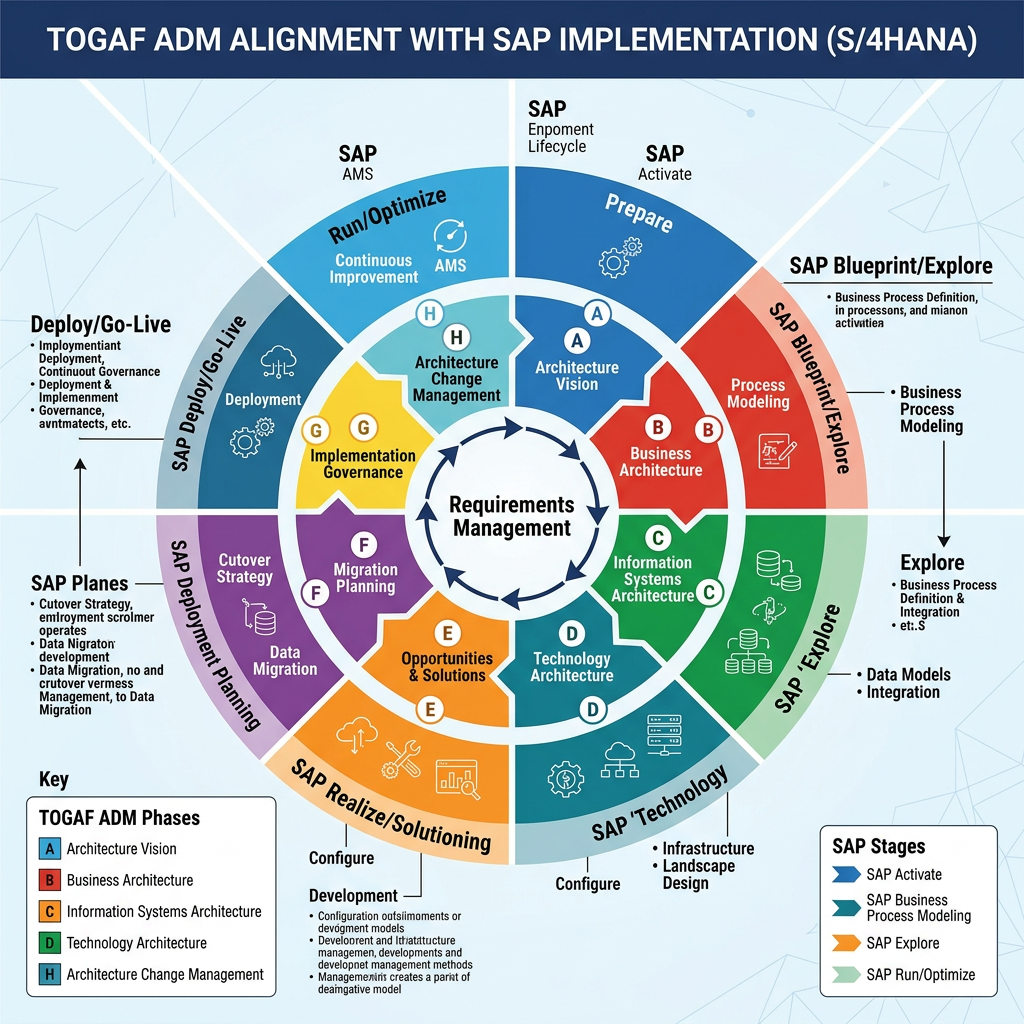
A Practical Guide for Enterprise Architects to Start TOGAF® ADM in SAP Programs
SAP implementation is not just a system upgrade—it is an enterprise-wide transformation that impacts business processes, organizational structures, data, and technology.
TOGAF® ADM (Architecture Development Method) provides a standardized framework to govern such transformations end-to-end, from strategy to implementation and change management. In parallel, SAP also defines its own enterprise architecture frameworks and role structures. Therefore, Enterprise Architects (EA) must act as a bridge between “enterprise-level architecture” and “SAP solution architecture.”
Target Audience
This article is intended for:
- Enterprise Architects involved in SAP implementation projects
- Professionals with TOGAF® Foundation or Practitioner-level knowledge who want to apply ADM in real projects
- Those seeking clarity on what EA should prepare before SAP Fit-to-Standard workshops
Where to Start in TOGAF® ADM
TOGAF® ADM consists of the Preliminary Phase, Phases A–H, and Requirements Management.
For SAP implementation, Enterprise Architects should initially focus on:
- Preliminary Phase: Establish EA governance and principles
- Phase A (Architecture Vision): Define vision, scope, and stakeholder alignment
- Requirements Management: Build a framework for managing business requirements
The following sections outline the key tasks EA should perform in these phases.
Preliminary Phase: Establishing the Foundation
The Preliminary Phase prepares the organization to adopt TOGAF-based EA practices.
In SAP projects, this phase defines how the SAP program is governed under EA.
Task 1: Define EA Governance and Organization
- Define the scope of EA governance (business, application, data, technology) and its relationship with the SAP program
- Align global vs. local decision-making boundaries
- Establish roles such as Enterprise Architect, Solution Architect (SAP/non-SAP), and Domain Architects
- Set up an Architecture Board with clear authority and responsibilities
This setup must align with EA responsibilities in SAP programs, including strategic alignment, architecture design, technology selection, and risk management.
Task 2: Define Architecture Framework and Meta-model
- Adopt TOGAF® ADM while aligning with SAP EA frameworks and reference architectures
- Define how to integrate EA tools (e.g., LeanIX) and SAP reference content
- Design the meta-model: business capabilities, processes, applications, data objects, and technology layers
- Position SAP solutions (S/4HANA, Ariba, IBP, etc.) within the EA layers
SAP’s EA framework complements TOGAF® by providing scalable structures and building blocks tailored to enterprise needs.
Task 3: Define Architecture Principles (Including SAP-Specific)
- Enterprise-wide principles: standardization, reuse, modularity, data consistency
- SAP-specific principles:
- “Fit-to-Standard first”
- Minimize custom development
- Single Source of Truth
- Cloud-first strategy
- Define coexistence vs. full replacement strategy for legacy systems
These principles act as decision criteria for design reviews and governance in later phases.
Phase A: Defining the Architecture Vision
Phase A focuses on aligning stakeholders around vision, scope, and expectations.
Task 4: Identify Business Drivers and Objectives
- Clarify transformation drivers (e.g., global inventory visibility, cost transparency, faster financial closing, compliance)
- Define KPIs such as lead time reduction, inventory turnover, and FTE optimization
Linking business goals to architecture vision ensures consistency throughout design and implementation.
Task 5: Define Scope, Constraints, and Assumptions
- Scope: business units, regions, company codes, processes (Order-to-Cash, Plan-to-Produce), systems
- Constraints: budget, timeline, cloud/on-premise decisions, integration requirements, organizational limitations
- Assumptions: project readiness, user capability, master data readiness
These are documented in Architecture Vision and Statement of Architecture Work for stakeholder alignment.
Task 6: Stakeholder Analysis and Communication Plan
- Identify stakeholders: executives, business leaders, IT, SAP CoE, global sites, partners
- Analyze interests, expectations, and concerns
- Define communication channels: architecture reviews, reports, workshops
Strong stakeholder engagement increases support for EA activities.
Requirements Management: Designing the Flow of Requirements
Requirements Management is a continuous process across all ADM phases.
Task 7: Define Requirements Process and Tools
- Classify requirements: business, functional, non-functional (performance, security), regulatory
- Define lifecycle: creation, prioritization, impact analysis, approval, traceability
- Select tools: SAP Cloud ALM, Solution Manager, and integration with EA repositories
Ensuring traceability between requirements and architecture enables clear justification of design decisions.
Summary of Key EA Tasks
When applying TOGAF® ADM to SAP implementation, the initial priorities for Enterprise Architects are:
- Establish EA governance and organizational structure
- Define architecture framework and meta-model
- Create architecture principles (including SAP-specific)
- Clarify business drivers and objectives
- Define scope, constraints, and assumptions
- Plan stakeholder engagement and communication
- Establish requirements management processes and tools
First Practical Steps: What to Do Next
Rather than attempting the full ADM at once, start with these practical steps:
- Draft architecture principles (including SAP-specific ones) and review with the Architecture Board
- Create a one-page Architecture Vision summarizing business scenarios and KPIs
- Align with the project manager on requirements management processes and tools
Even these three steps help clarify the value of EA to the project team and establish early momentum.
Please refer to this article for topics related to Enterprise Architecture (EA).
Enterprise Architecture – Insight Arc | SAP, Enterprise Architecture & Supply Chain Strategy
TOGAF ADM: Preliminary / Phase A – official and explanatory resources
- ADM Phase Overview (The Open Group – official summary of each ADM phase, its objectives and key steps)
http://www.togaf.com/admref/_welcome.html - Preliminary Phase – TOGAF 9.1 (official guidance on establishing the organization‑specific EA framework, principles, and governance)
https://coe.qualiware.com/resources/togaf/9-1/part2-adm/preliminary-phase/ - TOGAF Architecture Development Method (overview of all ADM phases and their purpose)
https://www.sparxsystems.jp/help/17.0/the_togaf_adm.html - TOGAF ADM and Visual Paradigm – Simplifying Enterprise Architecture (Japanese article describing each ADM phase, including Preliminary and Phase A, with tool support)
https://guides.visual-paradigm.com/ja/simplify-enterprise-architecture-with-togaf-adm-and-visual-paradigm/ - TOGAF ADM overview and study notes (Japanese memo summarizing ADM phases, including Preliminary and Phase A, for TOGAF certification preparation)
https://qiita.com/torippy1024/items/d4a6fc8829011c3dd8ef - TOGAF ADM: A Comprehensive Guide for Enterprise Architecture (article explaining the ADM phases, their objectives, and how they maintain traceability to business requirements)
https://www.cnblogs.com/uml-tool/articles/18663661 - Comprehensive Guide to the Preliminary Phase of TOGAF ADM (detailed explanation of what to set up during the Preliminary Phase: frameworks, governance, principles, repositories, etc.)
https://togaf.visual-paradigm.com/2025/01/20/comprehensive-guide-to-the-preliminary-phase-of-togaf-adm/ - Enterprise Architecture Design Using the TOGAF Framework (example of applying Preliminary and Phase A in an enterprise architecture design case)
https://www.scitepress.org/Papers/2024/129285/129285.pdf - TOGAF ADM: Phase A Architecture Vision – A Quick Overview (short video explaining the purpose and main outputs of Phase A)
https://www.youtube.com/watch?v=lVfEi913W2E - Learning TOGAF ADM Preliminary Phase in 5 Mins (slide‑style explanation of the Preliminary Phase in a condensed format)
https://fr.scribd.com/document/365613766/Learning-TOGAF-ADM-Preliminary-Phase-in-5-Mins
SAP Enterprise Architecture & TOGAF alignment
- Conducting Preliminary Phase – SAP Enterprise Architecture Framework (SAP Learning Journey explaining how SAP’s EA framework structures the Preliminary Phase and how reference architectures are selected and tailored)
https://learning.sap.com/learning-journeys/applying-the-sap-enterprise-architecture-framework/conducting-preliminary-phase - Intelligent Enterprise Architecture Fundamentals – Conducting Preliminary Phase (course content describing SAP’s EA methodology for the Preliminary Phase in the context of the Intelligent Enterprise)
https://learning.sap.com/courses/intelligent-enterprise-architecture-fundamentals/conducting-preliminary-phase - SAP’s Enterprise Architecture Framework and TOGAF 10 – Common Ground (article describing how SAP’s EA framework aligns with TOGAF 10 and how both can be used together)
https://www.linkedin.com/pulse/saps-enterprise-architecture-framework-togaf-10-common-sudhakar-jha - Simplifying Enterprise Architecture: TOGAF EA vs SAP EA – Understanding the Differences and Bridges (article comparing TOGAF‑based EA and SAP EA, and explaining how to bridge them in practice)
https://www.linkedin.com/pulse/simplifying-enterprise-architecture-togaf-ea-vs-sap-mohammed-ph-d–7tsgc
EA role in SAP implementation / requirements & governance
- Role of the Enterprise Architect in SAP Implementation (article summarizing the responsibilities of EAs in SAP programs: strategy alignment, architecture design, technology selection, and risk management)
https://www.linkedin.com/pulse/role-enterprise-architect-sap-implementation-nishit-priye-yozac
Enterprise Architect – Skills and Responsibilities (general description of the EA role, skills, and typical activities across organizations)
https://www.leanix.net/wiki/ea/enterprise-architect
Disclaimer
Parts of this article were developed with reference to generative AI suggestions and were reviewed, refined, and supplemented based on the author’s professional expertise and judgment.

Leave a Reply