Introduction: Why Stakeholder Strategy Determines SAP Project Success
When reviewing failed SAP implementation projects, issues such as “poor requirements definition” or “insufficient testing” are often cited. However, one critical factor consistently emerges: stakeholder mismanagement.
Misidentifying who the real decision-makers are, who influences the organization, and who supports or resists the initiative can lead to a situation where even the best-designed solution is neither adopted nor sustained. According to SAP, effective stakeholder engagement management is essential for project success.
Stakeholder mapping enables organizations to understand each stakeholder’s level of influence and interest, providing a foundation for designing efficient engagement strategies. In SAP Activate and other methodologies, stakeholder analysis and engagement planning are core components of Organizational Change Management (OCM).
Standard Framework: Stakeholder Map and Influence–Interest Matrix
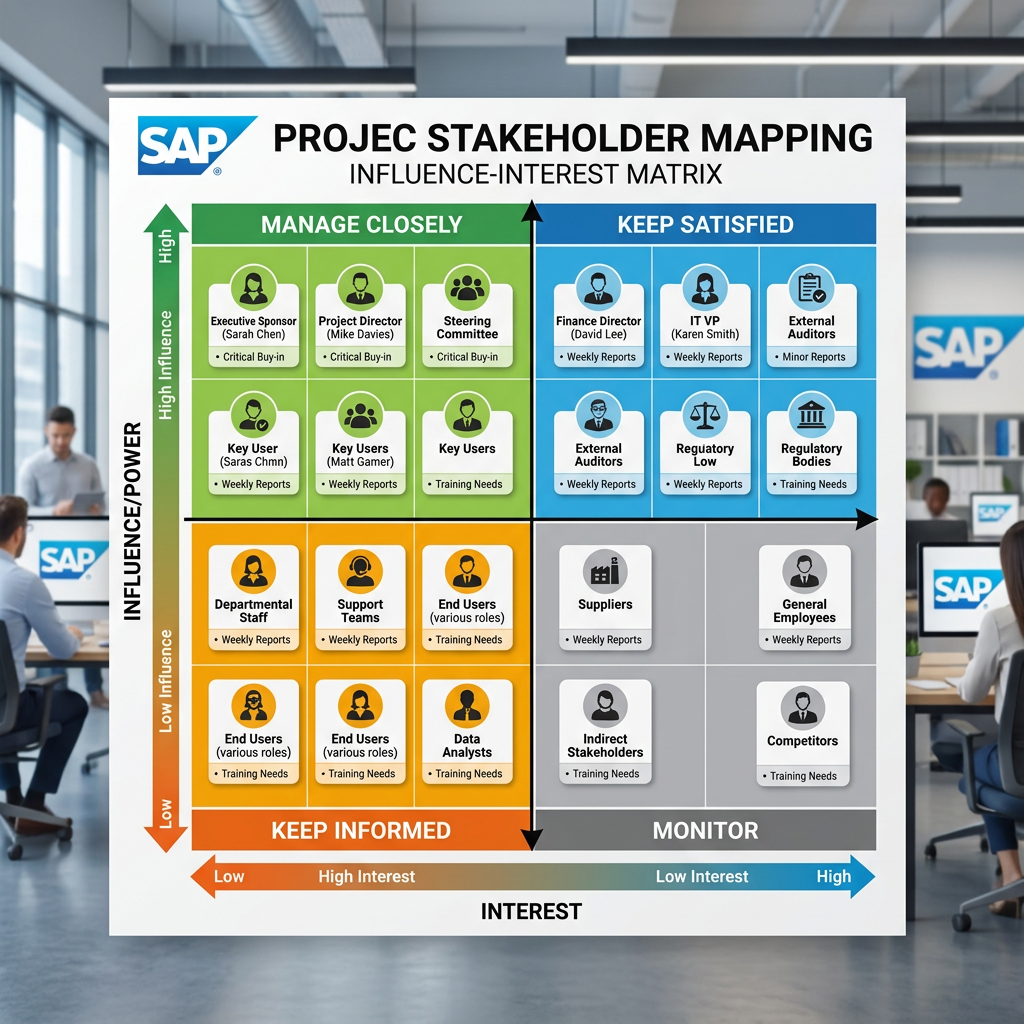
A stakeholder map visualizes the individuals and organizations surrounding a project and the relationships between them.
By evaluating stakeholders based on influence and interest, and plotting them on a matrix, project teams can identify high-priority stakeholders and define where to focus their efforts.
The Influence–Interest matrix is the foundational tool for this analysis. It allows SAP implementation teams to extend the framework further by incorporating:
- Decision-making authority (approvers)
- Organizational influence (influencers)
- Attitude toward the project (positive, neutral, negative)
This combination forms the basis of a robust stakeholder strategy.
Step 1: Identify All Stakeholders Without Gaps
The first step is to clearly define the project objectives and comprehensively identify all potential stakeholders.
It is essential to go beyond directly involved departments and include:
- Individuals with financial interest
- Indirect influencers
- External entities impacting the project
This proactive identification reduces unexpected disruptions later in the project.
Example stakeholder categories in SAP projects:
- Global HQ: CFO, CIO, Global Process Owners
- Regional entities: Plant Managers, Production Heads, Finance Directors, IT Managers
- External: Auditors, OEMs/customers, key suppliers, SI partners, hosting vendors
Step 2: Evaluate Influence, Interest, Role, and Attitude
Each stakeholder should be assessed across multiple dimensions:
- Influence level (High / Medium / Low)
- Interest level (High / Medium / Low)
- Role (Approver, Influencer, End User)
- Attitude (Positive, Neutral, Negative)
This structured evaluation enables prioritization and clearer engagement planning.
Typical interpretation of the Influence–Interest matrix:
- High Influence × High Interest: Manage closely (key sponsors)
- High Influence × Low Interest: Maintain executive-level reporting
- Low Influence × High Interest: Provide sufficient information and feedback channels
- Low Influence × Low Interest: Minimal communication; avoid over-engagement
Step 3: Visualize Relationships with a Stakeholder Map
Once evaluated, stakeholders are plotted on a map and connected using lines or arrows to represent relationships.
This visualization helps clarify:
- Collaboration vs. conflict relationships
- Flows of people, goods, money, and information
- Decision-making and reporting lines
- System and data dependencies
Example SAP stakeholder map structure:
- Center: SAP implementation project or target business process
- Inner ring: Sponsors, global process owners, key business leaders
- Outer ring: OEMs, suppliers, auditors, IT infrastructure vendors
- Arrows: Approval flows, reporting lines, operational dependencies, data integrations
This provides an intuitive understanding of project dynamics.
Step 4: Design Stakeholder-Specific Engagement Strategies
Visualization alone is not sufficient. The real value comes from defining actionable communication and engagement strategies.
Focus resources on high-influence stakeholders and establish structured communication plans, such as regular executive updates.
Example engagement strategies based on stakeholder attitude:
- High Influence × Positive: Turn into ambassadors; involve in success narratives
- High Influence × Negative: Conduct one-on-one discussions; address concerns with alternatives
- Medium Influence × Negative: Build trust through local management
- Low Influence × Positive: Use as pilot users; collect feedback during UAT
Step 5: Operate the Map as a Living Document
A stakeholder map should not be static. It must be continuously updated and shared across the project team.
Best practices include:
- Maintaining the latest version in the cloud
- Tracking changes and history
- Ensuring accessibility for all stakeholders
In long SAP programs, organizational changes, leadership rotations, and strategic shifts are frequent. Therefore, treating the stakeholder map as a “living document” is critical, especially from an OCM perspective.
Conclusion: Embedding Stakeholder Strategy into SAP Delivery
Stakeholder analysis and engagement planning are integral to SAP methodologies such as SAP Activate, making it natural to embed stakeholder maps and Influence–Interest matrices into project execution.
By visualizing stakeholder influence and interest, organizations can prioritize engagement effectively and allocate resources where they matter most.
Maintaining and continuously updating the stakeholder map in a shared environment enables adaptive stakeholder strategies throughout all phases of an SAP implementation.
Ultimately, strong stakeholder strategy is not optional—it is a decisive factor in ensuring SAP project success.
Reference Links
- SAP Digital Transformation Methodologies
https://news.sap.com/japan/files/2024/11/01/SAP-Digital-Transformation-Methodologies-revised-edition.pdf - SAP Activate Methodology
https://www.sap.com/japan/products/erp/activate-methodology.html - Stakeholder Mapping (Kotora)
https://www.kotora.jp/c/140556-2/ - Stakeholder Map Guide (ODIGO)
https://odigo.jp/stakeholder-map-how-to-make/
Disclaimer
Parts of this article were developed with reference to generative AI suggestions and were reviewed, refined, and supplemented based on the author’s professional expertise and judgment.

Leave a Reply