Introduction
For automotive electronics manufacturers, adopting SAP S/4HANA Cloud, private edition is not just an ERP upgrade; it is a strategic move to standardize core business processes and renew the digital backbone of the enterprise.
The more difficult decision for CIOs and program managers is how to position the Manufacturing Execution System (MES) as the “brain” of the shop floor and to what extent they should stay within the SAP stack.
When selecting an MES package, it is essential to validate whether the solution can meet shop floor requirements without increasing operational workload or introducing unnecessary, over‑engineered functions.
Defining the Boundary Between ERP and MES
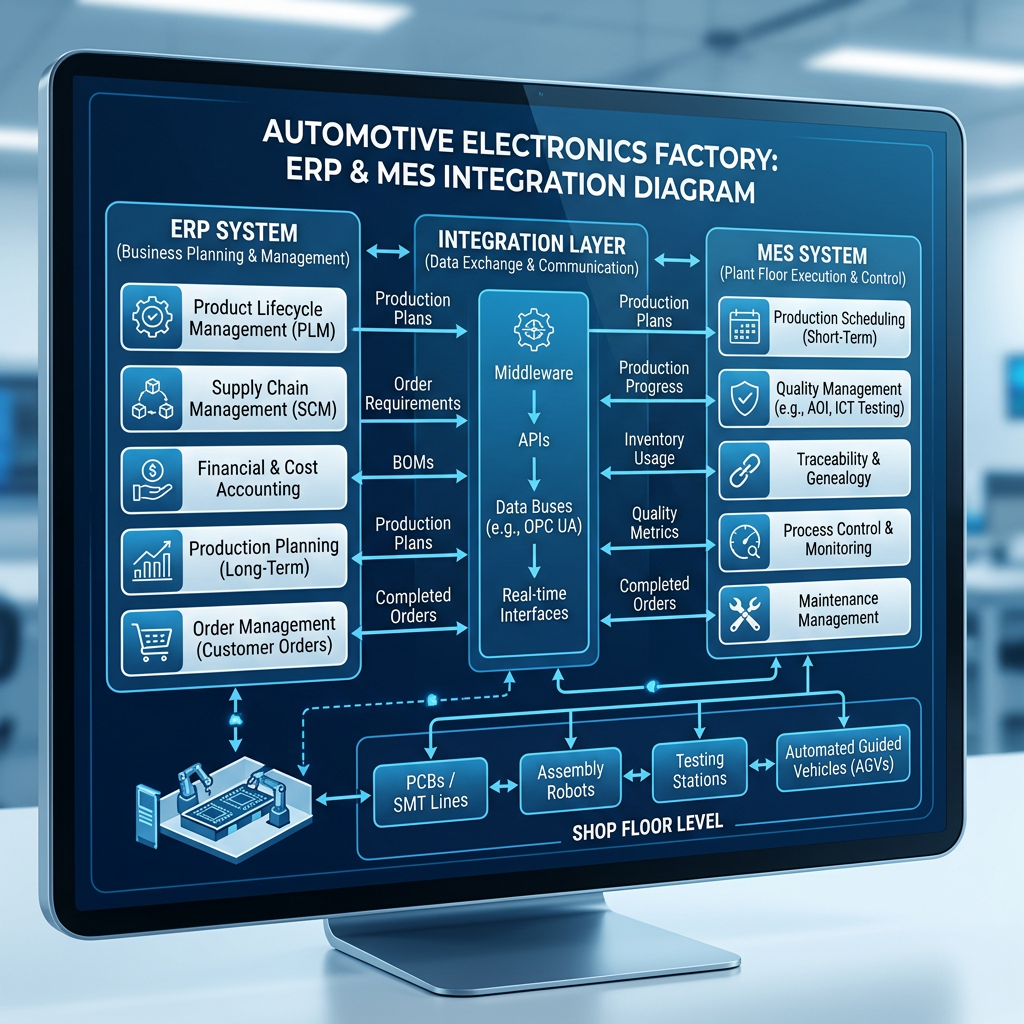
The first design question is how to draw the boundary between SAP S/4HANA and MES.
In a standard reference model, SAP S/4HANA covers demand and supply planning together with MRP, while the MES owns finite capacity scheduling and execution, returning shop floor actuals such as quantities, defects, and labor hours back to the ERP system.
In practice, the major breakpoint between ERP and MES lies between “production planning” and “detailed scheduling and execution,” with MES responsible for capturing production data on the shop floor and feeding back only what ERP actually needs.
MES Must‑Have Capabilities for Electronics Manufacturing
For electronics component plants, it is effective to structure MES requirements around four functional domains: execution and dispatching, data collection and management, traceability and analytics, and integration and platform.
These domains can be mapped to the well‑known MESA‑11 model, which classifies 11 core MES functions into areas such as detailed scheduling, dispatching, data acquisition, quality, tracking, and performance analysis.
In electronics manufacturing specifically, finite capacity scheduling and real‑time rescheduling, full traceability with 5M1E perspectives, in‑process quality including SPC, and automated equipment data collection with edge processing are particularly critical.
Why Adopt SAP Digital Manufacturing
SAP Digital Manufacturing is a cloud‑based MES designed with standard integration to SAP S/4HANA at its core.
Combined with SAP S/4HANA Cloud, private edition, it enables seamless integration of production orders and batch data while establishing a consistent data model from shop floor to top floor.
SAP positions Digital Manufacturing as a Manufacturing Operations Management (MOM) platform that supports agile execution and strengthens a sustainable workforce by tightly connecting the shop floor with enterprise processes to minimize risk and control cost.
From a CIO perspective, staying within the SAP stack simplifies upgrades and maintenance and makes it easier to leverage SAP Business Technology Platform (BTP) for analytics, extensions, and advanced use cases across ERP and MES.
When to Choose a Non‑SAP MES
There are, however, clear scenarios where a non‑SAP MES package becomes a strong candidate.
Typical examples include semiconductor‑like environments with very long lead times, complex re‑entrant flows, and advanced WIP and carrier management requirements that go beyond standard MES functions.
Another case is when a global MES standard such as Siemens Opcenter is already in place and customers want to maximize existing PLM–MES templates, especially for configuration‑driven work order generation and variation management.
Siemens and other MOM vendors describe scenarios where MES is tightly integrated with PLM so that work orders are created directly from configuration data and the impact of engineering changes on both planned and ongoing orders can be analyzed in real time.
Small Starts and a Composable MES Rollout
Although MES can look like a massive, monolithic system, real shop floor improvement usually comes from many targeted, incremental initiatives rather than a big‑bang rollout of all functions at once.
Recent trends show that many MES products now cover the full MESA‑11 scope while still being designed for composable, partial adoption, which makes a small‑start strategy both feasible and recommended.
Industry guidance increasingly emphasizes starting with narrow but high‑impact areas such as traceability and quality data collection, then expanding scope step by step based on proven value.
For CIOs and project managers running S/4HANA programs, the pragmatic approach is to launch S/4HANA and, in parallel, invest first in MES capabilities with clearly quantifiable ROI—such as traceability or in‑process quality—and then extend to scheduling and broader optimization along a defined roadmap.
Conclusion: How to Decide on S/4HANA PCE × MES
For electronics manufacturers, the combination of SAP S/4HANA Cloud, private edition and MES is not a simple product selection question; it is an architectural decision that will shape the competitiveness of the entire supply chain.
The key is to evaluate options not only by “which product to buy” but also by how you define the ERP–MES boundary, how you prioritize the four MES functional domains, and how well the solution aligns with your PLM landscape and overall data platform strategy.
By digitalizing manufacturing processes with the right MES and integration architecture, manufacturers can both initiate disruptive innovation and respond quickly to external disruptions.
When assessing MES packages, it is therefore essential to look beyond product names and the sheer number of functions and instead validate how well each candidate supports the specific execution, data, traceability, and integration capabilities your manufacturing and quality strategy requires.
If your target plants differ significantly in terms of existing MES, process characteristics (for example, whether they are closer to semiconductor processes), or standard PLM products in use, sharing those assumptions will enable a more concrete recommendation on whether SAP Digital Manufacturing or another MES is the better strategic fit.
Reference Links
- SAP Digital Manufacturing – Product overview
https://www.sap.com/products/scm/digital-manufacturing.html - SAP Digital Manufacturing – Features
https://www.sap.com/products/scm/digital-manufacturing/features.html - SAP Help Portal – SAP Digital Manufacturing
https://help.sap.com/docs/sap-digital-manufacturing - SAP S/4HANA Cloud, private edition – Product documentation
https://help.sap.com/docs/SAP_S4HANA_CLOUD_PE - Siemens: 9 functions of manufacturing execution software (MES)
https://blogs.sw.siemens.com/ja-JP/industrial-machinery/2022/06/07/9-functions-manufacturing-execution-software-mes/
Disclaimer
Parts of this article were developed with reference to generative AI suggestions and were reviewed, refined, and supplemented based on the author’s professional expertise and judgment.

Leave a Reply