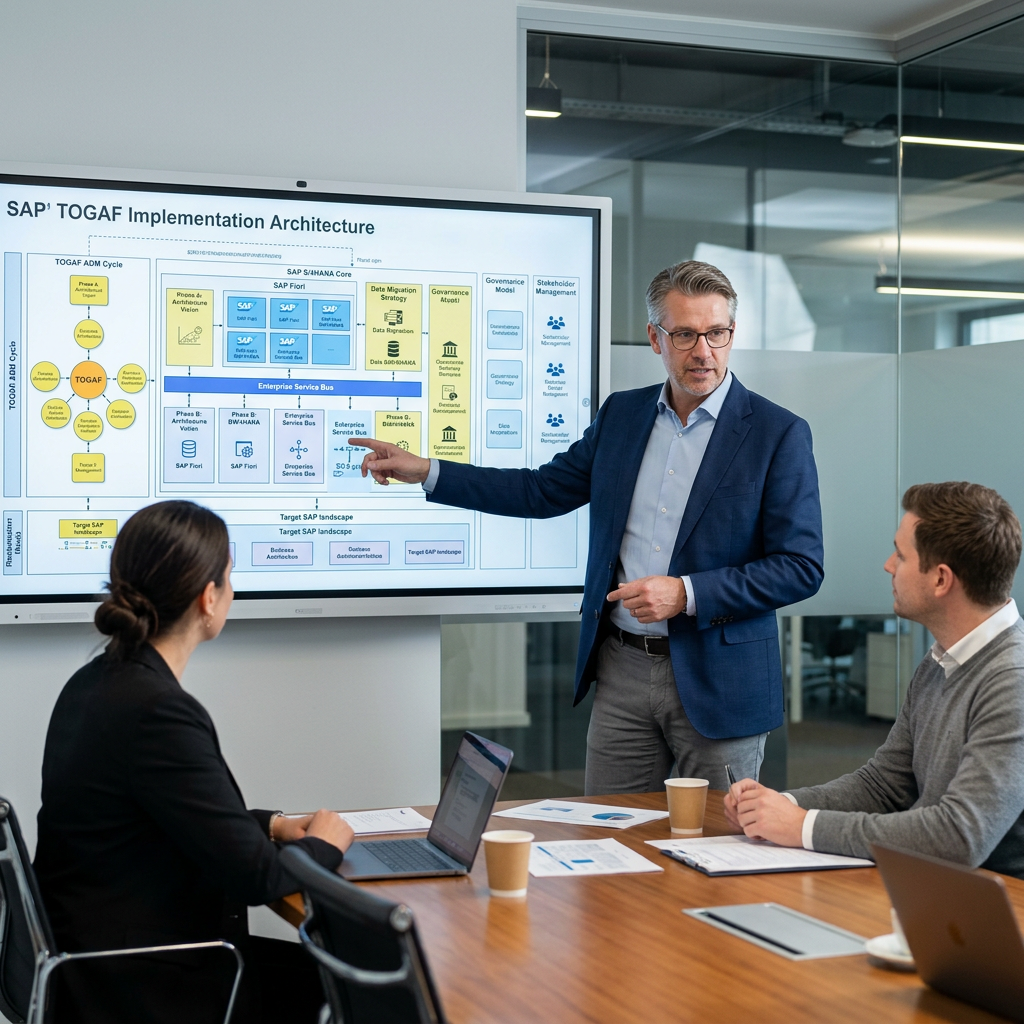
Introduction: Why TOGAF-Based EA Is Essential for SAP Programs
SAP implementation in global manufacturing is not just an ERP upgrade—it is a transformation initiative that must balance global standard processes with local operational realities.
To prevent fragmentation and failure, organizations need a governance framework that consistently designs and aligns business, application, data, and technology layers across the enterprise. TOGAF-based Enterprise Architecture (EA) provides this structure.
TOGAF®, through its Architecture Development Method (ADM), offers a globally recognized framework to systematically design architectures and transition roadmaps from business to technology layers.
While SAP provides methodologies such as SAP Activate and SAP EA, these function as “SAP-centric lenses.” TOGAF® EA, in contrast, acts as the overarching “umbrella,” ensuring enterprise-wide alignment beyond SAP itself.
The Role of EA in Global Manufacturing SAP Programs
An Enterprise Architect is responsible for aligning business strategy with IT architecture across the organization. In global SAP programs, this role expands significantly:
- Define architecture principles for global templates (process, master data, interfaces, add-ons) and control deviations during rollouts
- Design IT-enabled business transformation aligned with advanced manufacturing capabilities (costing, planning, quality, traceability)
- Establish and maintain a consistent enterprise-wide application landscape including SAP and surrounding systems (PLM, MES, WMS, data platforms)
In essence, the EA is not just “an architect within an SAP project,” but the architect of SAP within enterprise transformation.
EA Responsibilities Across TOGAF® ADM Phases
1. Preliminary / Phase A: Vision and Principles
The EA defines the architectural foundation of the SAP program:
- Enterprise architecture principles
Example:- Global standards first; local requirements managed as exceptions
- SAP standard first; add-ons minimized and reusable
- Core master data globally governed; transactions locally managed
- Scope definition of global vs. local responsibilities
- Alignment between TOGAF® ADM and SAP Activate phases
2. Phase B: Business Architecture
The EA ensures global consistency beyond individual process designs:
- Define global end-to-end processes (sales, procurement, manufacturing, logistics, finance), leveraging reference models such as SCOR
- Align regional models (e.g., Japan model) with global standards
- Link business KPIs (inventory turnover, OTD, cost variance) to process design
3. Phase C: Application and Data Architecture
This is the core of EA responsibility in SAP programs:
- Design enterprise application landscape centered on S/4HANA, including PLM, MES, WMS, and data platforms
- Define global template structure:
- Core SAP modules (SD, MM, PP, FI/CO)
- Master data governance (materials, customers, suppliers, BOM)
- Interface standards (IDoc, APIs, file-based integration)
- Establish data architecture and governance:
- Golden records
- Ownership models
- MDG adoption
4. Phase D: Technology Architecture
Define infrastructure and platform strategy:
- Cloud strategy (S/4HANA Cloud, Private Cloud, hybrid, on-premise)
- Global infrastructure policies (regions, latency, BCP/DR)
- Security and identity integration (e.g., Azure AD, global role design)
5. Phases E–G: Migration Planning and Governance
The EA plays a dual role in planning and governance:
- Define rollout strategy (pilot selection, rollout waves, dependencies)
- Establish global template change governance (change boards, exception criteria, reuse policies)
- Conduct architecture governance reviews (design, integration, security)
6. Phase H: Continuous Architecture Evolution
EA responsibilities continue after go-live:
- Continuously update architecture roadmap (S/4HANA innovations, SAP BTP, SaaS integration)
- Rationalize technical debt and local add-ons introduced during rollout
Collaboration with Other Roles
The EA acts as the “horizontal integrator” across roles:
- Executives: Provide vision, principles, and roadmap for decision-making
- PMO: Visualize dependencies, constraints, and risks from an architecture perspective
- Business process owners: Align process standardization with system design
- SAP solution architects: Ensure compliance with EA principles
- Infrastructure/security teams: Align with global technology architecture
- Local IT teams: Balance global template adoption with local requirements
The EA is both a decision-maker and a facilitator of structured dialogue.
Required Skill Set for EA in Global SAP Programs
Business Skills
- Manufacturing domain expertise (especially SCM and costing)
- Understanding of global supply chain operations
Technical Skills
- SAP S/4HANA and module knowledge
- Integration design (APIs, events, ETL)
- Cloud and hybrid architecture
Architecture & Governance Skills
- Practical application of TOGAF® ADM
- Architecture principles and governance design
- Global template rollout governance
Soft Skills
- Cross-cultural stakeholder management
- Executive-level storytelling and communication
Key Success Factors: Three Critical Axes
To succeed as an Enterprise Architect in SAP programs, focus on:
- Enterprise perspective: Position SAP as part of enterprise-wide transformation
- Global perspective: Balance standardization and local flexibility through principles
- Continuous perspective: Treat go-live as a starting point, not the end
Enterprise Architects should clearly identify which TOGAF® ADM phases and deliverables they lead, and act as the bridge between global templates and enterprise architecture.
Please refer to this article for topics related to Enterprise Architecture (EA).
Enterprise Architecture – Insight Arc | SAP, Enterprise Architecture & Supply Chain Strategy
Reference Links
- SAP LeanIX: What is TOGAF®? | The Definitive Guide to TOGAF
https://www.leanix.net/en/wiki/ea/togaf - SAP LeanIX: Enterprise Architecture strategy and first 30 days plan
https://www.leanix.net/en/wiki/ea/enterprise-architecture-strategy-and-best-practices - SAP LeanIX: Enterprise Architecture Frameworks – Selection and Implementation
https://www.leanix.net/en/wiki/ea/enterprise-architecture-frameworks - SAP Learning: Tailoring TOGAF for SAP Enterprise Architecture
https://learning.sap.com/courses/introducing-enterprise-architecture-frameworks/tailoring-togaf-for-sap-enterprise-architecture - SAP Community Blog: SAP EA Framework Presentation at the TOGAF® Standard 10th Edition – Launch Event
https://community.sap.com/t5/enterprise-architecture-blog-posts/sap-ea-framework-presentation-at-the-togaf-standard-10th-edition/ba-p/13560525 - SAP Community Blog: TOGAF and SAP EAF Relationship – Part 1
https://community.sap.com/t5/additional-blog-posts-by-sap/togaf-and-sap-eaf-relationship-part-1/ba-p/12896930 - SAP Community Discussion: SAP EA Framework Presentation at the TOGAF® Standard 10th Edition – Launch Event
https://community.sap.com/t5/enterprise-architecture-blog-posts/sap-ea-framework-presentation-at-the-togaf-standard-10th-edition/ba-p/13560525 - LinkedIn Article: SAP’s Enterprise Architecture Framework & TOGAF
https://www.linkedin.com/pulse/saps-enterprise-architecture-framework-togaf-10-common-sudhakar-jha - JCE (EN): How ERP Implementation Supports Globalization
https://en.japancreativeenterprise.jp/2021/02/08/how-erp-implementation-supports-globalization/ - SHIFT Inc.: Collaboration with SAP Japan and SAP Partners
https://en.shiftinc.jp/news_en/announcement-of-collaboration-with-sap-japan-and-sap-partners/
Disclaimer
Parts of this article were developed with reference to generative AI suggestions and were reviewed, refined, and supplemented based on the author’s professional expertise and judgment.

Leave a Reply