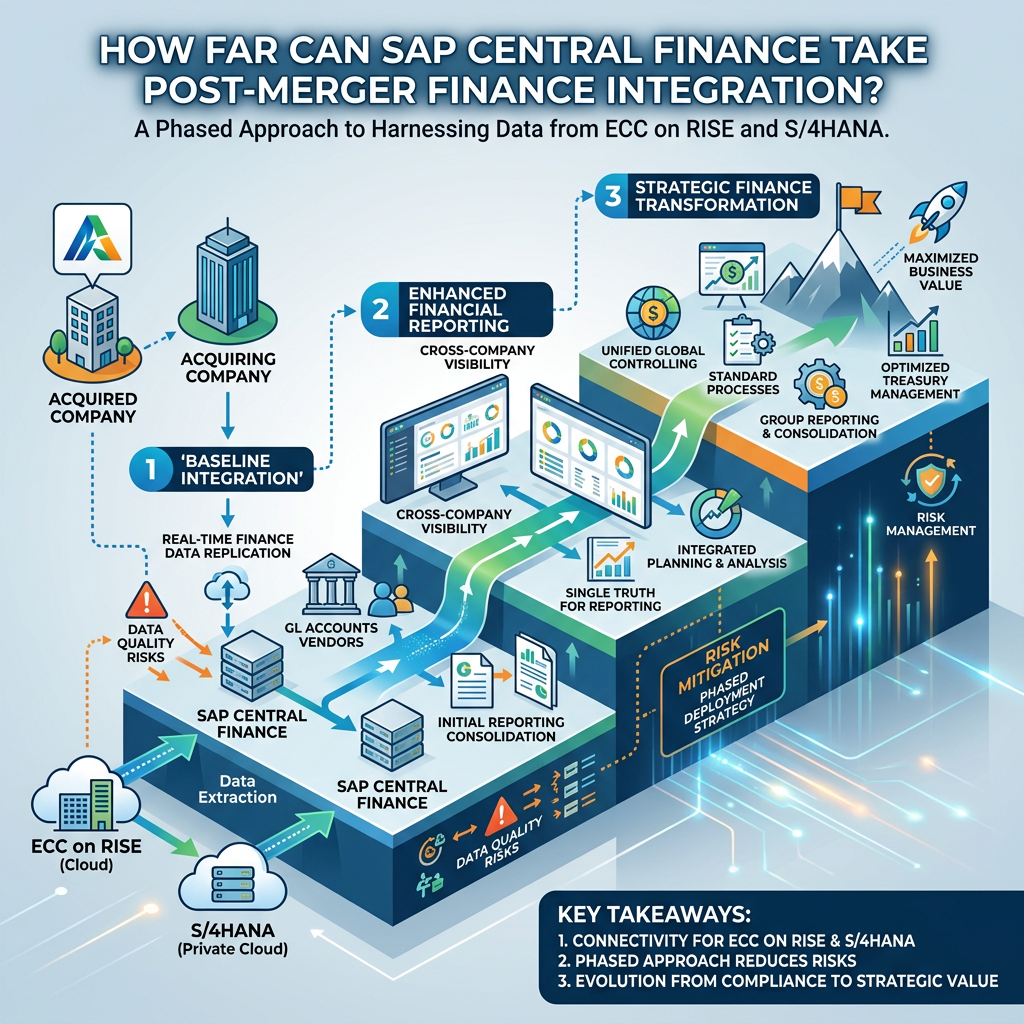
Post-merger integration (PMI) almost always starts with the same demand from the executive team: “Show us the numbers for the entire group, quickly and on a consistent basis.” Yet ripping out and replacing every acquired company’s ERP in one go is rarely realistic, given the cost, the timeline, and the operational risk involved.
This is where SAP S/4HANA for central finance (SAP Central Finance) comes in. It lets each entity keep running its existing ERP while its financial data is replicated in real time into the parent company’s SAP S/4HANA system and consolidated in the Universal Journal (ACDOCA).
In this article, we use a fictional corporate group to assess how far SAP Central Finance can actually take you in financial integration. Every key point is backed by official SAP documentation, and we clearly separate our own inferences from points that could not be confirmed in published sources.
1. The Scenario: A Typical Post-Merger SAP Landscape
| Entity | System | Modules in Use | Notes |
| Parent company | SAP S/4HANA Cloud Private Edition (new implementation) | Used as the Central Finance system | Integration target |
| Site A (acquired subsidiary) | SAP ECC 6.0 on RISE | SD / MM / FI / CO | Broad use of standard SAP processes |
| Site B (acquired subsidiary) | SAP S/4HANA on-premise | FI only | Sales, purchasing, production, etc. run on custom-built (in-house) systems that interface with FI |
This is a common pattern after a merger. One company runs a legacy ECC system across a wide range of processes. The other already owns S/4HANA but uses it only for financial accounting (FI), with surrounding business processes handled by in-house systems.
2. SAP Central Finance Fundamentals: Three Key Statements from SAP
Let’s start with three statements from the official SAP documentation that form the basis of this assessment.
Quote 1: What gets integrated
“You can then replicate financial accounting and management accounting postings to your Central Finance system.” — SAP Help Portal: Central Finance Overview
Quote 2: Where it gets integrated
“In your SAP S/4HANA system, FI documents and CO postings are combined into one document; the universal journal entry.” — SAP Help Portal: Central Finance Overview
Quote 3: Which systems can be connected
“SAP S/4HANA systems” / “SAP ERP releases as source systems that are still in maintenance starting from SAP ERP 6.0.” — SAP Help Portal: Central Finance Guide (2023)
SAP S/4HANA Cloud Private Edition, which the parent company is implementing in our scenario, is also supported as the target system.
“The terms target system and Central Finance system both refer to the SAP S/4HANA system or SAP S/4HANA Cloud, private edition to which you want to transfer your data.” — SAP Help Portal: Central Finance Guide (2023)
The standard architecture connects multiple source systems to a single SLT (SAP Landscape Transformation Replication Server), which in turn feeds one Central Finance system.
“In a typical set-up, multiple source systems are connected to one System Landscape Transformation Replication Server which in turn is connected to one Central Finance system.” — SAP Help Portal: Central Finance Overview
Key point: The landscape in our scenario (parent on S/4HANA Private Cloud, plus ECC and S/4HANA on-premise) is a standard, fully viable SAP Central Finance pattern.
3. The Evaluation Principle: “If It Isn’t Recorded at the Source, It Won’t Be Integrated”
SAP Central Finance replicates accounting documents and CO data created in the source systems. It follows that data from modules a source system does not use will never reach Central Finance (author’s inference).
In a post-merger ERP assessment, then, the benefits you can expect depend far more on which modules each entity actually uses, and how extensively, than on which ERP product it runs.
4. Assessing Site A (ECC on RISE: SD, MM, FI, CO)
The broadest replication scope
Because Site A makes extensive use of standard SAP processes, it can take advantage of virtually every replication capability Central Finance offers.
- Cost object replication: Production orders can be mapped to product cost collectors or internal orders.
“PP Production Order | Product Cost Collector | N:1” — SAP Help Portal: Central Finance Guide (2023) - Commitment replication for purchasing
“Replication of commitments and commitment updates for purchase requisitions and purchase orders.” - Logistics data replicated for accounting purposes (AVL: Accounting View of Logistics Information): Covers sales documents, customer invoices, purchasing documents, and supplier invoices.
“The AVL is only supported for source systems of SAP ERP 6.0 EhP3 and higher, including SAP S/4HANA systems. (Replication of purchasing document is only supported for source systems of SAP ERP 6.0 EhP4 and higher.)” - Material cost estimate replication
“Replication of Material Cost Estimates”
(All quotes above are from the SAP Help Portal: Central Finance Guide (2023).)
Caveat 1: Costing-based CO-PA does not carry over as is
If Site A runs costing-based profitability analysis (Costing-Based CO-PA) in ECC, Central Finance receives the data in account-based Margin Analysis, and value fields are not replicated.
“In the Central Finance scenario, during ongoing replication, only the characteristics are replicated from the source system to the Central Finance system with Margin Analysis (CO-PA) and stored in the universal journal (table ACDOCA).” “Value fields are not included in FI replication to Central Finance.” — SAP Help Portal: Central Finance Guide (2023)
Profitability analysis will need to be redesigned for post-integration management reporting.
Caveat 2: A source system is supported only while it remains in maintenance
A source system must be “still in maintenance” (Quote 3). The maintenance timeline for ECC 6.0 (EHP 6–8) is as follows:
“mainstream maintenance ends on December 31, 2027, followed by optional extended maintenance through the end of 2030” — BMC
The “SAP ERP, private edition, transition option” for RISE customers covers 2031 to 2033, but SAP has made clear that it is not a maintenance extension.
“SAP states that it is not a maintenance extension for SAP ERP.” — SAPinsider
We could not confirm in official sources whether Site A will remain officially supported as a Central Finance source system from 2031 onward. This needs to be verified directly with SAP.
Site A at a glance
- Integration benefit: High (financial accounting, management accounting, logistics data, and product costing can all be integrated)
- Implementation complexity: Medium to high (master data mapping, CO-PA redesign)
- Timeline risk: Yes (2027 / 2030)
5. Assessing Site B (S/4HANA On-Premise: FI Only, Plus Custom Systems)
“It’s already S/4HANA, so it’ll be easy” is not a safe assumption
Because Site B runs S/4HANA, its source system already has ACDOCA.
“If you have an SAP S/4HANA source system, you can use table ACDOCA.” — SAP Help Portal: Central Finance Guide (2023)
However, Site B uses FI only. As a result, CO internal postings, cost objects, commitments, logistics data (AVL), and profitability analysis characteristics will not flow from Site B (author’s inference).
The biggest risk: how the custom systems post to FI
If the custom systems post into Site B’s FI via ALE (for example, using IDocs), those documents cannot be correctly replicated to Central Finance.
“Documents created via ALE in the source system cannot be replicated correctly to the Central Finance system. In the ALE scenarios, postings are processed in a simplified manner, which is not compatible with the Central Finance scenario and could result in missing or inconsistent postings in the Central Finance system.” — SAP Help Portal: Central Finance Guide (1909)
Likewise, if details specific to the custom systems are stored in custom tables (Z tables), that data will not be replicated.
“Transactional data that is stored in supplementary tables in the source system is not replicated to Central Finance.” — SAP Help Portal: Central Finance Guide (2023)
The official documentation does not clearly state whether postings made via BAPI or RFC are free of issues, so we could not confirm this. It should be validated through hands-on testing.
An alternative: connect the custom systems directly
Another option is to connect the custom systems directly to Central Finance as third-party (non-SAP) source systems (SAP KBA 3619145). In that case, however, only the logistics fields needed for the specific scenario are replicated.
“Therefore, only the field values relevant for this scenario are replicated.” — SAP Help Portal: Central Finance Guide (2023)
Site B at a glance
- Financial accounting (general ledger, AP/AR) integration benefit: High (provided postings are not made via ALE)
- Management accounting integration benefit: Low (with no CO data at the source, cost center and profit center derivation must be designed from scratch in Central Finance)
- Biggest risk: The interface method
6. Side-by-Side Comparison
| Area | Site A: ECC (SD/MM/FI/CO) | Site B: S/4HANA (FI only + custom systems) |
| General ledger and AP/AR integration | High | High (if postings are not made via ALE) |
| Management accounting (cost centers, orders, profitability analysis) | High (costing-based CO-PA requires redesign) | Low |
| Logistics data and commitments | High | None (limited fields only, even with a non-SAP connection) |
| Product costing | Medium to high | None |
| Central Payment | Supported | Supported (AP/AR is managed in FI) |
| Implementation complexity | Heavy master data mapping effort | Investigation and possible rework of posting methods |
| Future risk | ECC end of maintenance | Low |
Lesson learned: A newer ERP does not automatically mean an easier integration. The benefits of financial integration are determined not by “which product” but by “which modules are used the standard way.”
7. Group-Wide Benefits
Despite the differences between sites, the following benefits apply across the entire group.
- A common reporting structure across the group
“map the different accounting entities (for example, account, profit center, or cost center) in your source systems to one common set of master data in the Central Finance system.” — SAP Help Portal: Central Finance Overview - No additional MDG license required for mapping functions only
“An extra license for MDG is not required if you only want to use the mapping functions and not the master data distribution functions.” - Process centralization: Central Payment, Central Asset Accounting, Central Projects (WBS), Central Tax Reporting, and more can be consolidated at the parent company.
- Central Payment for intercompany AP/AR only (SAP S/4HANA 2022 and later)
“Starting from SAP S/4HANA 2022, it’s also possible to activate Central Payment only for intercompany AP/AR line items of a company code.” - Centralized error handling
“Errors from all the replication scenarios are handled in the Central Finance System using SAP AIF.”
(Quotes from the MDG item onward are from the SAP Help Portal: Central Finance Guide (2023).)
8. Constraints That Are Easy to Overlook
- Central Payment cannot be reversed once activated.
“You cannot deactivate Central Payment once it’s activated.” - Document splitting and document summarization settings must match between the source and Central Finance systems.
“The settings of document splitting need to be set up the same way in the source and Central Finance systems.” - Some documents are out of scope. Parked documents, recurring entries, and balance carryforward items are not replicated, nor are long texts or attachments.
(All quotes above are from the SAP Help Portal: Central Finance Guide (2023).)
It is also reasonable to assume that group consolidation, including intercompany eliminations, will be handled separately from Central Finance, for example with SAP S/4HANA Group Reporting (author’s inference; the sources referenced here do not address this directly).
9. Recommended Approach After a Merger
- Assess the current state: Inventory each entity’s modules in use, the ECC enhancement package (EhP) level, the CO-PA approach (costing-based or account-based), and how peripheral systems post into FI (ALE/IDoc, BAPI, file upload, etc.).
- Define the master data strategy: Establish group standards for the chart of accounts, profit centers, cost centers, business partners, and more, and map them using MDG mapping.
- Choose a connection approach for each entity: For a case like Site B, compare “connecting via S/4HANA” with “connecting the custom systems directly as non-SAP sources.”
- Roll out in phases: Start with financial accounting integration (the reporting platform), then expand to management accounting, Central Payment, and asset accounting.
- Plan the end state: For an ECC system nearing end of maintenance, such as Site A, integrate its finance through Central Finance first, and plan the subsequent move to S/4HANA in parallel.
Summary
- SAP Central Finance is a strong option for integrating finance in the Universal Journal after a merger, while each entity continues running its existing ERP.
- The integration benefits vary significantly depending on each entity’s module footprint. An ECC system using SD, MM, FI, and CO can deliver greater benefits than an S/4HANA system using FI alone.
- How peripheral systems post into FI (ALE in particular) and the ECC end-of-maintenance timeline are two items that must be checked at the very start of any assessment.
This article is an illustrative assessment based on publicly available information. For an actual project, base your decisions on the latest SAP Notes, release information, and direct confirmation with SAP.
Reference Links
- SAP Help Portal: Central Finance Overview
- SAP Help Portal: Central Finance Guide (2023)
- SAP Help Portal: Central Finance Guide (1909)
- SAP KBA 3619145: Replication from Non-SAP Systems via External Interface
- BMC: A Job Readiness Plan for SAP ECC End of Mainstream Maintenance
- SAPinsider: SAP Support Deadlines: Planning for 2027, 2030, and 2033
- SAP News: Updates for SAP ERP, Private Edition, Transition Option
Disclaimer
Parts of this article were developed with reference to generative AI suggestions and were reviewed, refined, and supplemented based on the author’s professional expertise and judgment.

Leave a Reply