Executive Summary
This article explores how commercial vehicle OEMs such as Mitsubishi Fuso Truck and Bus Corporation can maximize enterprise integration synergies from large‑scale corporate integrations by strategically positioning SAP S/4HANA as the core ERP platform and governance backbone. It is written from a project management perspective, assuming a context similar to the planned integration of Mitsubishi Fuso and Hino into a new company under Toyota and Daimler Truck, and focuses on how to translate business synergies into concrete ERP, architecture, and governance decisions.
1. External Environment of Commercial Vehicle OEMs
The external environment of commercial vehicle OEMs can be organized into four drivers: decarbonization, electrification and hydrogen competition, customer requirements, and corporate integration.
First, decarbonization pressure is intensifying. Daimler Truck publicly targets “CO₂e‑free transport and passenger transport during driving operation”, which clearly signals that zero‑emission solutions are becoming a non‑negotiable strategic agenda even in the commercial vehicle segment.
Second, competition in electrification and hydrogen is escalating. Mitsubishi Fuso’s eCanter has been positioned as the world’s first series‑produced all‑electric light‑duty truck and has been delivered to customers in Japan, Europe, and the US, positioning the company as an early mover in light‑duty EV trucks. However, competition from Chinese and other global players in electric and autonomous commercial vehicles is intensifying, making it increasingly difficult for a single OEM to sustain all necessary technology investments alone.
Third, commercial vehicle–specific customer requirements differ substantially from passenger cars. Customers expect not only vehicles but also uptime, maintenance, parts supply, body‑builder integration, leasing, fleet management, and connectivity to charging or hydrogen infrastructure. This means OEMs must shift from a “sell and forget” model to a lifecycle‑oriented revenue model, where profitability depends on service, uptime, and data‑driven fleet operations rather than on vehicle sales alone.
Fourth, corporate integrations drive industry restructuring. The planned integration of Mitsubishi Fuso and Hino is framed as an “equal footing” integration, with the new company expected to employ over 40,000 people and focus on collaboration in vehicle development, procurement, and production. AP News and other sources highlight collaboration in “vehicle development, procurement, and production” as a core integration theme, emphasizing that this is not just a scale‑up but an attempt to bundle R&D, sourcing, manufacturing, and capital‑intensive technology investments across companies.
2. SWOT View of Commercial Vehicle OEMs
Strengths
Commercial vehicle OEMs possess strong domestic and global sales and service networks, robust vehicle development capabilities, and deep, long‑accumulated know‑how in quality and manufacturing. For companies like Mitsubishi Fuso, field experience with vehicles such as the eCanter gives them a rare advantage as early movers in electric commercial vehicles.
Moreover, the planned integrated company with more than 40,000 employees implies significant potential scale advantages across development, procurement, production, sales, and service operations.
Weaknesses
At the same time, existing systems and legacy business processes are often highly complex. Model variants, bodies, configurations, market‑specific regulations, service parts, and global sales channels intertwine, creating a high‑entropy environment. In a corporate integration scenario, material codes, BOM structures, sales channels, warranty policies, cost structures, accounting standards, and plant operations are likely to differ by company, making harmonization a non‑trivial challenge.
Further, when certification or quality issues occur, the absence of accurate traceability, change history, parts composition, and shipment records in the core system directly translates into enterprise risk. For commercial vehicle OEMs, where each vehicle is tightly tied to customer operations, the lack of robust digital traceability becomes a particularly critical weakness.
Opportunities
The most significant opportunity lies in synergies from integration:
- Consolidated procurement
- Parts and platform commonization
- Shared development and production footprints
- Mutual utilization of sales and service networks
- Joint investments in EV and hydrogen technologies
The Asia‑Pacific region offers strong structural demand in urban logistics, public transportation, construction, and infrastructure, providing substantial growth potential for decarbonized commercial vehicles.
In addition, OEMs can expand their business model from pure vehicle sales to services, maintenance, fleet management, and utilization of operational data. When deploying SAP, the ERP system should be architected not merely as a transactional backbone but as the management platform that supports lifecycle revenue from vehicles and services.
Threats
Commercial vehicle OEMs face threats from price competition, the financial burden of electrification investment, supply chain constraints, stricter regulations, and the rapid rise of Chinese manufacturers. Media such as the Financial Times interpret the Mitsubishi Fuso–Hino integration as a strategic response to intensified competition from Chinese players in electrification and autonomous driving.
Because commercial vehicles form part of customers’ operational infrastructure, vehicle downtime, parts shortages, or quality issues can directly cause customer business interruptions. Therefore, visibility and resilience across supply chains and service parts networks effectively become core components of competitive advantage.
3. Strategic Direction for Commercial Vehicle OEMs
The strategic direction for commercial vehicle OEMs can be summarized in a single shift:
From “a company that sells vehicles” to “a company that provides commercial mobility uptime and value”.
To realize this shift, five strategic imperatives are essential.
First, manage integration synergies through management KPIs. Procurement cost reduction, parts commonization ratios, inventory reduction, development lead time reduction, plant utilization, and service parts fill rates should be defined as post‑integration common KPIs.
Second, embed electrification and hydrogenization not only in product strategy but also into core business processes and systems. For EVs, the scope of management extends to batteries, charging infrastructure, leasing schemes, warranties, collection, and reuse. Traditional vehicle BOM and parts management alone is no longer sufficient.
Third, build a digital thread connecting BOM, cost, quality, sales, and service. Because commercial vehicles often feature significant specification differences, body variations, and operating conditions on a unit basis, seamless information flow from design through manufacturing, sales, and maintenance constitutes a key competitive advantage.
Fourth, position service businesses as a major revenue pillar. Maximizing vehicle uptime requires integrated management of service contracts, preventive maintenance, service parts inventory, dealer collaboration, and warranty processes.
Fifth, balance post‑integration process standardization with regional flexibility. OEMs should pursue global templates while ensuring flexibility for country‑specific regulations, tax regimes, sales practices, and dealer network characteristics.
4. Architecture Strategy for SAP Implementations
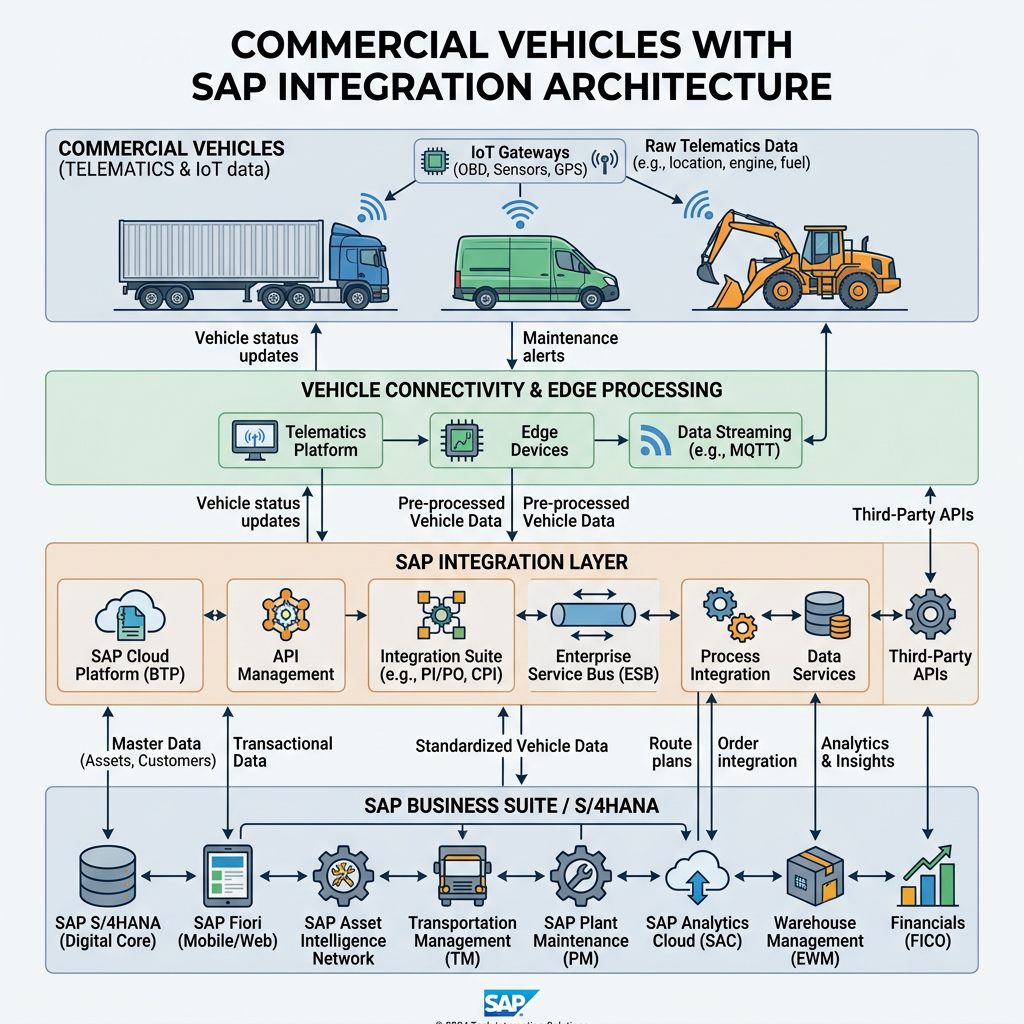
Assuming SAP as the core ERP platform, a pragmatic architecture strategy for commercial vehicle OEMs in a corporate integration scenario could take the following form.
4.1 Position S/4HANA as Integrated Management Core
After integration, financials, management accounting, procurement, inventory, production, sales, and service must be connected through a common data model. SAP S/4HANA should be positioned as the central platform to provide this continuity.
Critically, S/4HANA needs to unify fragmented accounting, material master data, BOMs, purchasing, inventory, and cost structures that were previously separated by company, plant, or brand. Integration synergies only become measurable and manageable once data structures are harmonized and comparable within the ERP system.
4.2 Adopt a Clean Core Principle
In corporate integration programs, trying to accommodate every legacy process from each company will inevitably complicate the core system. Therefore, SAP standard capabilities must be leveraged to the maximum, and non‑differentiating processes should be standardized wherever possible.
SAP Business Technology Platform (SAP BTP) is positioned by SAP as enabling customers to “integrate, automate, extend, and build AI‑supported business applications”, emphasizing that integration and extension should be decoupled from the ERP core and implemented on the platform side. Anchoring extensions in BTP and adhering to a Clean Core principle reduces technical debt and preserves the agility needed for future business model evolution.
4.3 Avoid Fragmentation Across PLM, ERP, MES, and Service
For commercial vehicle OEMs, E‑BOMs, M‑BOMs, routings, production orders, quality data, costs, and service parts must be tightly linked. PLM becomes the source of design information, ERP the source for execution and financials, MES the source for shop‑floor reality, and service systems the source for in‑field lifecycle data.
It is essential to clearly define which system holds the master record for each domain. For example, design BOMs reside in PLM; manufacturing BOMs and inventory‑related cost structures in ERP; operational execution and performance data in MES; and vehicle uptime and service history in the service platform. These systems should then be integrated through well‑governed interfaces rather than overlapping master responsibilities.
4.4 Define an Integrated Master Data Strategy Upfront
The biggest risk in corporate‑integration SAP programs is to leave data integration policies vague while designing business processes. Materials, business partners, BOMs, equipment, plants, sales locations, dealers, vehicles, VINs, service parts, and warranty conditions directly impact post‑integration management and reporting.
Therefore, OEMs should consider master data governance solutions such as SAP MDG to define data ownership, approval processes, coding schemes, and data quality KPIs at the integrated‑company level. This governance framework should precede detailed process design and be treated as a core management decision.
4.5 Template Commercial Vehicle–Specific Processes
Commercial vehicle OEMs must handle more complex individual specifications, body‑builder coordination, fleet sales, service contracts, parts supply, warranties, recalls, and long‑term maintenance than passenger car OEMs. Consequently, SAP templates should explicitly include:
- Integrated demand, production, and procurement planning
- Vehicle configuration management
- Order‑specific specification management
- BOM and routing integration
- Supplier collaboration and JIT/JIS processes
- In‑plant logistics and finished vehicle distribution
- Dealer sales, warranty, service parts, and profitability analysis
Codifying these processes in a reusable SAP template accelerates deployment and supports consistent governance across regions and brands.
4.6 Direct Data, AI, and Analytics Platforms to Management Control
Post‑integration management requires mechanisms to measure and track synergy realization. SAP Datasphere, SAP Analytics Cloud, SAP Business Data Cloud, and surrounding data platforms can be used to visualize management KPIs.
Key KPIs may include procurement price variances, common parts ratios, inventory turns, stock‑out rates, on‑time delivery, warranty cost ratios, vehicle profitability, service contract penetration, plant‑level cost performance, and quantified synergy realization amounts. Connecting these KPIs to transactional data in S/4HANA and related systems ensures that management reporting reflects real operational outcomes.
5. Implementation Principles for Project Managers
In SAP programs involving corporate integration, project managers play the role of enterprise integration designers rather than mere schedule controllers.
First, Fit‑to‑Standard must not be misunderstood as “forcing the business to conform to SAP”. Properly understood, it is a management process for deciding which processes should be differentiated and which should be standardized across the integrated company.
Second, synergy KPIs should be explicitly embedded in the project charter. Examples include target percentages for procurement cost reductions, parts commonization increases, inventory day reductions, and financial closing acceleration. In this way, SAP implementation objectives are directly linked to business outcomes.
Third, an Architecture Board should be established. Without a central body to govern system boundaries across PLM, SAP, MES, dealer systems, service platforms, and data platforms, integration architecture will inevitably become fragmented. Architecture principles should be defined upfront, with exceptions requiring explicit management approval.
Fourth, deployment waves should be designed not only by company but also by value domain. For instance, finance and procurement integration can be prioritized, followed by production and inventory, and finally service and dealer collaboration, in line with the sequence that maximizes synergy realization.
Fifth, simple migration of legacy systems must be avoided. Directly transplanting pre‑integration processes from each company into S/4HANA yields little competitive advantage for the integrated entity. Instead, SAP implementation should be used as a once‑in‑a‑generation opportunity to define and embed a new operating model.
6. Conclusion
For commercial vehicle OEMs such as Mitsubishi Fuso Truck and Bus Corporation, future competitiveness will depend not only on vehicle engineering capabilities but also on how quickly electrification, decarbonization, service monetization, supply chain resilience, and integration synergies can be operationalized in management systems.
The essence of SAP implementation is not simply “installing ERP”. It is about deciding, as an integrated enterprise, which processes to standardize, which to differentiate, and which data to rely on for steering the business.
Accordingly, the recommended architecture direction for commercial vehicle OEM SAP strategies is as follows: position S/4HANA as the central integrated management platform, adhere to a Clean Core principle, connect PLM, MES, service, and data platforms via loosely coupled integration, and manage corporate integration synergies through clearly defined KPIs supported by analytics platforms.
This is the architectural north star that SAP program managers in commercial vehicle OEMs should pursue when leading core system integration initiatives.
Reference Links
Commercial Vehicle Industry
- Toyota Global Newsroom
“Daimler Truck, Mitsubishi Fuso, Hino and Toyota Motor Corporation Conclude Definitive Agreements on Integrating Mitsubishi Fuso and Hino Motors”
Toyota Global Newsroom - Daimler Truck Investor Relations
“Definitive Agreements on Integrating Mitsubishi Fuso and Hino Motors”
Daimler Truck Investor Relations
Electrification
- Mitsubishi Fuso Truck and Bus Corporation
“FUSO eCanter”
Mitsubishi FUSO eCanter - Daimler Truck
“Sustainability – Planet”
Daimler Truck Sustainability
SAP Enterprise Architecture
- SAP
“SAP Business Technology Platform”
SAP Business Technology Platform - SAP
“Clean Core”
SAP Clean Core Strategy - SAP
“Customer Story: Mitsubishi FUSO”
SAP Customer Story: Mitsubishi FUSO
Enterprise Architecture
- The Open Group
“TOGAF® Enterprise Architecture Standard”
The Open Group TOGAF Standard
Disclaimer
Parts of this article were developed with reference to generative AI suggestions and were reviewed, refined, and supplemented based on the author’s professional expertise and judgment.

Leave a Reply