Why This Article Matters
The most common failure in the early phases of Enterprise Architecture (EA) work is not weak technical design. It is misreading the business strategy — or moving forward while that strategy remains vague. Phase A of the TOGAF® ADM (Architecture Vision) exists precisely to eliminate that risk, and the standard explicitly lists “to validate the business principles, business goals, and strategic business drivers of the organization” as one of the objectives of the phase (The Open Group, Phase A: Architecture Vision).
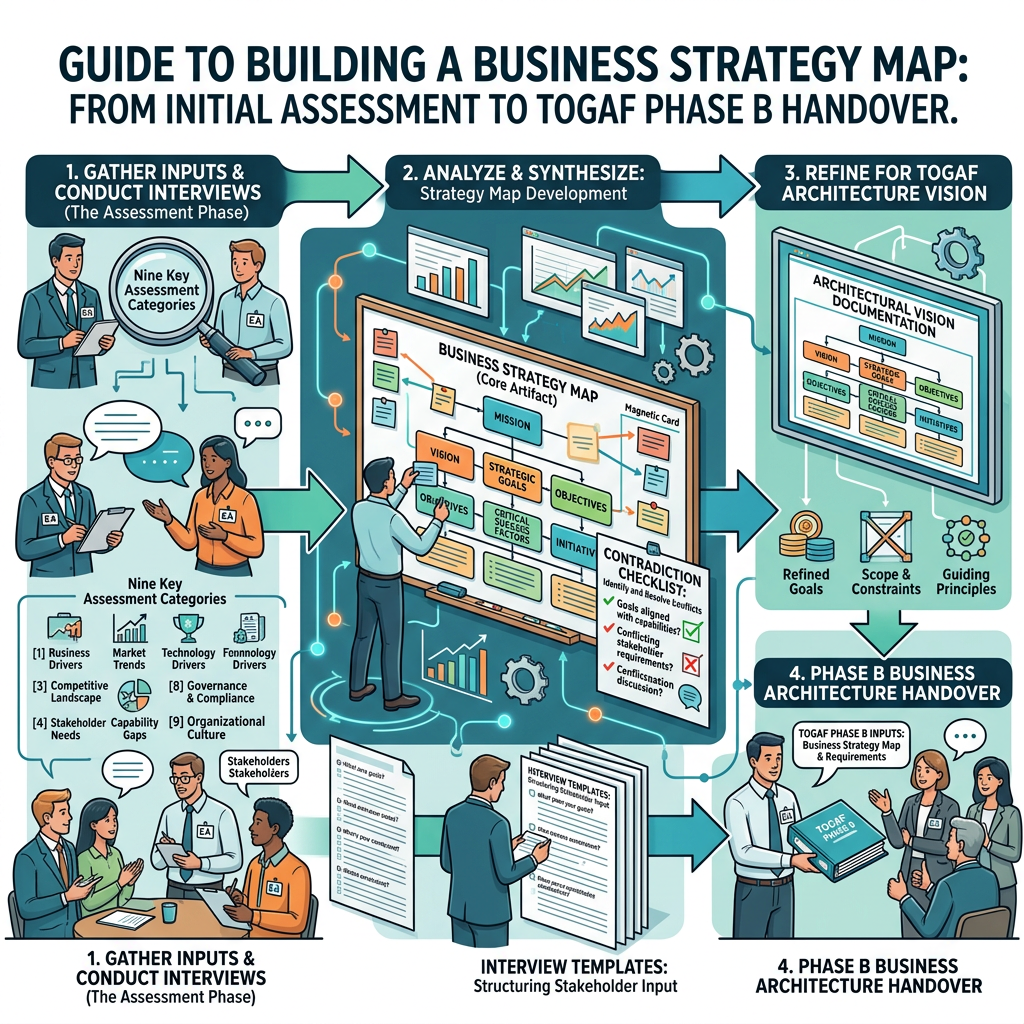
The instrument that makes this validation visible is the Business Strategy Map. This article covers, from a working Enterprise Architect’s perspective:
- What a Business Strategy Map is, and where it sits within TOGAF®
- The items to confirm and question during a Business Strategy Assessment, organized into nine categories
- Ready-to-use interview templates and a worked example (manufacturing / SAP S/4HANA context)
- How to hand the output over to Phase B and beyond
1. A Business Strategy Map Is Not a Mandatory TOGAF® Deliverable
Let us be precise about the premise. The Business Strategy Map is not a formal deliverable defined by the TOGAF® standard. What TOGAF® does list as an input to Phase A is “Business Strategy, Business Principles, Business Goals and Business Drivers (when pre-existing),” and the outputs include the “Approved Statement of Architecture Work” together with “refined statements of Business Principles, Business Goals and Strategic Drivers” (The Open Group, Phase A).
In other words, the Business Strategy Map is a working artifact that converts that input into that output — structured input, refined statements out. Because the standard does not name it, you are free to design it around how your organization actually operates.
The typical structure is a vertical chain of causality.
External and internal drivers
↓ why now
Business strategy (strategic themes)
↓ what must be achieved
Business goals + quantified objectives / KPIs
↓ what the business must become able to do
Business capabilities / value streams
↓ how it will be realized
Architecture requirements and candidate initiatives
↑ what constrains all of the above
Business principles, constraints, risks
This resembles a Balanced Scorecard strategy map, but the EA version differs in one decisive respect: the bottom layer connects to capabilities and architecture requirements. A map without that connection ends up as a handsome slide for the board and nothing more.
2. How to Build It: Five Recommended Steps
Step 1: Inventory existing documents — always before any interview
Read the mid-term business plan, board materials, divisional annual plans, the previous IT roadmap, and audit findings first. An Enterprise Architect who tries to extract strategy from scratch burns executive time and forfeits credibility.
Step 2: Draft first, then verify
Build a draft strategy map from the existing documents, however incomplete. Designing interviews as “verification of a draft” rather than “questions on a blank page” improves quality dramatically.
Step 3: Interview by layer
- Executives (30–45 min): strategic themes, non-negotiable constraints, the definition of success
- Business unit heads (60 min): quantification of goals, operational pain, priorities
- Process owners (60–90 min): the reality of the value stream, the volume of exceptions
Step 4: Detect and surface contradictions
Eighty percent of a strategy map’s value lies in having made the contradictions visible. Use the checklist below.
Step 5: Secure stakeholder approval
A Phase A output that is not approved is meaningless; the standard frames the output as an approved Statement of Architecture Work (The Open Group, Phase A). Record unresolved points as open issues, each with a decision deadline and a named decision maker.
3. Business Strategy Assessment: Nine Categories of Questions
This is the core of the article. Each category includes the question, the architect’s reason for asking, and the warning signs.
Category 1: Understanding the Strategy Itself
| Question | Why an architect asks |
| Which mid-term plan is current, when was it approved, and when is the next revision? | An architecture built on a stale strategy is obsolete on day one |
| Is the primary thrust growth, profitability, differentiation, or cost leadership? | Standardization-first and differentiation-investment lead to opposite architectures |
| What is the scope: which businesses, regions, and product lines? | Undefined scope is the single largest source of downstream rework |
| Is there an intent to change the business model itself (servitization, direct sales, M&A, dissolving a joint venture)? | It changes the premise of process design |
| What assumptions does the strategy rest on (market growth, FX, regulation, raw material prices)? | These become the flexibility requirements for the architecture |
Warning signs: “We have a strategy, but nobody refers to it.” “Each division has its own separate strategy deck.”
Category 2: Drivers — Why Now?
TOGAF® positions the identification of the organization’s strategic drivers as an activity of Phase A (The Open Group, Phase A).
- External drivers: regulatory change, customer or OEM requirements, competitive moves, technology shifts, sustainability reporting obligations
- Internal drivers: end of support for core systems, talent shortages and retiring expertise, site consolidation, quality or recall issues, audit findings
- Identify the time trigger: can the organization answer “why now” with a date? End-of-support dates, statutory effective dates, IPO or reporting deadlines, plant start-up dates.
A practical tip: classify drivers as regulatory (unavoidable), competitive (discretionary), or internal (deferrable). Roadmap prioritization then almost determines itself.
Category 3: Decomposing Goals and Objectives into Measurable Terms
| Question | What you are confirming |
| Are strategic goals decomposed into quantified objectives with values and deadlines? | If not, the architect proposes the decomposition |
| Who owns each KPI, and what is its calculation logic? | An ambiguously defined KPI makes benefit measurement impossible |
| Is the current baseline actually measured? | An improvement target without a baseline cannot be verified |
| How does this connect to financial measures (revenue, cost ratio, inventory turns, ROIC, working capital)? | You will need this in the investment decision forum |
| Have trade-offs between objectives been prioritized? | Cost reduction and lead-time reduction rarely coexist |
A worked decomposition (manufacturing)
- Strategic theme: strengthen the resilience of the global supply network
- Business goal: shorten recovery time when a critical component supply is disrupted
- Quantified objective: reduce switchover lead time to an alternate source from 21 days to 7 days by March 2028
- Required capabilities: supplier risk visibility, maintained alternate-part master data, multi-sourcing operations
- Architecture requirements: unified supplier master, a data model for part substitution relationships, integration of external risk data
Category 4: Business Principles and Constraints
TOGAF® states plainly that architectural constraints will normally be informed by the business principles and architecture principles (The Open Group, Phase A).
- Are business principles documented (for example: global standard first, fit-to-standard, data mastered at the source, acquisitions conform to the standard template)?
- Are the principles merely declared, or is there a record of them actually governing a decision?
- Non-negotiable constraints: budget ceilings, no-downtime windows (financial close, peak production), regulation, existing contracts and licences, labour agreements
- Where is the line between corporate mandate and local discretion? Is there a target for template adoption?
Warning sign: an organization that says “fit-to-standard” while carrying hundreds of historical exception approvals. In that case the principle does not effectively exist, and the architect should begin by redefining it.
Category 5: Capabilities and Value Streams
This is the layer that connects strategy to systems, and where an Enterprise Architect adds the most value.
- Can the capabilities required to deliver the strategy be enumerated (typically 30–50, well structured)?
- What is the current maturity of each (for example: 1 = ad hoc, 2 = partially standardized, 3 = standardized, 4 = measured and managed, 5 = continuously improved)?
- Which value streams are affected (order to cash, design to production, source to pay, concept to market)?
- Are capabilities classified as differentiating (build it), standardizing (conform to the package), or non-core (outsource)?
- Who is the process owner, and which sites are in scope?
The differentiating-versus-standardizing classification becomes the very basis for later fit-to-standard judgements and add-on investment decisions. Entering an implementation project with this left vague turns requirements definition into a scope tug-of-war.
Category 6: Stakeholders and Their Concerns
Phase A aims to articulate an architecture vision that addresses stakeholder concerns and objectives (The Open Group, Phase A).
- Have the decision makers, the sponsor (budget holder), and the affected functions been identified?
- What is each stakeholder’s definition of success, and do those definitions agree?
- Where are the conflicts (corporate standardization versus local business specifics, sales lead time versus factory levelling)?
- Where is resistance expected, and how much change management will it demand?
- Who holds a de facto veto — including the influential figures who do not appear on the org chart?
A practical tip: record concerns in the stakeholder’s own words. Summarized concerns get overturned in the approval meeting with “that is not what I meant.”
Category 7: Baseline and Existing Assets
- Do existing architecture documents, baseline descriptions, and system landscape diagrams exist, and when were they last updated?
- Has a comparable initiative been attempted before? Why did it fall short — technically, or organizationally?
- What are the support contracts, licences, and end-of-life dates for current systems?
- What projects are already in flight, and where do they overlap or conflict with this vision?
- What is the actual state of data quality (master duplication rates, where manual spreadsheets intervene)?
Roughly eighty percent of past failures are organizational in origin. Resubmitting a technically correct vision will meet the same wall, so always ask.
Category 8: Risks, Assumptions, and Dependencies
- Identify risks to strategy delivery (market, execution, talent, technology, cyber) with impact and likelihood
- Dependencies on other initiatives (reorganization, new sites, a third party’s system migration)
- Dependency on the capability of suppliers and partners to respond
- Alternative scenarios if assumptions break (tighter regulation, demand collapse, FX shock)
- Named owner and deadline for each mitigation
Following TOGAF’s approach to risk management, record initial risk and residual risk after mitigation separately. The quality of the Statement of Architecture Work improves accordingly.
Category 9: Value Realization and Governance
- The conditions under which the business case holds (investment, payback period, assumptions behind NPV and IRR)
- Who carries the benefit in their P&L — an investment with no function accountable for booking the benefit does not get realized
- The benefit tracking mechanism: who measures what, when, and reports it where
- Architecture governance: the composition of the EA board, meeting cadence, decision rights
- The exception approval process and the method of compliance assessment
- Who approves the Phase A output, the Statement of Architecture Work (The Open Group, Phase A)
4. Contradiction Checklist: Run This Before You Submit
- A strategic theme with no driver behind it (you cannot explain why you are doing it)
- A business goal with no quantified objective (achievement cannot be judged)
- A KPI with no measured baseline
- A capability investment that maps to no strategic theme (scope creep)
- A strategic theme with the required capabilities left blank (no means of delivery)
- Mutually contradictory objectives listed side by side with no priority
- Constraints (no-downtime windows, budget ceilings) that are physically irreconcilable with the schedule
- An initiative with no function accountable for booking the benefit
- A capability with no owner
- Exceptions to a principle that have become the norm
When you find a contradiction, the architect’s priority is not to resolve it but to get the decision maker to decide it. The role of the Enterprise Architect is not to ghost-write the strategy; it is to present the decisions that must be made.
5. Handing the Map Over to the Next Phase
| Strategy Map element | Primary destination |
| Drivers and strategic themes | Architecture Vision document, Statement of Architecture Work |
| Business goals and KPIs | Benefits management plan, Architecture Requirements Specification |
| Business principles and constraints | Architecture Principles, constraints section of the Architecture Definition Document |
| Capabilities and maturity | Phase B (Business Architecture), gap analysis |
| Differentiating / standardizing classification | Fit-to-standard policy, add-on investment criteria |
| Stakeholders and concerns | Stakeholder map, selection of architecture views |
| Risks and dependencies | Risk register, Implementation and Migration Plan |
The “refined statements of Business Principles, Business Goals and Strategic Drivers” that TOGAF® requires as a Phase A output emerge naturally from this mapping (The Open Group, Phase A).
6. Interview Templates You Can Copy and Use
For executives (30–45 minutes)
- If you had to name the one thing that must be achieved in the next three years, what would it be?
- If it were not achieved, what would the cause most likely be?
- In this initiative, is there anything that absolutely must not change?
- Which number, moving to which level, would let you declare success?
- When a decision stalls, who ultimately decides?
For business unit heads (60 minutes)
- What consumes the most time in your current operations?
- What is the volume of that work, and how many people are involved?
- Are the current figures (lead time, days of inventory, rework rate) measured today?
- If you were to set a target, what level by when?
- Which issue always causes friction with other functions?
For process owners (60–90 minutes)
- Where, and by how much, does the standard process differ from actual practice?
- How often do exceptions occur each month?
- Which steps are handled outside the system, in spreadsheets, email, or by phone?
- Who creates and changes master data, and how?
- During which periods can this process not be stopped?
7. Common Pitfalls
Pitfall 1: Merely listening and transcribing.
An Enterprise Architect’s job is not transcription. Value appears when you point out the contradictions, the gaps, and the unmeasurable objectives, and press for decisions.
Pitfall 2: Skipping the capability layer and jumping to systems.
Wiring strategy directly to solutions reliably produces scope disputes later. The capability layer is tedious; do not omit it.
Pitfall 3: Circulating a map that has not been agreed.
Material that has not passed an approval process gets disowned at the inconvenient moment as “IT’s interpretation.”
Pitfall 4: Building it once and never updating it.
Strategies get revised. Synchronize the strategy map with the mid-term planning cycle and state its review date explicitly.
Summary
The Business Strategy Map is not a formal TOGAF® deliverable, yet it is the central practical instrument for converting Phase A’s inputs — business strategy, principles, goals, and drivers — into its outputs: refined statements and an approved Statement of Architecture Work (The Open Group, Phase A: Architecture Vision).
There are nine categories to confirm: the strategy itself, drivers, goals and KPIs, principles and constraints, capabilities and value streams, stakeholders, baseline, risks, and value realization with governance. And the most important point is not producing an elegant map. It is making the contradictions visible and getting the decision makers to decide.
Reference
- The Open Group, Phase A: Architecture Vision
Disclaimer
Parts of this article were developed with reference to generative AI suggestions and were reviewed, refined, and supplemented based on the author’s professional expertise and judgment.

Leave a Reply