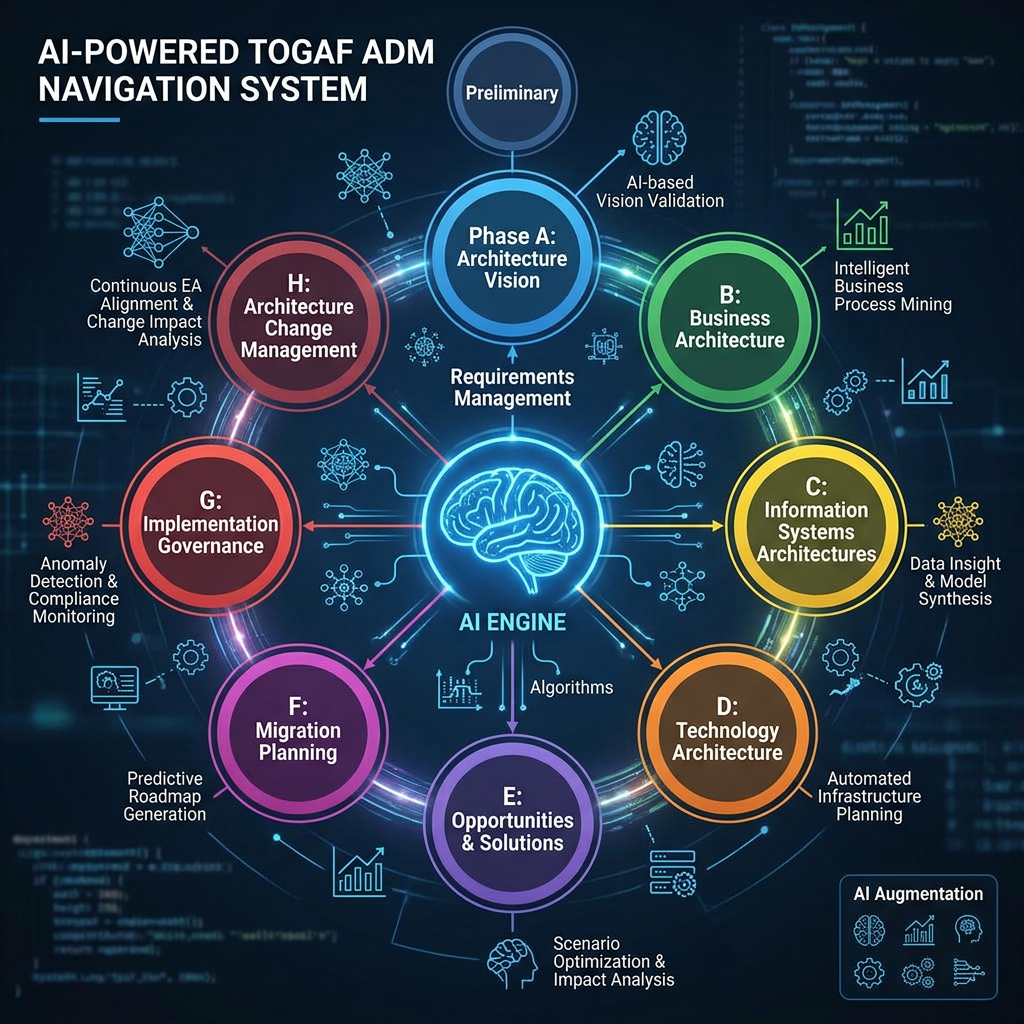
As highlighted in reference ①, AI is changing Enterprise Architecture from a “static map of the past” into a “future-oriented navigation system” that guides decision-making and transformation. In practical terms, AI shifts EA from a retrospective discipline into a forward-looking engine for innovation and execution.
From the perspective of an enterprise architect, this is a clear paradigm shift:
- Model and artifact creation moves to “AI-generated drafts + architect review.”
- The architect’s role evolves from “person who draws diagrams” to “strategic navigator who evaluates AI-generated models and links them to enterprise strategy.”
- Dependency and technical debt analysis is delegated to AI, allowing architects to focus on decisions and stakeholder alignment.
Reference ① explicitly stresses that AI is not about “robots replacing architects,” but about augmenting intelligence, automating repetitive work, and surfacing hidden insights in complex architectures. When designing TOGAF® ADM, it is therefore critical to deliberately separate “what should be automated” from “what must remain a human responsibility” in each phase.
Preliminary Phase: Using AI to Raise the Quality of the Foundation
In the Preliminary Phase, we define scope, EA principles, capability maturity, and repository structures that underpin all subsequent ADM phases. Reference ①’s emphasis on “automating monotonous work and unlocking hidden insights in complexity” directly informs how AI should be used here.
Typical AI usage patterns in the Preliminary Phase include:
- EA maturity assessment automation
- Feed assessment results and past project documentation into an LLM to generate a draft report of current EA capabilities.
- Use that report as a basis for TOGAF-compliant maturity evaluation and improvement roadmaps refined by the architect.
- Drafting EA principles and governance documents
- Provide corporate strategy and IT policies in natural language and let AI generate a draft set of EA principles.
- By designing workflows that assume transformation from natural language to structured artifacts (reference ②), you can later connect principles and policies to ArchiMate or UML models.
- Proposing repository structures
- Scan existing CMDBs and master data schemas, then ask AI to propose an EA repository structure across Capabilities, Applications, Data, and Technology domains.
- This raises the accuracy of automated discovery and model generation in later phases.
In SAP S/4HANA Private Cloud Edition or multi-instance manufacturing environments, deciding “which data sources to expose to AI” at the Preliminary Phase has a disproportionate impact on the effectiveness of all subsequent phases, both for discovery and for prescriptive analysis.
Phase A: Generating Vision and ArchiMate Views from Natural Language
Reference ② almost perfectly captures how AI should be used in Phase A (Architecture Vision).
“Imagine explaining a new customer onboarding process in plain English and, within seconds, receiving a fully structured, notation-correct ArchiMate view. That’s the promise of AI-powered EA tools.”
In Phase A, AI can significantly boost the creation of core deliverables:
- Architecture Vision document drafts
- Feed executive interview notes and strategy decks into an LLM.
- Let AI produce a draft vision document that organizes business goals, drivers, constraints, and scope, ready for architect and stakeholder review.
- Initial Value Chain and Capability Map
- Describe the current business model in natural language and have AI generate initial capability maps and value chain diagrams.
- In line with reference ③, link these maps to ArchiMate Motivation and Strategy layers to maintain traceability into later phases.
- Stakeholder maps and concerns extraction
- Provide organization charts and project structures; AI extracts stakeholders and their concerns into a structured list.
- This list becomes the starting point for an automatically drafted Architecture Contract.
In a manufacturing DX program (for example, S/4HANA roll-out for a Japanese Tier 1 supplier), you can describe target manufacturing and procurement capabilities and system boundaries in natural language, then let AI draw the first version of the target vision diagram. This dramatically reduces the startup time of stakeholder workshops and accelerates consensus building.
Phases B–D: Co-Creating Business, Application, and Technology Architectures with AI
Reference ③ clearly states that AI can generate ArchiMate artifacts for each ADM phase while preserving end‑to‑end traceability.
“Combining TOGAF ADM with ArchiMate is particularly powerful. AI can guide architects to the next stage by generating the necessary ArchiMate deliverables for each ADM phase and maintaining traceability from early phases through Architecture Change Management.”
Phase B: Business Architecture
- Automated extraction of As-Is process models
- Feed BPM tool logs, S/4HANA usage statistics, and shop-floor SOPs to AI.
- AI extracts current business processes, events, and roles, then translates them into ArchiMate Business layer views, which the architect validates.
- Prototyping To-Be processes
- Describe improvement ideas in text; AI generates BPMN or ArchiMate process drafts as workshop baselines.
Phase C: Information Systems Architecture (Application/Data)
- Automated application landscape discovery
- Scan SAP instances, MES, PLM, and legacy system connections.
- AI generates draft models of application components and interfaces, offloading the monotonous work of repository maintenance described in reference ①.
- Master data extraction and normalization proposals
- From current tables (materials, customers, suppliers, BOM), AI produces a conceptual data model draft at EA level, ready for refinement.
Phase D: Technology Architecture
- Automated infrastructure modeling
- AI analyzes cloud (AWS/Azure/GCP) and on-prem CMDB data to generate network, server, and middleware models.
- This makes it faster to visualize technical dependencies between S/4HANA Private Cloud Edition and surrounding systems.
- Technical risk and debt analysis
- Following reference ①’s “unlock hidden insights” message, AI analyzes dependency graphs to highlight legacy technology risks and cloud migration impacts before they materialize.
Phases E–G: Predictive Analytics and Natural-Language Decision Support
Reference ① highlights the shift from descriptive architecture (“what we have”) to prescriptive architecture (“what we should do”), which is especially relevant in Phases E–G.
“This is an evolution from descriptive architectures (‘what we have’) to prescriptive architectures (‘what we should do’).”
Phase E: Opportunities & Solutions
- Automated listing of migration options
- Using baseline and target models, AI can propose multiple migration scenarios (Big Bang, staged, hybrid).
- Each scenario’s benefits, risks, and impact scope can be summarized in natural language as a stakeholder-friendly briefing draft.
Phase F: Migration Planning
- Roadmap and work package drafting
- AI analyzes target architecture dependencies to generate prioritized work packages, transition architectures, and roadmaps.
- Using the traceability concepts from reference ③, these roadmaps can be automatically linked to artifacts from Phases B–D and tracked through to Change Management.
Phase G: Implementation Governance
- Natural-language impact analysis
- Ask “What if we delay S/4HANA Go-Live for this plant by one quarter?” and AI explains the impacts in natural language based on current models.
- This operationalizes reference ①’s shift from reactive to preventive governance by surfacing risks before Go-Live.
- Architecture Compliance review support
- AI scans implemented configurations, code, and infrastructure; it lists potential EA principle violations and standard deviations for architect review.
Architecture Change Management: Keeping EA Continuously Updated with AI
Reference ③’s emphasis on maintaining traceability “through to Architecture Change Management” provides the design direction for AI usage in this phase.
“…ensuring traceability from the initial phases through to architecture change management.”
Effective AI use patterns here include:
- Continuous change detection and model updates
- AI detects new SAP sites, added plants, or modified interfaces and updates the EA repository automatically.
- This mitigates the risk of EA models degenerating into purely historical documents.
- Automatic classification of change requests and impact scoping
- LLMs analyze ticket and Change Request content, then link them to impacted capabilities, applications, and technology components.
- AI-enabled EA service catalog
- When business asks, “We want to change the production planning logic only for this site,” AI provides preliminary impact analysis and response options.
- The architect then makes the final decision based on these AI-generated insights.
Summary: Designing AI as a Co-Creation Partner Across ADM
Synthesizing messages from references ①–③, AI-enabled TOGAF ADM can be designed as follows:
- Reference ①: AI’s role in EA is to extend architect intelligence, automate monotonous work, and provide prescriptive insights—never to replace the architect.
- Reference ②: By generating models like ArchiMate from natural language, AI dramatically improves document and artifact creation throughput in every ADM phase.
- Reference ③: Integrating AI into the TOGAF ADM + ArchiMate combination enables automatic artifact generation and traceability from early phases through to Architecture Change Management.
For enterprise architects, a practical three-layer approach is:
- In Preliminary, design the data and meta-model that AI will consume.
- In Phases A–D, establish an operating style of “AI draft generation + architect review.”
- In Phases E–G and Change Management, actively leverage predictive analytics + natural-language explanations to shift your role from “model builder” to “strategic navigator.”
By intentionally positioning AI as a co-creation partner in each ADM phase, architects can evolve their practice from drawing models to steering strategic decisions, while maintaining rigorous traceability and governance across complex landscapes like SAP S/4HANA-driven manufacturing environments.
Reference Links
- Visual Paradigm「Accelerating Enterprise Architecture: A Step-by-Step Guide to Using AI for ArchiMate Viewpoints」
https://www.viz-tools.com/accelerating-enterprise-architecture-a-step-by-step-guide-to-using-ai-for-archimate-viewpoints-2/ - Archimetric「How AI Accelerates TOGAF ADM in Enterprise Architecture」
https://www.archimetric.com/ai-powered-togaf-guide-through/ - Cybermedian「AI-Powered TOGAF: Automating Enterprise Architecture with Visual Paradigm」
https://www.cybermedian.com/ai-powered-togaf-enterprise-architecture-automatio/ - Cybermedian「Comprehensive Guide to AI-Enhanced TOGAF Architecture Development Method (ADM) Using Visual Paradigm」
https://www.cybermedian.com/comprehensive-guide-to-ai-enhanced-togaf-architecture-development-method-adm-using-visual-paradig - Visual Paradigm Guides「Mastering TOGAF ADM with AI: A Coffee Shop Digital Evolution Case Study」
https://guides.visual-paradigm.com/mastering-togaf-adm-ai-coffee-shop-ea/ - Cybermedian「Mastering Enterprise Architecture: A Comprehensive Guide to Lightweight TOGAF with Visual Paradigm AI」
https://www.cybermedian.com/mastering-enterprise-architecture-a-comprehensive-guide-to-lightweight-togaf-with-visual-paradig - go-TOGAF「How AI Is Revolutionizing Enterprise Architecture: Trends, Tools, and Tactics」
https://www.go-togaf.com/how-ai-is-revolutionizing-enterprise-architecture-trends-tools-and-tactics/ - Cybermedian「Step-by-Step Enterprise Architecture Tutorial with TOGAF」
https://www.cybermedian.com/step-by-step-enterprise-architecture-tutorial-with-togaf/
Disclaimer
Parts of this article were developed with reference to generative AI suggestions and were reviewed, refined, and supplemented based on the author’s professional expertise and judgment.

Leave a Reply