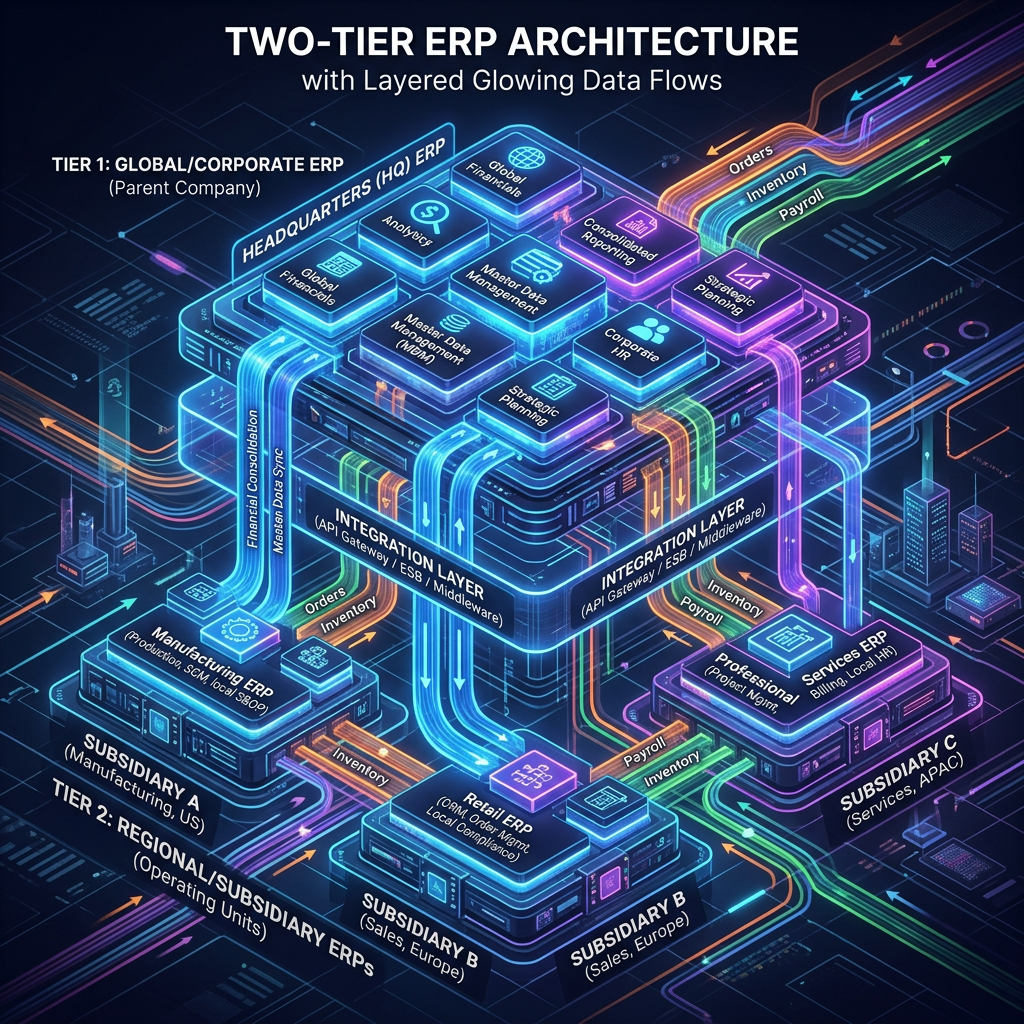
Why Two‑Tier ERP Matters Now for Automotive Suppliers
Automotive suppliers are expanding production footprints across North America, Europe, China, and ASEAN to align with OEMs’ global sourcing strategies.
At the same time, M&A activity aimed at acquiring new technologies and market access is increasing, making the group‑wide system landscape more complex than ever.
In this environment, the traditional approach of enforcing a single global SAP instance from headquarters is hitting its limits:
- Significant differences in business practices between countries, OEMs, and vehicle platforms cannot be fully absorbed by a single global template.
- For acquired companies that already have ERP and MES in place, a rapid, full replacement with SAP is often too costly and time‑consuming.
To address these challenges, the Two‑Tier ERP concept promoted by Gartner – a layered architecture of core ERP and subsidiary ERP – has emerged as a powerful option for global ERP strategy.
“The two‑tier ERP model positions large‑scale products such as SAP, operated by the headquarters, as the core ERP, while allowing overseas locations and group companies to select flexible ERP systems that can meet different business needs at each site, and then integrates them with the core ERP.”
Fundamentals of the Gartner Two‑Tier Model and SAP Two‑Tier ERP
What Is Gartner’s Two‑Tier ERP Model?
Gartner’s Two‑Tier model is based on the idea of designing ERP for global enterprises in hierarchical layers for headquarters and subsidiaries.
“Two‑tier ERP is an approach proposed since the late 2000s by companies such as Gartner. For example, the headquarters operates a core ERP, while overseas locations and group companies operate subsidiary ERPs. ERP is operated in a layered structure, and optimization is pursued for the group as a whole through data integration between ERPs.”
“The two‑tier ERP model positions large‑scale products such as SAP, operated by the headquarters, as the core ERP, while allowing overseas locations and group companies to select flexible ERP systems that can meet different business needs at each site, and then integrates them with the core ERP.”
“Two‑tier ERP refers to an ERP system configuration in which a core ERP (tier one) is implemented at the headquarters or parent company, while a subsidiary ERP (tier two) is implemented at subsidiaries or overseas locations.”
From these definitions, the essentials are clear:
- Tier 1 (Core ERP): Used by headquarters/parent company, hosting group‑wide standard processes, shared master data, and corporate performance management.
- Tier 2 (Subsidiary ERP): Used by subsidiaries, overseas plants, and newly acquired companies, chosen to match local business requirements and commercial practices.
- Both tiers are designed from the outset for data integration, enabling group‑wide optimization while preserving local flexibility.
In other words, the Two‑Tier model is not just a product choice; it is a group IT architecture that assumes a layered structure and systematic integration.
How SAP Defines Two‑Tier ERP
SAP itself has formalized a Two‑Tier ERP strategy that aligns closely with Gartner’s concept.
“Learn how two‑tier ERP works, including variants of hybrid ERP, and how two‑tier ERP can be used in various industries and company structures.”
“Mergers, acquisitions, and divestitures often happen suddenly, and by adopting a two‑tier ERP strategy, you can efficiently stand up new ERP systems within a limited time frame.”
“In the context of a merger or acquisition, two‑tier ERP makes it easier to achieve tight, seamless integration between multiple business systems. Data, applications, and interfaces work together harmoniously to help avoid disruption to core business operations.”
For automotive suppliers, typical Two‑Tier combinations include, for example:
- Core ERP: SAP S/4HANA (on‑premise or private cloud) at headquarters
- Subsidiary ERP: SAP S/4HANA Cloud Public Edition, SAP Business ByDesign, or other cloud ERP solutions chosen based on local or business‑segment needs
Two‑Tier ERP Architecture Patterns from an EA Perspective
From an Enterprise Architecture (EA) standpoint, automotive suppliers typically consider three representative Two‑Tier patterns.
Pattern 1: Global Rollout (Headquarters‑Driven Model)
Objective: Provide a consolidated view of production, inventory, and cost worldwide, while meeting OEMs’ global sourcing and quality requirements.
“In the two‑tier ERP model, the core tier‑one ERP is designed for large multinational enterprises—many of them Fortune 1000 companies with multi‑billion‑dollar revenues—and is built to meet their complex needs.”
“In a two‑tier ERP strategy, headquarters uses the core tier‑one system for corporate‑level common processes, while subsidiaries use tier‑two systems to address their specific needs.”
“As manufacturers accelerate their overseas expansion, global system integration and governance have become major management challenges. In particular, balancing ‘deployment speed’ with ‘global governance’ is a critical issue.”
Viewed through the four EA layers, the pattern looks like this:
- Business Architecture
- Headquarters: Group‑wide financial consolidation and management accounting, global cost management, shared procurement, global supply chain policies.
- Local entities: OEM‑specific and platform‑specific production planning, local sourcing, logistics, tax, and regulatory compliance.
- Application Architecture
- Core ERP: SAP S/4HANA at headquarters, optionally with Central Finance and Central Procurement.
- Subsidiary ERP: Cloud ERP (e.g., SAP S/4HANA Cloud Public Edition) rolled out to local entities using a fit‑to‑standard approach for rapid go‑live.
- Data Architecture
- Global master data (materials, business partners, chart of accounts) maintained in the core ERP and mapped to local keys at the subsidiaries.
- Sales, inventory, cost, and CAPEX/OPEX data integrated from subsidiaries to the core via event‑based or scheduled interfaces.
- Technology Architecture
- SAP BTP and integration services used to expose core–subsidiary interfaces as reusable APIs or events.
The essence of this pattern is to preserve governance and shared KPIs in the core ERP while using cloud ERP to dramatically increase rollout speed to overseas sites.
Pattern 2: M&A‑Driven Post‑Integration Model
Objective: Avoid a disruptive big‑bang replacement of an acquired company’s ERP, and instead pursue a staged integration while keeping business operations stable.
“Pattern 3: M&A‑driven post‑integration model
– A company acquired through M&A continues to use its existing ERP while integrating it with the headquarters ERP.”
“With a two‑tier ERP strategy, you can temporarily or permanently retain the acquired company’s existing ERP as the subsidiary ERP and integrate only the required information into the headquarters core ERP.”
“In the context of a merger or acquisition, two‑tier ERP makes it easier to achieve tight, seamless integration between multiple business systems. Data, applications, and interfaces work together harmoniously to help avoid disruption to core business operations.”
From an EA angle, this pattern can be described as follows:
- Business Architecture
- Short term (Day 1–Day 100): Minimize changes to the acquired company’s business processes, prioritizing business continuity above all else.
- Medium to long term: Define group‑level KPIs (gross margin, inventory turns, PPM, defect rates, etc.) and enable cross‑company performance comparisons.
- Application Architecture
- Headquarters: SAP S/4HANA (often with Central Finance) as the core ERP and consolidation/management accounting hub.
- Acquired entities: Existing ERPs (SAP or non‑SAP) retained as subsidiary ERPs, integrated to the core via standard interfaces.
- Data Architecture
- Transfer only the data required for group management—such as financials, sales, and inventory—from the acquired ERP to the core.
- Map account structures and material hierarchies in the core ERP to enable group‑wide reporting and analytics.
The critical design choice here is to formally position the acquired ERP as a Tier‑2 system rather than treating it merely as “legacy to be retired”. This supports both short‑term business continuity and a clear roadmap toward future harmonization.
“With a two‑tier ERP approach, you can temporarily or permanently retain the acquired company’s existing ERP as the subsidiary ERP and integrate only the information required into the headquarters core ERP. This minimizes operational disruption after M&A and enables a more flexible integration journey.”
For automotive suppliers, this pattern is particularly effective in technology‑driven acquisitions (e.g., advanced sensor, material, or software suppliers) and regional market acquisitions (such as local Tier‑2 manufacturers in emerging markets).
Pattern 3: Regional and Segment‑Optimized Model
Objective: Tailor ERP usage to the specific needs of different business segments, such as aftermarket, remanufacturing, or low‑cost products for emerging markets.
“In a two‑tier ERP strategy, headquarters uses the core tier‑one system for corporate‑level common processes, while subsidiaries use tier‑two systems to address their specific needs.”
“Learn how two‑tier ERP works, including variants of hybrid ERP, and how two‑tier ERP can be used in various industries and company structures.”
“SAP understands that two‑tier ERP adoption can help many organizations expand their geographic reach. That’s why it offers 60 local versions in 34 languages and provides tools that allow further localization in more than 160 additional countries and regions.”
In this model:
- The core ERP maintains global material master data, cost calculation logic, and financial policies.
- Segment/region‑specific subsidiary ERPs handle unique requirements: aftermarket returns and warranty processes, remanufacturing, lean inventory approaches for emerging markets, and so on.
- SAP’s multi‑language, multi‑localization capabilities are leveraged to address local tax, e‑invoice, and statutory reporting requirements.
The result is a structure where headquarters sees a single global enterprise, while local teams operate systems tailored to their markets and business models.
Example SAP Landscape for Two‑Tier ERP
Here is a simple example of how a two‑tier SAP landscape for an automotive supplier might look:
| Layer | System Example | Primary Role |
| Core ERP | SAP S/4HANA (Headquarters) | Consolidation, management accounting, global costing, corporate finance, shared procurement |
| Subsidiary ERP – Plants | SAP S/4HANA Cloud Public Edition / other cloud ERPs | Production, inventory, sales, local finance, local tax and compliance |
| Subsidiary ERP – M&A | Existing ERP (SAP or non‑SAP) | Preservation of acquired entity’s operations, integration of required data only |
| Integration Platform | SAP BTP, SAP Integration Suite | Core–subsidiary APIs, event‑based integration, extensibility platform |
| Analytics | SAP Analytics Cloud | Group‑wide dashboards, analytics, and simulations |
Using this type of landscape, SAP and its partners are positioning Two‑Tier ERP as a way to achieve both deployment speed and strong global governance.
“As manufacturers accelerate their overseas expansion, global system integration and governance have become major management challenges. In particular, balancing ‘deployment speed’ with ‘global governance’ is a critical issue.”
Concrete Benefits for Automotive Suppliers
Finally, let’s summarize the key benefits automotive suppliers can gain from combining Gartner’s Two‑Tier model with SAP Two‑Tier ERP, from an EA point of view.
1. Post‑M&A Business Continuity and Fast Integration
With a Two‑Tier approach, you don’t have to force a big‑bang ERP replacement on acquired companies. Instead, you can keep their ERP as a Tier‑2 system, integrate the necessary data into the core ERP, and gradually harmonize processes.
“With a two‑tier ERP approach, you can temporarily or permanently retain the acquired company’s existing ERP as the subsidiary ERP and integrate only the information required into the headquarters core ERP. This minimizes operational disruption after M&A and enables a more flexible integration journey.”
“In the context of a merger or acquisition, two‑tier ERP makes it easier to achieve tight, seamless integration between multiple business systems.”
2. Geographic Reach with Strong Local Fit
By utilizing SAP’s localization portfolio, you can deploy cloud ERP rapidly across global plants while still meeting local statutory and tax requirements.
“SAP understands that two‑tier ERP adoption can help many organizations expand their geographic reach. That’s why it offers 60 local versions in 34 languages and provides tools that allow further localization in more than 160 additional countries and regions.”
This is especially critical for automotive suppliers that must ramp up new plants quickly in response to OEM sourcing decisions in new regions.
3. Enhanced Global Performance Management
By centralizing key data in the core ERP, you can improve global visibility of inventory, production, and profitability, and drive cross‑plant optimization in areas such as inventory levels, stock transfers, and capacity utilization.
“Learn how two‑tier ERP works, including variants of hybrid ERP, and how two‑tier ERP can be used in various industries and company structures.”
When combined with analytics solutions such as SAP Analytics Cloud, Two‑Tier ERP becomes a foundation for data‑driven decision‑making in global automotive supply chains.
If your organization is currently planning a global S/4HANA program or facing post‑M&A integration challenges, formalizing a Gartner‑aligned Two‑Tier ERP architecture may be one of the most pragmatic levers for balancing speed, control, and flexibility in your SAP roadmap.
Please refer to the following blog for insights on SAP Global Template deployment.
Understanding SAP Global Template and Instance Strategy
Reference Links
Two‑Tier ERP concept and strategy (general):
- What is Two‑Tier ERP? Definition and Use Cases (SAP)
https://www.sap.com/japan/products/erp/what-is-erp/two-tier-erp.html - Two‑Tier ERP: A Strategic Advantage for Complex Business Environments (SAP Blog)
https://www.sap.com/japan/blogs/two-tier-erp-a-strategic-advantage-for-complex-business-environments - Cloud ERP in a Two‑Tier ERP Model for Subsidiaries (SAP)
https://www.sap.com/japan/resources/two-tier-erp
Global rollout and governance:
- Achieving SAP Global Rollout (be one solutions)
https://www.beonesolutions.com/jp/our-global-sap-rollout-expertise/ - Two‑Tier ERP Approach for Manufacturing Companies (SCSK)
https://www.scsk.jp/sp/sap/leaflets_videos/erp-video_202603/
Background and conceptual explanations (Japanese but useful for reference even in an English post):
- What Is Two‑Tier ERP? Benefits, Challenges, and Use Cases (Oro)
https://www.oro.com/zac/blog/two-tier-erp/ - ERP Deployment Methods for Overseas Subsidiaries – Two‑Tier ERP
https://www.cloud-for-all.com/blog/erp-introduction-method - What Is Two‑Tier ERP? (ERP Mania)
https://note.com/erpmania/n/nfb0e458d7192 - How Two‑Tier ERP Strengthens Global Group Governance (Majisemi)
https://note.com/majisemi/n/n8e94a0f13da1
Automotive / manufacturing context:
- SAP Automotive Industry Solutions Overview
https://www.youtube.com/watch?v=quVkOfivD9M - How SAP Is Transforming Manufacturing Challenges to Drive Competitive Advantage (DXC)
https://dxc.com/ja/insights/knowledge-base/blogs/japan/how-sap-is-transforming-manufacturing-challenges-to-drive-competitive-adv
Disclaimer
Parts of this article were developed with reference to generative AI suggestions and were reviewed, refined, and supplemented based on the author’s professional expertise and judgment.

Leave a Reply