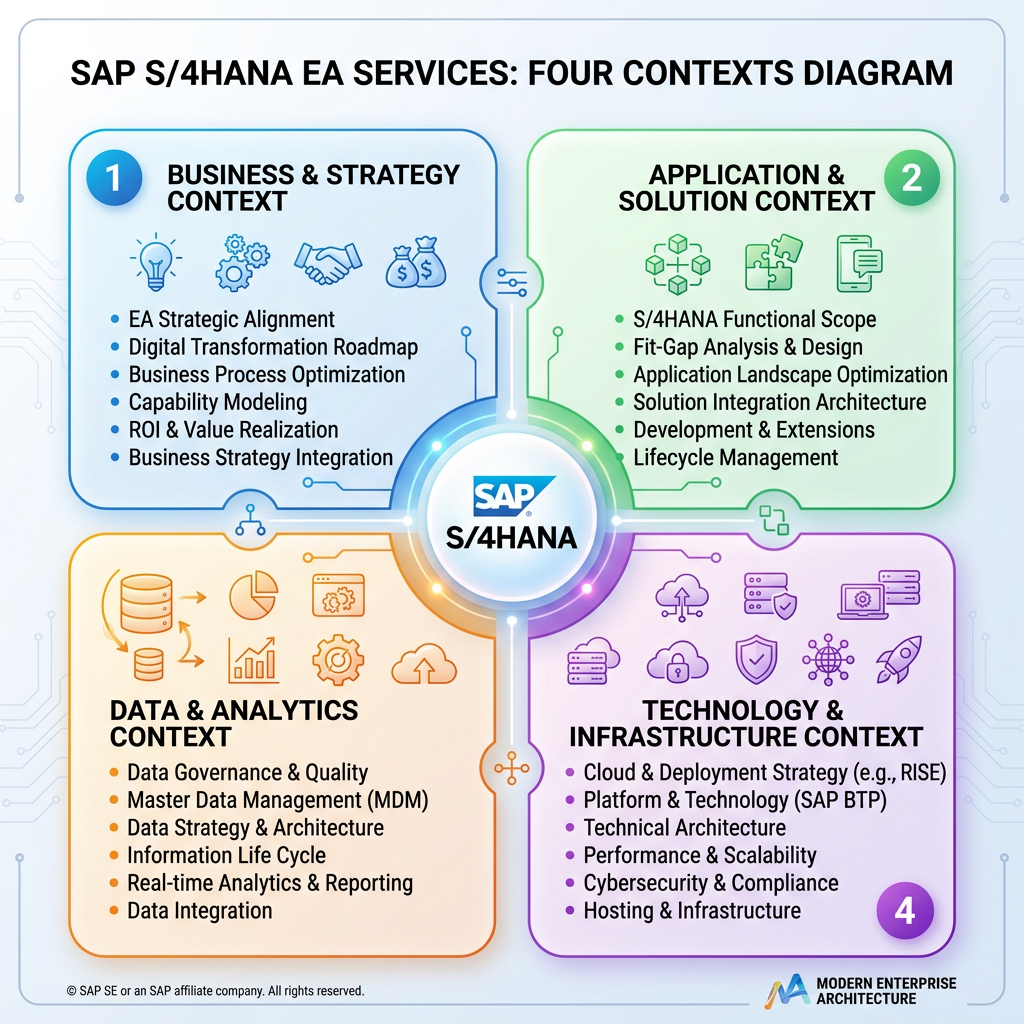
1. Why SAP Program Managers Need an “EA Services” Perspective
Implementing SAP S/4HANA is not just a system upgrade; it is a full‑scale business transformation that redesigns your business model, end‑to‑end processes, and data structures.
Yet in many projects, discussions are dominated by project terminology such as “requirements definition,” “Fit/Gap,” and “migration plan,” while the alignment with the overall enterprise architecture (EA) remains opaque.
This is where the EA capabilities and services defined by TOGAF® and DPBoK become highly useful.
If you translate these into the SAP implementation context, you can turn them into an “EA Service Catalog” that program managers can actually use:
- Which EA services are needed in which project phase
- Which deliverables (reports, assessments, guidelines) those services should produce
- How to embed those services into PMO activities and governance
2. Applying the TOGAF® and DPBoK EA Services Emergence Model to SAP Programs
The TOGAF® and DPBoK emergence model structures EA services into four contexts:
- Individual / Founder
- Team
- Team of Teams
- Enduring Enterprise
Mapped to SAP S/4HANA programs, you can roughly think of them like this:
| DPBoK context | Typical SAP S/4HANA scope example | Main PM concerns |
| Individual / Founder | Department‑driven S/4HANA Cloud PoC, small lighthouse project | Business value of the PoC, minimum standards and risks |
| Team | Single‑country / single legal entity S/4HANA implementation | Change management, stakeholder alignment, infra–application consistency |
| Team of Teams | Global template with multi‑country, multi‑site rollout | Portfolio view, reuse, release strategy, process standardization |
| Enduring Enterprise | Group‑wide EA, optimization of a landscape with multiple ERPs and SaaS systems | Enterprise‑wide optimization, M&A, capability roadmap, standards governance |
From a PM perspective, being explicit about “which context our program is currently in” makes it much easier to control the depth and granularity of EA services you need to provide.
3. Individual / Founder Context: Using EA Services in PoC and Small S/4HANA Cloud Projects
3.1 Typical scenario (example)
- A single manufacturing plant leads a PoC for inventory and purchasing using S/4HANA Cloud (Public or Private Edition).
- Group‑wide standard processes and data models are not yet defined.
- The organization is at the “prove the business value with a PoC first” stage.
Even at this scale, using the TOGAF® EA services prevents the PoC from becoming a one‑off exercise and ensures that reusable deliverables feed into the next phase.
3.2 Key EA services to use and concrete SAP examples
Business value assessment and analysis service
- SAP examples:
- Define KPIs such as inventory turns, purchasing lead time, inventory variance rate, and lead time from MIGO to FI posting.
- Formulate impact hypotheses using S/4HANA standard capabilities (MRP, inventory valuation, Fiori analytics).
- Deliverable examples:
- “Estimated Inventory Reduction Potential Report from S/4HANA Implementation”
- “Value vs Risk Matrix: Current Excel Operations vs S/4HANA Standard Processes”
- PM view:
- You can directly embed these outputs into the business case documentation for decision‑making.
Stakeholder management service
- SAP examples:
- Identify key business users, plant managers, IT infrastructure leads, and information security officers involved in the PoC.
- Map “who cares about what and who participates in which decision.”
- Deliverable examples:
- Stakeholder list with interest areas
- Engagement plan (workshops, demos, review sessions schedule)
- PM view:
- Think of this as structuring your communication plan using TOGAF deliverable formats rather than inventing your own from scratch.
Sustainability management support service
- SAP examples:
- Assess potential for reducing paper‑based documents, inventory scrapping, and wasted materials through S/4HANA.
- Evaluate the feasibility of connecting to CO2 emissions tracking and (in the future) SAP Sustainability Control Tower.
- Deliverable example:
- “Sustainability Assessment Memo for S/4HANA PoC”
- PM view:
- Even at PoC stage, incorporating ESG and sustainability aspects strengthens your narrative to senior management.
Architecture and standards guidance service
- SAP examples:
- Decide on single‑tenant vs multi‑tenant, use of SAP BTP, and extension principles (In‑App vs Side‑by‑Side).
- Define minimal naming conventions and customization policies (e.g., boundaries for Z‑developments).
- Deliverable examples:
- “Architecture Principles for PoC (One‑Pager)”
- “Do / Don’t List for Extension Design”
- PM view:
- These light‑weight principles help you avoid PoC configurations that will later become obstacles to industrialization.
Risk management service (change, privacy, security)
- SAP examples:
- Check whether personal data is processed, whether cross‑border data transfer occurs, and how identity providers are integrated for cloud authentication.
- Identify risks when reusing PoC settings and data in the productive landscape.
- Deliverable examples:
- “Key Risks to Recognize at PoC Stage”
- “Risk Evaluation Topics for Transition from PoC to Full Implementation”
- PM view:
- You can feed these directly into the project risk register and governance forums.
3.3 How to embed this in PM practice
- Add a dedicated “EA Services” chapter to the project charter or project plan.
- Based on the PoC scope, implement the five services above in a lean, fit‑for‑purpose way.
- Standardize deliverables in PowerPoint or Confluence templates so that future PoCs can reuse them with minimal effort.
4. Team Context: EA Services for Single‑Country S/4HANA Implementations
4.1 Typical scenario
- A mid‑size manufacturing company runs an end‑to‑end S/4HANA implementation (FI/CO/MM/PP/SD) in one country up to go‑live.
- The program integrates with multiple local legacy systems.
- Change management, training, and business cutover become major themes.
At this level, you deepen the services used in the “Individual / Founder” context and significantly strengthen change management.promotion.
4.2 EA services to add or enhance
Change management service
- SAP examples:
- Process changes such as moving from handwritten slips to Fiori‑based entry or changing BOM management practices.
- Revising segregation of duties and roles & authorizations.
- Deliverable examples:
- Change impact report across people, processes, and technology.
- Training and communication plan aligned with those impacts.
- PM view:
- By positioning the Change Management Plan as a formal EA service deliverable, you can explain its necessity more convincingly to stakeholders.
Stakeholder management (higher precision)
- SAP‑specific additions:
- Emphasize interoperability and integration points with surrounding systems.
- Clarify owners and stakeholders for CRM, MES, corporate accounting systems, and other critical interfaces.
- Deliverable example:
- “Interface‑Level Owner and Responsibility Matrix”
- PM view:
- This matrix becomes a powerful tool to avoid gaps in interface accountability at cutover.
Sustainability management (reuse focus)
- SAP‑specific additions:
- Evaluate reusability of configurations, extensions, and interfaces for future rollouts.
- Deliverable example:
- “List of Reusable Configuration and Development Assets for Future Rollouts”
Architecture and standards guidance (service‑orientation emphasis)
- SAP‑specific additions:
- Promote service‑oriented architecture patterns (APIs, events, orchestration).
- Define standard patterns for SAP BTP, API Management, Integration Suite, etc.
- Deliverable example:
- “Standard Interface Pattern Catalog (Sync/Async, File/API/Event)”
Risk management (governance + change)
- SAP‑specific additions:
- Evaluate go‑live risks such as data migration quality, temporary dual entry during parallel runs, and authorization misconfigurations.
- Deliverable examples:
- Cutover risk assessment report
- Governance model for approving changes prior to production deployment
4.3 How to embed this in PM practice
- Explicitly register EA services as tasks in the project WBS.
- Example: “EA‑01 Stakeholder Analysis,” “EA‑02 Change Impact Assessment.”
- Feed EA risk management deliverables directly into the project risk log and steering committee packs.
5. Team of Teams Context: EA Services for S/4HANA Global Template and Multi‑Rollout Programs
5.1 Typical scenario
- Headquarters designs an S/4HANA global template and rolls it out stepwise to multiple countries and plants.
- The PM must coordinate stakeholders on both the template side and the local rollout side.
- Portfolio management, release strategy, and reuse of assets become mission‑critical.
In this context, many additional TOGAF® EA services can be directly linked to how you run the global SAP program.
5.2 Key EA services to add
Architecture project planning service
- SAP examples:
- Plan global template build (Phase 0) and each country rollout (Phases 1–n) from an EA perspective.
- Deliverable examples:
- “Architecture Work Definition Document”
- Scope: What is decided at template level vs what is decided locally.
- Resources: EA team, local architects, process owners.
- Tools: EA and process visualization tools such as LeanIX and Signavio.
Architecting tailoring service
- SAP examples:
- Define how ADM phases iterate in the template project and link to each country project.
- Deliverable example:
- “Global EA Method Tailoring Guide” that distinguishes:
- Strategy level: global template policies
- Segment level: regional differences
- Capability level: site‑specific deviations
- “Global EA Method Tailoring Guide” that distinguishes:
Architecture vision and strategy service
- SAP examples:
- Document which business value the S/4HANA global template is meant to create.
- Deliverable example:
- Architecture vision document that clarifies, for example, global inventory visibility standards, harmonized costing, and scope of global master data standardization.
Architecture modeling and documentation (MVA)
- SAP examples (as Minimum Viable Architecture):
- Business process maps (Signavio / BPMN).
- Application landscape (e.g., LeanIX views).
- Data object relationship diagrams for master and transactional data.
- Deliverable examples:
- As‑Is architectures per country, the To‑Be template, and Transition views for each rollout wave.
Architecture integration service
- SAP examples:
- Analyze how changes in the template will impact already‑rolled‑out countries.
- Deliverable example:
- “Template Change Impact Analysis Report” including update plans for affected applications, processes, and interfaces.
Digital product release support service
- SAP examples:
- Coordinate fixed template releases (e.g., twice a year) with local go‑live and maintenance windows.
- Deliverable examples:
- Release policy and release calendar
- Release guidance per rollout wave
Portfolio management support service
- SAP examples:
- Prioritize investments across S/4HANA, BTP extensions, and surrounding SaaS (CRM, PLM, MES, etc.).
- Deliverable examples:
- “Global IT Portfolio Prioritization Report”
- “Roadmap for Legacy Decommissioning and New Solution Introduction”
Enterprise analysis and evaluation service
- SAP examples:
- Cross‑project analysis of rollout KPIs such as schedule adherence and number of critical incidents during cutover.
- Deliverable examples:
- “Rollout Maturity Assessment Report”
- “Country‑by‑Country Process Performance Comparison”
5.3 How to embed this in PM practice
- Create a global EA Service Catalog for the program and provide it as a service menu to each country project.
- Set up an EA working group under the PMO and run the services above on a regular cadence aligned with release and rollout milestones.
6. Enduring Enterprise Context: Corporate‑Level EA and SAP Portfolio Management
6.1 Typical scenario
- After the first wave of S/4HANA implementations, the company continues to optimize a landscape where multiple ERPs, SaaS solutions, and legacy systems coexist.news.
- M&A‑driven system integrations and legacy ERP consolidations continue to occur.
- EA organization becomes a permanent function providing EA services day‑to‑day.
Here, EA services are operated as a corporate product, embedded into standard governance processes.
6.2 EA services to add or strengthen
Architecture‑compliant development service
- SAP examples:
- Define compliance criteria against standard architecture principles for S/4HANA, BTP, and other cloud platforms.
- Deliverable example:
- “SAP Solution Compliance Checklist” and standard templates for project reviews.
Compliance assessment and analysis service
- SAP examples:
- Periodically assess whether new country or company S/4HANA projects align with global standards.
- Deliverable examples:
- Solution evaluation reports
- Interoperability assessment reports focusing on regional and global data integration.
Capability planning service
- SAP examples:
- Map capabilities such as “global supply chain visibility” or “global cash management” to required people, processes, and systems.
- Deliverable example:
- Capability roadmaps showing how S/4HANA, IBP, Ariba, SuccessFactors, etc. combine to deliver those capabilities.
EA development process improvement service
- SAP examples:
- Continuously improve SAP EA methods based on TOGAF®, and refine the way LeanIX / Signavio are used.
- Deliverable example:
- “EA Service Delivery Maturity Assessment and Improvement Proposal”
Deepened business value, stakeholder management, architecture integration, and EA analytics
- Use cases:
- M&A integration scenarios and consolidation of multiple S/4HANA instances.
- Deliverable example:
- “Assessment Report for Acquired Company Systems and SAP Integration Approach”
6.3 How to embed this in PM practice
- Define EA services as a catalogue of corporate products, and require each new project to select which services it consumes at initiation.
- In SAP program portfolio committees, systematically use EA deliverables (compliance assessments, capability roadmaps, etc.) as mandatory decision inputs.
7. EA Service To‑Do List SAP PMs Can Start Using Tomorrow
If you are a SAP S/4HANA program manager, you can start using TOGAF® EA services with the following minimum To‑Do list:
- Determine the context of your project
- PoC‑level (Individual / Founder)
- Single rollout (Team)
- Global rollout (Team of Teams)
- Enterprise portfolio (Enduring Enterprise)
- Make required EA services explicit in your WBS and task lists
- Examples: stakeholder management, change management, business value assessment, architecture guidance, risk management.
- Define at least one concrete SAP deliverable per service
- Examples: change impact report, template vision, capability roadmap.
- Create templates and reuse them across projects
- Build an “EA Service Deliverable Library” using Confluence, SharePoint, or Notion.
- Use EA deliverables as formal inputs to program governance
- Submit them to steering committees and executive reporting as standard decision materials.
Conclusion
This article organized TOGAF® and DPBoK EA services into a form that SAP S/4HANA program managers can directly apply in day‑to‑day delivery.
By using the four DPBoK contexts—from PoC, to single‑country rollouts, to global templates, and finally to enterprise portfolios—you can make explicit which EA services are needed at which scale and at what depth.
The first step for any PM is to identify the context of their project and make the required EA services visible in the WBS and deliverable list.
Once you template and reuse stakeholder management, business value assessment, architecture guidance, and risk management deliverables across initiatives, your SAP programs will evolve from “one‑shot mega projects” into a continuously improving EA service operation.
If you want your S/4HANA program to drive both business transformation and IT landscape optimization—not just a technical migration—start by building your own EA Service Catalog tailored to your organization.
Please refer to this article for topics related to Enterprise Architecture (EA).
Enterprise Architecture – Insight Arc | SAP, Enterprise Architecture & Supply Chain Strategy
Reference links
- Enterprise Architecture (EA) and the TOGAF framework in the DX era
https://renue.co.jp/posts/enterprise-architecture-togaf-framework-dx-it-optimization-guide - Enhancing TOGAF Enterprise Architecture Development – Key Guidelines
https://guides.visual-paradigm.com/ja/enhancing-togaf-enterprise-architecture-development-key-guidelines/ - What is TOGAF? | TOGAF Guide | SAP LeanIX
https://www.leanix.net/ja/wiki/ea/togaf - Enterprise Architecture Frameworks – Selection and Implementation
https://www.leanix.net/ja/wiki/ea/enterprise-architecture-frameworks - JEITA EA implementation guide for private companies (Japanese)
https://home.jeita.or.jp/is/committee/solution/sankou-siryou/CEATEC2005CONFERENCE_EAguide1006.pdf - SAP Digital Transformation Methodologies (Japanese, SAP official PDF)
https://news.sap.com/japan/files/2024/11/01/SAP-Digital-Transformation-Methodologies-revised-edition.pdf
Disclaimer
Parts of this article were developed with reference to generative AI suggestions and were reviewed, refined, and supplemented based on the author’s professional expertise and judgment.

Leave a Reply