Introduction
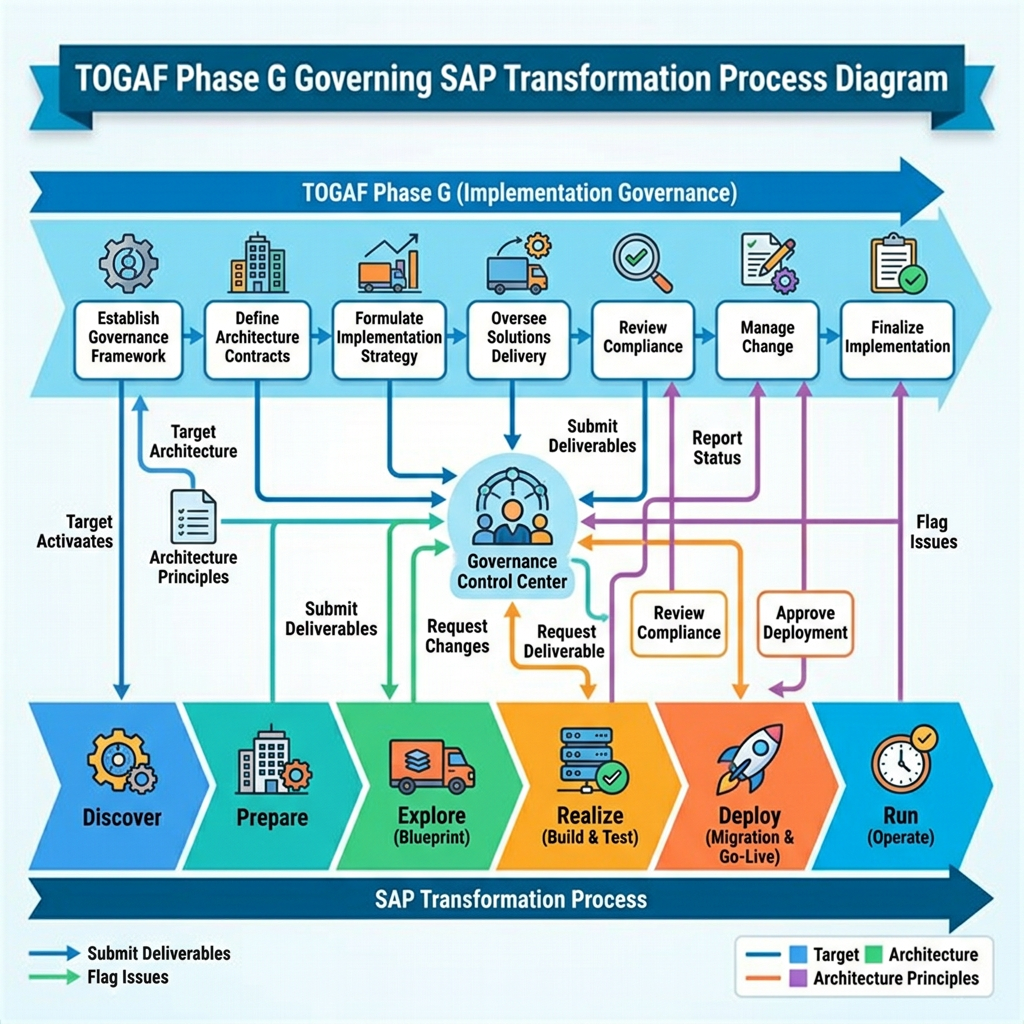
Achieving a successful SAP implementation requires more than solid requirements and system design. The real challenge lies in governing architecture during execution. TOGAF® ADM Phase G (Implementation Governance) plays a critical role in ensuring architectural compliance, preventing design deviations, and managing change requests effectively throughout SAP projects.
Why TOGAF® ADM Phase G Matters in SAP Projects
TOGAF® ADM Phase G defines two primary objectives:
- Ensure implementation projects conform to the Target Architecture
- Execute Architecture Governance for change requests arising during implementation
This is particularly important in SAP programs, where common risks include:
- Over-customization driven by local requirements
- Exception-based operations
- Fragmentation across business units
Without strong governance, misalignment between template design and execution decisions leads to integration issues and operational inefficiencies. SAP Activate also highlights the need for clear roles, responsibilities, and decision-making processes to keep projects on schedule and within budget.
The Essence of TOGAF® ADM Phase G
TOGAF® ADM Phase G is not just about handing over architecture artifacts. It ensures that architectural intent is preserved throughout implementation. Key activities include:
- Confirming deployment scope and priorities
- Identifying required resources and skills
- Guiding solution deployment
- Conducting Architecture Compliance Reviews
- Supporting operational implementation
- Performing post-implementation reviews
Reference: http://www.togaf.com/admref/_chap13.html
Implementation Governance should be viewed not as an audit function, but as a continuous management capability that connects architectural compliance with real-world delivery decisions.
Key Roles in SAP Implementation Governance
Within SAP programs, TOGAF® ADM Phase G supports four essential governance roles:
- Ensure compliance with global or enterprise templates and prevent unnecessary local extensions
- Evaluate change requests from an architectural perspective and control the use of standard functions, add-ons, and extensions
- Define decision-making structures and maintain accountability across business, IT, and architecture teams
- Capture reusable knowledge through post-implementation reviews for future rollouts
In large-scale SAP transformations, success depends less on having a perfect architecture and more on having a governance model that enables consistent, correct decision-making.
Outputs vs. Outcomes in Phase G
Typical outputs of TOGAF® ADM Phase G include:
- Architecture Contracts
- Compliance Assessments
- Change Requests
- Approved implementation solutions
In SAP projects, these translate into:
- Design principles
- Exception approval records
- Deviation logs
- Quality gate decisions
- Post-implementation review reports
The real outcome is the safe execution of business transformation aligned with the Target Architecture.
Example:
A global SAP rollout maintains consistent integration and security policies across regions while allowing controlled local adaptations, ensuring scalability and long-term value.
Skills Required for Enterprise Architects
To operationalize TOGAF® ADM Phase G in SAP implementations, Enterprise Architects must combine governance and delivery capabilities:
- Architecture Governance: Compliance assessment, exception handling, Target Architecture alignment
- Governance Design: Role definition, decision frameworks, structured governance bodies
- SAP Expertise: Standard functionality, extension models, integration patterns, operational constraints
- Compliance & Security: SoD, audit readiness, security controls, change management
- Transformation Leadership: Stakeholder alignment, escalation management, post-go-live evaluation
The key is integration—technical SAP knowledge and governance expertise must function together to ensure practical and enforceable decisions.
Practical Application in SAP Projects
Instead of adding governance as overhead, embed TOGAF® ADM Phase G into existing SAP project activities:
- Design reviews
- Extension approval processes
- Quality gates
- Release decisions
- Hypercare transition checkpoints
Additionally, adopt a phased rollout strategy rather than a big-bang approach. Incremental deployment improves alignment between architecture compliance and business outcomes while reducing risk.
Please refer to this article for topics related to Enterprise Architecture (EA).
Enterprise Architecture – Insight Arc | SAP, Enterprise Architecture & Supply Chain Strategy
Reference Links
- SAP Learning (Roles and Responsibilities in SAP Activate)
https://learning.sap.com/courses/sap-learning-and-enablement/integrating-enablement-roles-in-each-sap-activate-phase_acf5b856-ff69-4dbb-bea7-fe45e911672f - TOGAF ADM Phase G (Implementation Governance)
http://www.togaf.com/admref/_chap13.html
Disclaimer
Parts of this article were developed with reference to generative AI suggestions and were reviewed, refined, and supplemented based on the author’s professional expertise and judgment.

Leave a Reply