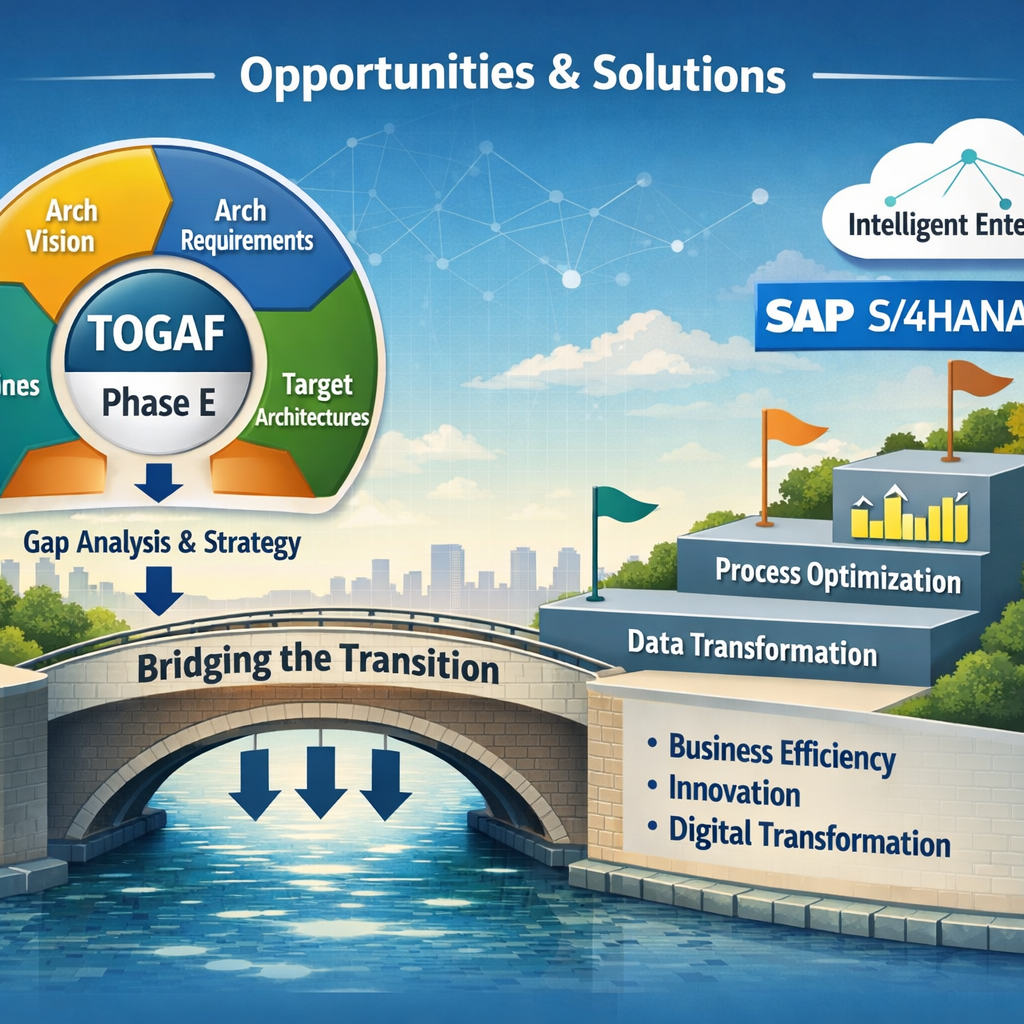
For many enterprises, SAP S/4HANA implementation is not merely a system deployment—it represents a comprehensive business transformation program. Within this context, TOGAF’s Architecture Development Method (ADM) provides a powerful framework that serves as a common language connecting business and IT.
Among the ADM phases, Phase E “Opportunities and Solutions” plays a critical role as the pivotal juncture where target architecture translates into actionable SAP project portfolios and migration plans. This article examines Phase E from an SAP implementation perspective and outlines the essential considerations Enterprise Architects must address.
Understanding TOGAF® ADM Phase E : Opportunities and Solutions
TOGAF® ADM Phase E transforms the target architecture defined in Phases B through D into an executable implementation plan. The primary activities in this phase include:
- Determining which projects and work packages will realize the target architecture
- Designing the sequence and stages for reaching the new architecture (transition architectures and roadmaps)
- Selecting appropriate solutions (products, mechanisms, and approaches) to address identified gaps
In essence, Phase E bridges the divide between “architectural vision” and “implementation program”. From an EA perspective, inadequate decisions at this stage can result in SAP projects devolving into a collection of ad-hoc add-on developments.
Phase E Positioning in SAP Implementations
When applied to SAP projects, Phase E addresses critical questions such as:
- Which scope areas should be implemented, in what sequence, and across which countries, business units, or locations?
- Which requirements will be met with SAP standard functionality versus customizations or extensions?
- Should the migration from legacy systems to S/4HANA occur in a single wave or through phased deployment?
- How should the global template be structured, and what rollout approach should be adopted?
While Phases B through D define the “to-be architecture,” Phase E designs the realistic path to achieve it, considering real-world constraints including budget, resources, legacy system coexistence, regulatory requirements, and local specifications.
Primary Objectives of Phase E (SAP EA Perspective)
From an SAP-focused Enterprise Architecture standpoint, Phase E objectives can be articulated through four key dimensions:
1. Define the SAP Transformation Program Structure
Identify and structure major projects including template construction, country/business unit rollouts, data migration, and testing/training initiatives. Establish clear mappings showing which projects address which business capabilities and architecture gaps.
2. Clarify Gap-Solution Correspondence
Compare solution options for business gaps—SAP standard, extensions (BTP/add-ons), external SaaS, or legacy system reuse—and determine the appropriate approach. Organize implementation principles and individual decisions around “build,” “buy,” “reuse,” or “descope” choices.
3. Design SAP Deployment Roadmap and Transition Architectures
Design deployment waves, release plans, rollout sequences, and phased migration scenarios based on business value and risk considerations. Define intermediate “Transition/Interim Architecture” states between current and target landscapes to create realistic migration paths.
4. Establish Architecture Governance Framework
Clarify global template principles, standard-first policies, and local requirement handling rules to define what is permissible and what is prohibited. Organize governance processes and roles for reviewing and approving solution proposals during subsequent design and implementation phases.
Phase E Inputs and Outputs (SAP Edition)
Inputs: Phase B-D Deliverables
Phase E builds upon existing deliverables rather than starting from scratch:
- Business Architecture: future-state process models, business capability maps, organizational structures and roles
- Information/Application Architecture: data domain definitions, application landscape vision, integration structures
- Technology Architecture: infrastructure, cloud strategy, network, security architecture
- Domain-specific gap analysis: current-state to future-state differentials, required gap remediation lists and improvement themes
For SAP projects, additional critical inputs include current SAP or alternative ERP usage patterns, peripheral system configurations, rollout target countries/business units/company codes with prioritization, investment constraints, resource limitations, and business milestones such as regulatory changes or organizational restructuring.
Outputs: Concrete Deliverable Examples
Phase E outputs must clearly articulate “what happens next.” Representative deliverables for SAP implementation audiences include:
SAP Deployment Roadmap (Architecture Roadmap)
Wave-based or release-based deployment plans (e.g., Wave 1: headquarters and Europe; Wave 2: North America; Wave 3: Asia). Configuration of process areas, SAP modules, and countries/company codes within each wave. Go-live timing and major milestones for each wave (design completion, testing completion, migration rehearsal).
Project/Work Package Inventory and Structure
Global template construction project, deployment projects for each rollout country/business unit/division, and cross-cutting work packages (data migration, test management, training, change management, integration platform alignment). Mapping of each work package to corresponding architecture gaps and business capabilities.
Solution Decision Records (Implementation Approaches)
Documented decisions for each business requirement indicating whether it will be addressed through “SAP standard,” “configuration (customizing),” “extensions (BTP/add-ons),” “external SaaS,” or “legacy system reuse.” Supporting principles guiding these decisions (e.g., code extensions prohibited in Public Cloud, BTP-first for extensions, add-ons permitted only for on-premise versions).
Transition Architecture Definition
Transition patterns from current landscape → intermediate landscape → target landscape. System role allocation during intermediate steps (e.g., accounting migrates first to S/4HANA; SCM continues on legacy system temporarily). Data migration approaches (Big Bang vs. phased migration, historical data handling, archiving strategies).
Phase E Outcomes: Organizational Value Creation
Beyond deliverables, Phase E generates important organizational “Outcomes” including:
Aligned, Realistic Transformation Roadmap
Moving beyond abstract slogans like “business enhancement through S/4HANA,” this phase produces documented clarity on when, where, what, and in what sequence implementation will occur, enabling realistic investment decisions and resource planning.
Gap-Solution Traceability Establishment
Gaps identified in Phases B-D become traceable to specific projects, work packages, and SAP solutions, reducing risks of scope omissions and excessive investment.
Functional Solution Selection Governance
With standard-first policies and template principles established, criteria emerge for handling requirements from various countries and business units, preventing “snowballing local unique requirements” in later stages and driving toward enterprise optimization.
Required Skills and Knowledge for Phase E
The skill sets required for Enterprise Architects, SAP Architects, and Program Managers focusing on Phase E include:
1. Cross-Domain Knowledge of Enterprise Architecture and SAP
Fundamental concepts across business, information/application, and technology architecture domains. SAP S/4HANA-centric landscape design (core, satellite, integration structures). Mapping business capabilities to SAP modules and solutions.
2. Understanding SAP Implementation Methodology and ADM Alignment
Mapping between standard methodologies like SAP Activate and TOGAF® ADM phase roles. Linkage between Discovery/Preparation/Explore phases and Phase E roadmaps. Design capability recognizing granularity differences between project-level and EA-level planning.
3. Program/Project Structuring Skills
Ability to decompose large-scale transformations into programs, projects, and work packages. Rollout strategy design (regional, business unit, product-based segmentation). WBS design and traceability to architecture gaps.
4. Solution Evaluation and Selection Skills
Capability to evaluate SAP standard functionality, extension options (BTP, Enhancement Framework), and peripheral SaaS solutions. Approach selection considering TCO, maintainability, extensibility, and cloud compatibility. Business acumen for “build/buy/reuse/eliminate” decisions.
5. Transition Architecture and Migration Strategy Design Capability
Understanding SAP migration patterns including Brownfield, Greenfield, and selective data transitions. Design of phased migrations including legacy system coexistence periods. Proposal capability for migration scenarios reflecting business readiness and risk tolerance.
6. Governance and Stakeholder Communication
Development and consensus-building for architecture and template principles. Operation of template review committees and design authority bodies. Communication skills to convey messages simply to executives while providing specificity to project teams.
Conclusion: The EA Role in SAP Implementation Success
TOGAF® ADM Phase E “Opportunities and Solutions” represents the watershed between “vision” and “implementation” in SAP projects. The quality of roadmaps and solution strategies developed at this stage significantly influences the success probability of multi-year SAP transformations.
During this phase, Enterprise Architects must shift from being “diagram creators” to “designers of executable transformation programs”. Balancing business and IT, global and local, standard and extension—navigating all these dimensions while driving SAP-centric enterprise architecture to realization represents the EA’s fundamental mission.
Please refer to this article for topics related to Enterprise Architecture (EA).
Enterprise Architecture – Insight Arc | SAP, Enterprise Architecture & Supply Chain Strategy
Reference Links
- A TOGAF-Guided Approach to SAP S/4HANA Migration – LinkedIn
- SAP S/4HANA Migration: What IT Executives Need to Know – SAP News
- How TOGAF ADM Phase C Drives Successful SAP Implementations
- Enterprise Architecture Framework Guide 2025: TOGAF & More
- SAP S/4HANA Migration: Your Must-Read Guide to the Right Path – Panaya
- Optimizing Enterprise Architecture with TOGAF Framework and SAP
- SAP S/4HANA Migration: Prepare Your Business for Success – Lighthouse Technologies
- The Role of Enterprise Architecture to Manage SAP’s Transformation – SAP Community
- How to Plan a SAP S/4HANA Migration in 6 Strategic Phases – Principal33
- Role of an Enterprise Architect in SAP Implementation – LinkedIn
- Evaluating the TOGAF Architecture Development Method – SAP Learning
- SAP Architect: Role Blueprint, Responsibilities, Skills, KPIs – DevOps School
Disclaimer
Parts of this article were developed with reference to generative AI suggestions and were reviewed, refined, and supplemented based on the author’s professional expertise and judgment.

Leave a Reply