Introduction: Globalization and the “Fair Price” Challenge
In the automotive industry, parts procurement has rapidly shifted from traditional keiretsu-style relationships to global competition and restructuring, driven by international sourcing and advances in information technology.
Source: https://assets.kpmg.com/content/dam/kpmgsites/jp/pdf/2026/jp-sap-automotive-erp.pdf.coredownload.inline.pdf
As OEMs expand production footprints worldwide and Tier 1 suppliers follow with global supply networks, a critical executive question emerges:
What defines a “fair price” across different countries and markets?
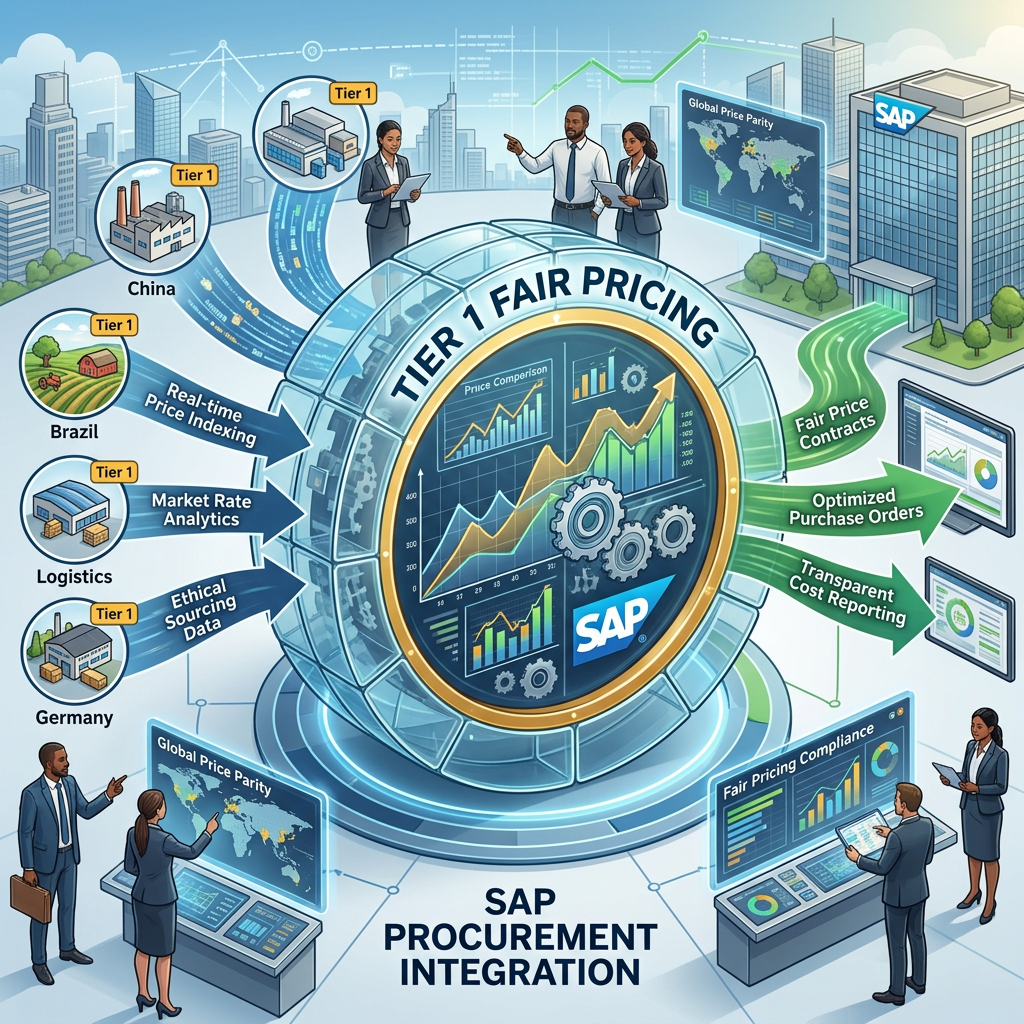
By leveraging SAP automotive solutions and cloud ERP, Tier 1 suppliers can integrate procurement, production, and sales data across global operations, enabling the design and governance of “fair pricing” that reflects tariffs, raw material volatility, and market dynamics.
Source: https://www.vistex.com/ja/solutions-sap/sap-extended-price-management/
This article provides a structured, case-based perspective for C-suite executives and global project leaders on how Tier 1 suppliers can align pricing strategy with profitability using SAP architecture.
1. Defining “Fair Price” in a Global Procurement Environment
In a globalized context, “fair price” must be understood through two distinct procurement models:
Relationship-Based Procurement
This model emphasizes collaboration through joint development, long-term contracts, and evaluation across quality, cost, delivery, engineering capability, and global supply capacity.
Here, “fair price” includes:
- Development investments
- Tooling costs
- Quality assurance costs
- Inventory risks
The objective is to ensure sustainable profitability while supporting OEM competitiveness.
Market-Based Procurement
This model applies to raw materials, standard components, and commodities, where pricing is heavily influenced by:
- Market indices
- Exchange rates
- Tariffs
- Logistics costs
In this context, “fair price” means maintaining alignment with global market prices while securing a reasonable margin based on sourcing conditions and risk exposure.
For global Tier 1 suppliers, pricing strategy begins with clearly defining these two models and embedding their logic into systems.
2. Building the Foundation with SAP
SAP provides an integrated platform tailored for the automotive industry to operationalize global pricing strategies.
Key capabilities include:
- Integrated Platform
Unifies procurement, manufacturing, sales, and aftersales processes into a single system, enabling end-to-end visibility of pricing, cost, and profitability. - Tariff Impact and Supply Strategy Optimization
Supports simulation of tariff impacts and identification of the most profitable supply routes (e.g., Europe vs. ASEAN vs. North America production). - Real-Time Data and Embedded AI
Detects disruptions such as raw material price spikes or logistics bottlenecks and enables timely pricing and supply chain adjustments.
For Tier 1 suppliers, the critical design question is:
How should pricing logic incorporate tariffs, market dynamics, and logistics variability within a global SAP template?
3. Translating Procurement Models into SAP Architecture
The dual procurement model translates into distinct SAP design patterns:
Relationship-Based Model (Long-Term / Co-Development)
- Long-term agreements and framework contracts tied to OEM platforms
- Integration with PLM, Project Systems, and cost accounting
- Lifecycle cost aggregation (development, tooling, quality improvements)
- Target cost and margin-driven pricing logic
- Defined “fair price range” aligned with OEM agreements
Market-Based Model (Short-Term / Index-Driven)
- Surcharge conditions linked to external indices (raw materials, FX, tariffs, logistics)
- Automated price adjustments in quotations, contracts, and billing
- Short pricing cycles for standard components
- Continuous monitoring of deviation from market benchmarks
By separating these pricing mechanisms within SAP, Tier 1 suppliers can centrally manage pricing aligned with procurement strategy.
4. Global Price Master and Comparative Analytics
Effective global pricing requires visibility into how identical parts are priced across regions.
Key design elements:
- Global Master Data Standardization
Unified coding for materials, suppliers, regions, pricing, and vehicle platforms. - Global Price Master
Central repository of price conditions, including tariffs, logistics costs, and margins across regions and customers. - Profitability Analysis (CO-PA)
Enables analysis of:- Where fair pricing is achieved
- Where price pass-through is insufficient
- Which supply routes maximize profitability
This allows Tier 1 suppliers to move from local optimization to global pricing governance.
5. Case Study: Operating Fair Pricing with SAP
Company Profile
- Global Tier 1 supplier headquartered in Japan
- Manufacturing in Europe, North America, and ASEAN
- Supplies EV powertrain components, battery modules, and aftermarket parts
- SAP S/4HANA Cloud deployed as a global template
Scenario
- Procurement Segmentation
EV raw materials follow market-based pricing, while core modules use relationship-based contracts. - Global Price Master Implementation
Centralized SAP system enables visibility of pricing differences across supply routes (e.g., ASEAN to North America vs. local production). - Tariff Simulation and Supply Optimization
SAP tools simulate tariff impacts to determine optimal sourcing strategies. - Relationship-Based Pricing Execution
Lifecycle costs are calculated and translated into target pricing models aligned with OEM agreements. - Market-Based Pricing Execution
Index-linked surcharges are automatically applied, with profitability monitored via CO-PA.
This integrated approach enables both pricing transparency and margin protection across global operations.
Conclusion: What “Fair Pricing” Means for Global Tier 1 Suppliers
For global Tier 1 suppliers, “fair pricing” is not simply about increasing or decreasing prices. It is about:
- Deciding where to deepen relationship-based procurement
- Determining where to optimize market-based sourcing
- Designing transparent pricing logic across both models
- Operating that logic end-to-end on an integrated SAP platform
The architecture and governance required to achieve this balance define the core of a global Tier 1 pricing strategy.
As a next step, organizations should evaluate their product portfolio and determine which segments should align with relationship-based versus market-based models, then reflect this structure in their SAP global template.
Reference Links
- KPMG Automotive ERP Insight
https://assets.kpmg.com/content/dam/kpmgsites/jp/pdf/2026/jp-sap-automotive-erp.pdf.coredownload.inline.pdf - SAP Extended Price Management (Vistex)
https://www.vistex.com/ja/solutions-sap/sap-extended-price-management/
Disclaimer
Parts of this article were developed with reference to generative AI suggestions and were reviewed, refined, and supplemented based on the author’s professional expertise and judgment.

Leave a Reply