Introduction: Why Product Costing Is So Challenging for Automotive Tier 1 Suppliers
For Japanese automotive Tier 1 suppliers, product costing and cost planning must be managed simultaneously across multiple dimensions: vehicle program, OEM customer, product variant, and lifecycle phase. On top of that, OEM-specific JIT and kanban processes, frequent engineering changes, and volatile market conditions must all be reflected consistently in the cost view.
At the same time, many core systems have become heavily customized over the years, with numerous add-ons and satellite systems, making it difficult to obtain a single, reliable view of product cost.
This article looks at how an automotive Tier 1 supplier with existing MRP and production add-ons can:
- Rebuild its product costing capability
- Elevate vehicle-program-level cost planning
- Consolidate distributed ERP instances
using SAP S/4HANA Cloud, Private Edition (S/4HANA PCE) as the core, from the perspective of a project manager.
Note: This article is based on publicly available information such as SAP product catalogs, implementation case studies, and consulting reports, and does not rely on the specific circumstances of any particular company.
1. Direction for Rebuilding Cost Management with S/4HANA PCE as the Core
1-1. The “Core” of Costing Provided by S/4HANA PCE
In SAP S/4HANA, Product Cost Controlling (CO-PC) and Actual Costing with Material Ledger (CO-ML) support an integrated process from standard cost build-up based on BOMs and routings through to month-end actual cost rollups. Leveraging the Universal Journal (ACDOCA) as a single source of transactional truth, standard functionality can complete activities such as automatic variance allocation and adjustments between inventory and cost of sales at a granular material level.
Because of this architecture, blogs and technical articles that explain “why you need actual costing at the material level and how to analyze it” repeatedly emphasize the effectiveness of item-level actual costing with S/4HANA.
In real-world automotive component case studies, companies that migrated from host-based legacy systems to SAP ERP have reported benefits such as:
- Improved accuracy of product costing and supply-demand management, resulting in increased sales and profitability.
- Better visibility of inventory by location, immediate reflection of production confirmations, semi-automated actual costing, and more granular item-level information enabling higher-precision variance analysis.
Taken together, these findings indicate that for Tier 1 suppliers, the “core” of cost management is naturally built by combining FI/CO on S/4HANA PCE—especially CO-PC, CO-ML, and CO-PA—with PP/MM as the owner of BOM and routing structures.
1-2. Role of Automotive Templates and Industry-Specific Extensions
In the Japanese market, several S/4HANA templates specifically target automotive parts manufacturers. One such template embeds automotive-specific capabilities such as kanban-related functions and integrated order management directly into SAP S/4HANA.
Another template for assembly manufacturers offers broad functional coverage across sales, purchasing, production, financial accounting, and management accounting as an integrated baseline.
For an automotive Tier 1 supplier, there are many business requirements that are difficult to express with standard SAP alone, including:
- OEM-specific JIT and kanban instructions
- Delivery schedules via EDI
- Handling of vehicle programs, variants, and specification codes
The basic pattern for rebuilding cost management is therefore to cover these unique requirements using templates and SAP Business Technology Platform (BTP) extensions, while consolidating cost-related data into S/4HANA’s standard costing logic at the core.
2. Tier 1 Cost Management Requirements and Key Functional Gaps
2-1. Gaps in Target Costing and Cost Planning at the Concept Phase
In a representative case study on rebuilding the cost planning framework at a Japanese automotive components manufacturer, the following challenges and measures are described.
- For mass production cost, it previously took days to complete cost calculations and report results to management, making it difficult for executives to quickly grasp profitability by customer, vehicle program, or variant.
- In response, the company introduced target costing capabilities including early setting and deployment of target costs and cost reduction goals, real-time visibility into estimated and forecasted costs, new cost review committees, and centralized management of project cost information and cost-reduction know-how for reuse across programs.
- For mass production cost control, they implemented a profitability management system enabling visibility into profit and loss by customer, vehicle program, and variant, and providing early insights into the financial impact of changes in sales and material prices to senior management.
While S/4HANA’s CO-PC and CO-ML are strong when it comes to calculating standard and actual costs, they do not natively provide functions that directly support processes such as “vehicle-program-based target costing,” “setting and tracking cost reduction targets,” or “running cost review governance.”
This is where a gap exists between Tier 1-specific cost planning requirements and the capabilities of SAP standard functionality.
2-2. Gaps in Profitability by Vehicle Program, Customer, and Variant
In the same cost planning case study, the management expectation is clearly stated as “a mechanism for quickly obtaining profitability information by customer, vehicle program, and variant.” CO-PA in S/4HANA supports flexible definition of characteristics (for example, customer, product, region, channel) to analyze profitability.
However, in practice, Tier 1 suppliers often face additional complexity, such as:
- OEM-specific vehicle and specification codes
- Relationships between development project codes and mass-production materials
- Handling of forecast, firm, and change instructions (call-offs)
These aspects typically require more than straightforward CO-PA characteristic design. To close the gap, project teams must combine detailed CO-PA design with extended master data structures or external master management (for example, via SAP BTP) to manage vehicle and variant information in a consistent way.
3. Architecture for Vehicle-Program-Level Cost Planning
3-1. Positioning SAP Product Lifecycle Costing (PLC)
SAP Product Lifecycle Costing (PLC) is a product costing solution focused on securing future product margins at early design stages when master data is still incomplete. According to SAP, PLC offers the following key features.
- Flexible calculation logic with manual overrides and recalculation
- Versioning and what-if simulations for evaluating alternative design scenarios
- Real-time costing support through open integration with SAP S/4HANA and other ERP systems
In automotive Tier 1 vehicle-program cost planning, companies frequently need to:
- Define target and estimated costs at vehicle-program launch
- Recalculate cost projections based on engineering changes, material price movements, and FX fluctuations
- Compare scenarios when OEMs change specifications or during commercial negotiations
PLC is designed precisely for this “early-phase simulation and version management,” and can be integrated with planning in S/4HANA CO and CO-PA to align program-level cost planning with mass-production cost control.
3-2. Architecture Combining S/4HANA, a Cost Database, and Analytics
In the earlier cost planning case study, building a dedicated cost database, leveraging historical vehicle and component cost information, and maintaining a database of cost reduction ideas are highlighted as key enablers. A potential SAP-centric architecture could look like this:
Planning Layer
- SAP PLC: Simulate vehicle-program cost models (components, labor, materials, outsourcing, and so on) and manage target and forecasted costs.
- Cost Database: Implemented on S/4HANA or SAP BTP to store historical program and component cost data as well as cost reduction items and improvement ideas.
Actuals Layer
- S/4HANA CO-PC/CO-ML: Calculate standard and actual cost at material level, run cost rollups, and visualize cost flows per material.
- S/4HANA CO-PA: Analyze profitability based on characteristics such as customer, vehicle program, and variant.
Analytics and Management Layer
- Profitability Management (for example, SAP Analytics Cloud): Visualize profit and loss by customer, vehicle program, and variant, and quantify the impact of changes in sales and material prices.
- Cost Review Dashboards: Provide an integrated view of target, estimated, and actual costs, plus cost reduction progress, as a shared platform for gate and cost review meetings.
This architecture enables consistent management of “target and estimated costs at the concept phase” and “actual cost and profitability in mass production” along the axes of vehicle program, customer, and variant.
4. ERP Consolidation Roadmap from Distributed Core Systems
4-1. Key Points When Consolidating Distributed Systems
In automotive component SAP case studies, companies often state that they adopted SAP systems to centralize information, enable real-time updates, and meet global and IT control requirements, while achieving visibility of inventory by location, immediate reflection of production results, semi-automated actual costing, and item-level variance analysis.
There are three points project managers should pay particular attention to:
- Common data model
Redesign master data for materials, equipment, business partners, and projects together with cost object design (cost centers, internal orders, projects, production orders, CO-PA segments) to ensure consistency.
During data migration, unify keys for vehicle programs, variants, customers, lines, and plants so that cost and profitability can be traced across systems. - Redesign of cost management processes and accountability
Clearly define processes and owners for setting target costs and cost reduction goals, updating cost forecasts, performing variance and root cause analysis, and running cost review meetings, and then reflect these responsibilities in SAP workflows and reporting design. - Extension strategy (Fit-to-Standard and side-by-side)
SAP recommends a combination of Fit-to-Standard, side-by-side extensions on SAP BTP, and in-app extensions for S/4HANA implementations.
When there are heavy custom add-ons in MRP and production, it is often more realistic to maintain existing systems for a period while consolidating order, production confirmation, inventory, and cost information into S/4HANA in a side-by-side architecture, rather than replacing everything with standard PP/MRP in one step.
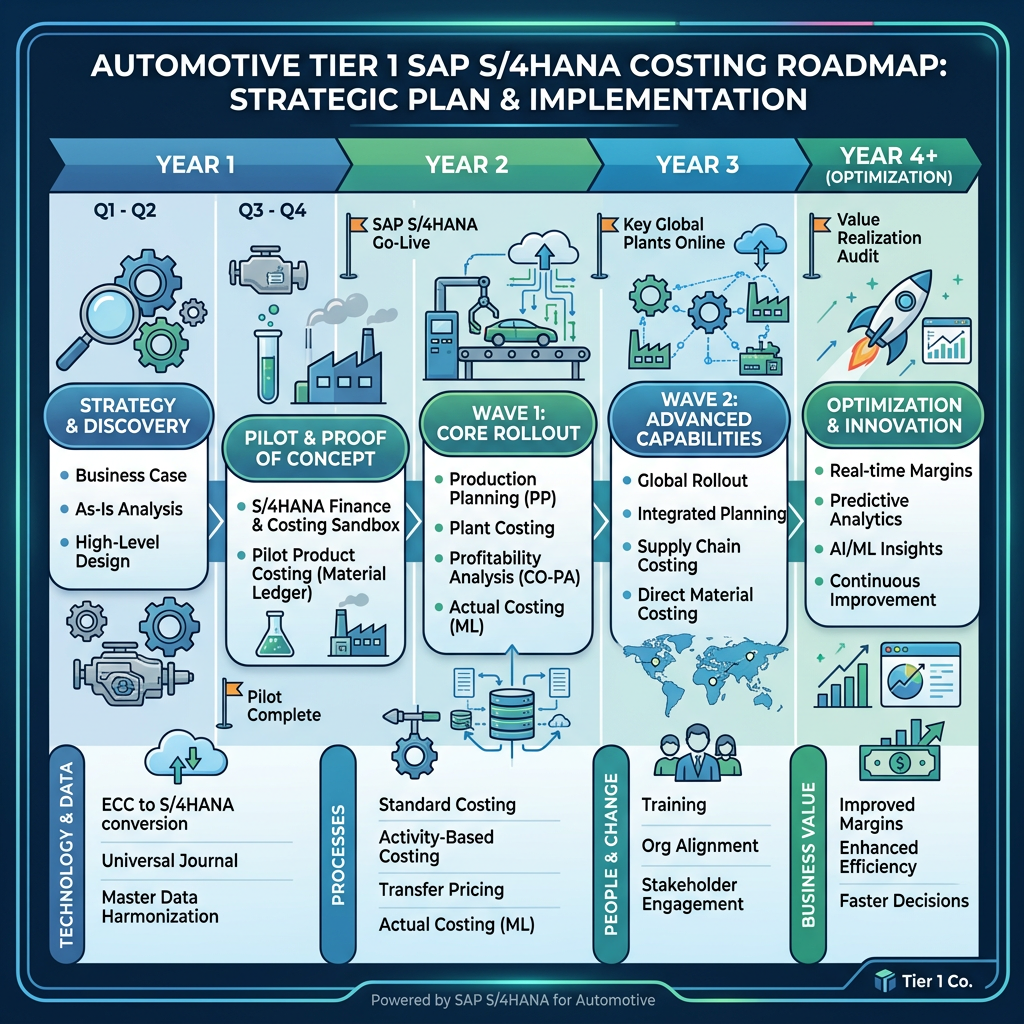
4-2. Thinking About the Roadmap (Phased Approach)
SAP’s official guidance on cloud ERP transformation presents a phased roadmap based on the RISE with SAP methodology, breaking down the journey into phases such as discovery, design, implementation, migration, and extension. General ERP explanations also describe the purpose of ERP as integrating fragmented core processes and optimizing production using sales plans and order information with automated MRP.
For automotive Tier 1 suppliers, the following phase model is realistic:
- Phase 0–1: Vision and architecture design
Objective: Define the target operating model for cost management and cost planning—including vehicle-program-level requirements—and the system architecture with S/4HANA PCE at the core.
Deliverables: To-be cost management model, cost object design, CO-PA characteristic design, integration patterns with existing MRP and production systems, and roles of BTP, PLC, and analytics platforms. - Phase 2: Core FI/CO and costing implementation
Objective: Go live with FI/CO and SD/MM on S/4HANA and build a foundation for standard and actual costing at material level as well as profitability by customer, vehicle program, and variant.
This is where you implement CO-ML for actual costing and CO-PA for profitability analysis, and deliver the first wave of variance analysis and program-level profitability reports. - Phase 3: Advanced cost planning and vehicle-program costing
Objective: Implement target costing, the cost database, and profitability management to operationalize vehicle-program-level cost planning.
At this stage, you introduce SAP PLC, BTP-based cost planning applications, and SAC-based vehicle-program dashboards to enable early target setting, visible cost forecasts, and institutionalized cost review governance. - Phase 4: Gradual integration of manufacturing and MRP
Objective: Gradually replace existing MRP and production add-ons with S/4HANA standard PP/MRP or industry templates, and more tightly integrate manufacturing, cost, and supply-demand management.
In this phase, you leverage automotive templates for kanban and integrated order management while aligning business processes with standard capabilities in line with the Fit-to-Standard principle.
Conclusion: A Message to Project Managers
For automotive Tier 1 suppliers, implementing SAP S/4HANA PCE is not only a large-scale system renewal but also a transformation program for product costing and cost planning. In particular, if you aim to achieve serious vehicle-program-level cost planning, you cannot avoid significant changes in business processes and organization in areas such as:
- Target cost management and cost forecasting at the concept phase
- Item-level actual costing and vehicle-program profitability in mass production
- Database-driven management of historical cost and cost reduction know-how
- Operation of cost review committees and governance structures
From a project manager’s standpoint, the key responsibilities include:
- Designing a cost management platform with S/4HANA PCE at the core
- Complementing planning and analytics capabilities with PLC, BTP, and SAC
- Balancing Fit-to-Standard with side-by-side extensions
- Managing phased delivery and risk from both business and IT perspectives
If your company or client has not yet clarified how far it wants to go in system-based “vehicle-program cost planning”—for example, focusing mainly on early-phase planning versus covering end-to-end including mass-production profitability—the first step should be to define that scope explicitly.
To move the discussion forward: to what extent do you want to systematize vehicle-program cost planning, and which phase do you want to prioritize—concept planning or mass-production profitability?
Reference Links
SAP S/4HANA and Manufacturing / Costing
SAP S/4HANA Cloud, private edition – Manufacturing
Overview of manufacturing capabilities in S/4HANA Cloud, private edition
https://www.sap.com/products/erp/s4hana-private-edition/features/manufacturing.html
SAP S/4HANA Cloud Public Edition – Manufacturing
Cloud ERP for discrete and process manufacturing
https://www.sap.com/products/erp/s4hana/features/manufacturing.html
SAP Product Lifecycle Costing
Product and service costing across the lifecycle
https://www.sap.com/products/scm/product-lifecycle-costing.html
SAP S/4HANA Product Costing and Actual Costing
SAP Community Blog: Product Costing in SAP S/4HANA
https://community.sap.com/t5/enterprise-resource-planning-blog-posts-by-sap/sap-s-4hana-in-product-costing/ba-p/13502370
ERP / Cloud ERP / Extension Strategy
SAP News: Embracing the Strategic Shift to Cloud ERP
High-level article on moving from legacy ERP to cloud ERP
https://news.sap.com/2024/11/embracing-strategic-shift-cloud-erp/
Disclaimer
Parts of this article were developed with reference to generative AI suggestions and were reviewed, refined, and supplemented based on the author’s professional expertise and judgment.

Leave a Reply