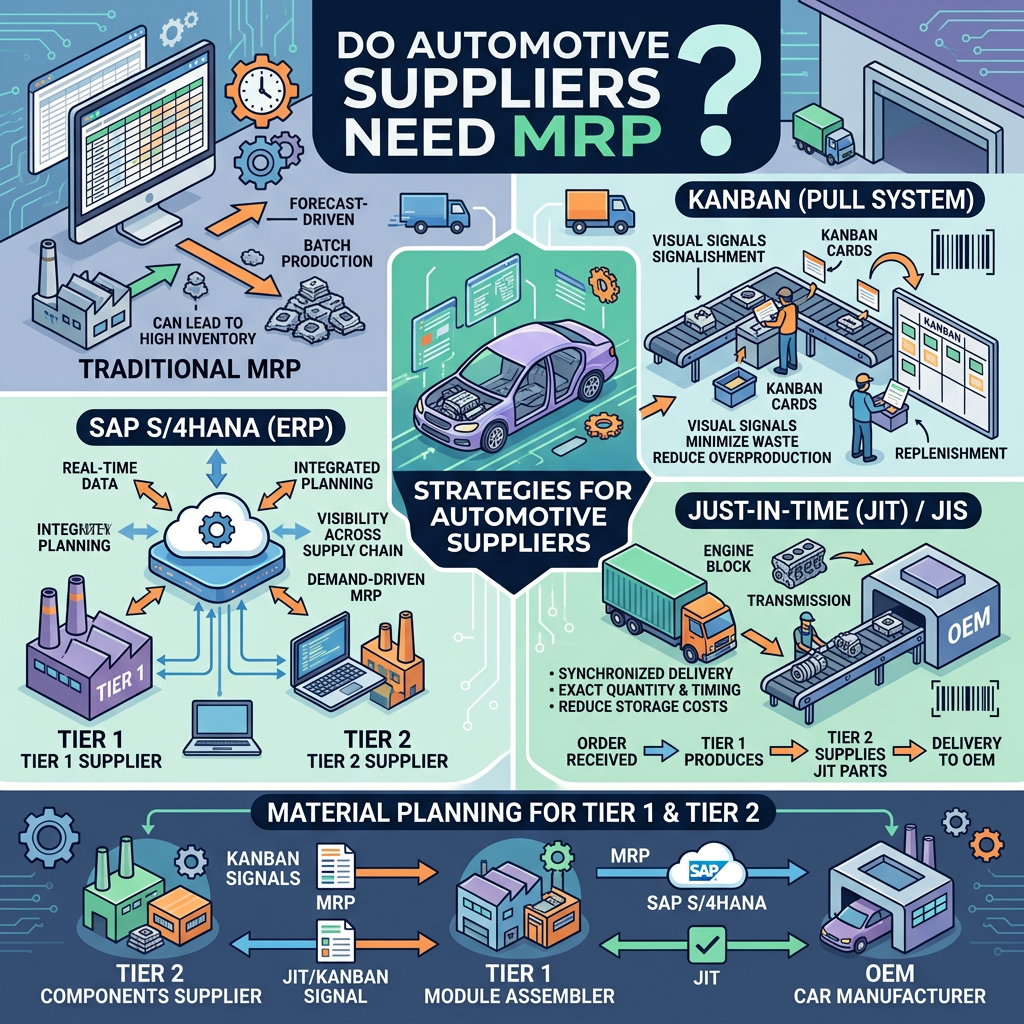
Introduction: Why Do Some Automotive Suppliers Believe MRP Is Unnecessary?
When implementing an enterprise resource planning (ERP) system such as SAP S/4HANA at an automotive supplier, project managers and IT teams may encounter a familiar argument from production management:
“We don’t use MRP in our operations.”
Or:
“Our production is managed through Kanban, so we don’t need MRP.”
This perspective is particularly common in discussions involving Japanese Tier 1 and Tier 2 automotive suppliers whose production operations are influenced by the Toyota Production System (TPS), Just-in-Time (JIT) manufacturing, and customer-driven replenishment processes.
In these environments, production and material replenishment are often driven by actual consumption, customer forecasts, confirmed delivery schedules, and Kanban signals.
Consequently, implementing conventional Material Requirements Planning (MRP) across every material and production process may not always be the most effective approach.
However, this raises a fundamental question:
Does operating without MRP mean that material requirements planning itself is unnecessary?
Not necessarily.
Even when automotive suppliers do not use conventional MRP, they may still calculate material requirements through proprietary production planning systems, spreadsheets, Kanban systems, or reorder point planning.
The real challenge for SAP implementation teams is understanding how material requirements are currently calculated and determining which planning functions should be retained, replaced, or redesigned.
This article examines the reasoning behind the argument that automotive suppliers do not need MRP and explores how project managers and IT leaders should design an appropriate production and material planning architecture when implementing SAP S/4HANA.
1. Why Some Automotive Suppliers Consider MRP Unnecessary
1.1 The Fundamental Difference Between MRP and the Toyota Production System
Material Requirements Planning calculates the quantities and timing of materials required to satisfy future product demand.
It typically uses demand information, bills of materials (BOMs), inventory balances, scheduled receipts, and procurement or production lead times.
In contrast, the Toyota Production System emphasizes Just-in-Time production and replenishment based on actual downstream consumption.
Kanban is one of the mechanisms used to support this pull-based production philosophy.
The fundamental differences can be summarized as follows.
| Comparison | MRP | Kanban |
| Planning philosophy | Planning based on future requirements | Replenishment based on actual consumption |
| Primary trigger | Forecasts and production requirements | Downstream consumption or withdrawal |
| Main calculation | Material quantities and required dates | Replenishment quantities and timing |
| Typical application | Medium- and long-term material planning | Short-term repetitive replenishment |
| Key information | BOM, inventory, receipts, lead times | Consumption, containers, replenishment lead time |
| Main challenges | Demand volatility, master data accuracy, planning changes | Sudden demand changes and long-lead-time materials |
Toyota’s production philosophy emphasizes producing what is needed, when it is needed, and in the required quantity.
SAP also supports Kanban replenishment without MRP as part of its standard functionality.
Therefore, implementing SAP S/4HANA does not automatically mean that every material must be planned using conventional MRP.
1.2 Production Planning Based on OEM Forecasts and Firm Orders
One distinguishing characteristic of the automotive supply chain is the availability of demand information from original equipment manufacturers (OEMs) and upstream suppliers.
For example, a Tier 1 supplier may receive:
- Medium- and long-term demand forecasts
- Monthly and weekly delivery schedules
- Short-term firm delivery instructions
- Just-in-Time and Just-in-Sequence (JIS) instructions
- Kanban replenishment signals
These inputs can be used directly to develop production and delivery schedules.
As a result, additional demand forecasting or conventional MRP may appear unnecessary.
However, OEM demand information typically describes the finished components or modules that the supplier must deliver.
It does not necessarily specify the quantities of every raw material and purchased component required to manufacture those products.
Consider an electronic control unit (ECU) supplier receiving a forecast for 10,000 units.
The supplier must still determine the required quantities of semiconductors, printed circuit boards, connectors, and other components.
Receiving demand forecasts from an OEM does not eliminate the need to calculate dependent material requirements.
This distinction is critical when evaluating MRP requirements during an SAP implementation.
2. Four Alternatives to Conventional MRP for Material Planning
Automotive suppliers can manage material requirements through several approaches without relying exclusively on conventional MRP.
2.1 Kanban-Based Replenishment
Kanban replenishment is triggered by actual material consumption.
For example, assume that each container holds 200 components.
If three containers become empty, the replenishment quantity is:
Replenishment Quantity = Number of Kanban Signals × Container Quantity
3 × 200 = 600 components
The number of Kanban containers can be designed using average consumption, replenishment lead time, safety stock requirements, and container capacity.
This approach is particularly effective for stable, repetitive production environments with relatively short replenishment lead times.
However, Kanban alone may not provide sufficient visibility into material requirements several months into the future, especially for long-lead-time components.
2.2 Reorder Point Planning
Reorder point planning triggers replenishment when the inventory position reaches a predefined threshold.
A simplified calculation is:
Reorder Point = Average Daily Consumption × Procurement Lead Time + Safety Stock
For example:
- Average daily consumption: 500 units
- Procurement lead time: 5 days
- Safety stock: 1,000 units
Reorder Point = 500 × 5 + 1,000 = 3,500 units
This approach is suitable for standardized materials and purchased components with relatively stable consumption patterns.
SAP S/4HANA supports reorder point planning.
It is important to recognize that SAP classifies reorder point planning as part of its broader material planning capabilities.
Therefore, when an organization claims that it does not use MRP, the project team should clarify whether it means that conventional demand-driven MRP is not used or that SAP’s material planning functionality is not used at all.
2.3 Proprietary BOM Explosion Based on OEM Forecasts
Some automotive suppliers calculate material requirements using proprietary systems that process OEM forecasts and explode product BOMs.
Consider an ECU manufacturer planning to produce 10,000 units.
If each ECU requires two semiconductors, the gross requirement is 20,000 semiconductors.
The supplier then considers available inventory, scheduled receipts, and safety stock requirements.
| Calculation Item | Quantity |
| Gross semiconductor requirements | 20,000 |
| Available inventory | 5,000 |
| Scheduled receipts | 3,000 |
| Target safety stock | 2,000 |
| Net requirements | 14,000 |
This is a simplified net requirements calculation. Actual planning must also consider requirement dates, receipt dates, reservations, lot sizes, and other planning parameters.
If a company performs this calculation using a proprietary application or Excel, it is effectively performing an MRP-equivalent function, even if it does not use SAP’s standard MRP functionality.
The company may not be operating without MRP. It may simply be operating without SAP MRP.
Understanding this distinction is essential when replacing legacy production planning systems.
2.4 Material Planning Based on Standard Consumption
Another approach calculates material requirements using standard consumption rates.
For example, assume that monthly production is planned at 50,000 units and each product requires 0.5 kg of material.
Monthly gross material requirements are:
50,000 × 0.5 kg = 25,000 kg
This approach can be effective when materials are highly standardized and product-mix changes have a limited impact on consumption.
However, planning accuracy may deteriorate when material consumption varies significantly due to product configurations, yield losses, engineering changes, or production mix.
3. Do Tier 1 and Tier 2 Automotive Suppliers Have Different MRP Requirements?
Tier 1 and Tier 2 suppliers often have different customer relationships, production processes, and procurement characteristics.
However, it would be misleading to conclude that Tier 1 suppliers need MRP while Tier 2 suppliers do not, or vice versa.
3.1 MRP Requirements for Tier 1 Suppliers
Tier 1 suppliers often need to synchronize production and deliveries with OEM manufacturing schedules.
For example, suppliers of seats, instrument panels, and door modules may be required to deliver products in the exact sequence of vehicle assembly.
In these situations, short-term production and delivery execution may be driven by JIS instructions rather than conventional MRP-generated production proposals.
However, the components used to manufacture these modules—including frames, resins, electronic components, and upholstery materials—may have significantly longer procurement lead times.
Consequently, MRP or an equivalent material planning mechanism may still be necessary for medium- and long-term procurement.
3.2 MRP Requirements for Tier 2 Suppliers
Tier 2 suppliers may receive forecasts, firm orders, and Kanban replenishment instructions from Tier 1 customers.
Consider a metal component manufacturer that uses Kanban to replenish finished components while purchasing steel based on monthly material plans.
In this scenario, conventional MRP may not be required to trigger short-term finished-goods replenishment.
However, MRP may still provide substantial value for planning steel procurement and identifying future material shortages.
3.3 Planning Requirements Should Be Determined by Manufacturing Characteristics
The need for MRP should be evaluated based on operational characteristics rather than supplier classification.
Important factors include:
- BOM complexity and number of levels
- Procurement lead times
- Demand volatility
- Product configuration and engineering changes
- Material commonality across products
- Inventory carrying costs
- Production capacity and lot-size constraints
SAP implementation teams should evaluate these characteristics by material group and select the most appropriate planning method.
4. Selecting the Right Planning Method in SAP S/4HANA
SAP S/4HANA provides multiple approaches to production and material planning.
These methods can be combined according to the characteristics of individual materials and production processes.
| Manufacturing or Procurement Characteristics | Recommended Planning Approach |
| Stable, repetitive replenishment with short lead times | Kanban |
| Standard materials with predictable consumption | Reorder point planning |
| Long-lead-time semiconductors and electronic components | MRP |
| Products with complex, multilevel BOMs | MRP |
| JIS components synchronized with OEM assembly | JIS execution with upstream material planning |
| Products with significant demand fluctuations | MRP with capacity planning where required |
| Production processes with significant equipment constraints | MRP with detailed planning and scheduling |
These approaches should not necessarily be treated as mutually exclusive.
For example, a supplier may use:
- Kanban for short-term replenishment of finished components
- MRP for medium- and long-term raw material procurement
- SAP PP/DS for detailed production planning and sequencing
The critical design requirement is to prevent the same demand from generating duplicate procurement or production proposals.
Planning responsibilities, planning horizons, system interfaces, and replenishment triggers must therefore be clearly defined.
5. Recommended Architecture: Combining MRP, JIT, and Kanban
For many automotive suppliers, a hybrid planning architecture that separates medium- and long-term planning from short-term execution is worth considering.
5.1 Medium- and Long-Term Planning: MRP
Medium- and long-term planning uses OEM or Tier 1 forecasts to determine future product demand.
Depending on business requirements, SAP Integrated Business Planning (SAP IBP) may be used for demand and supply planning, while SAP S/4HANA MRP calculates material requirements.
Typical objectives include:
- Securing long-lead-time materials
- Identifying future material shortages
- Optimizing inventory levels
- Consolidating demand for shared components
- Aligning purchasing plans with production requirements
5.2 Short-Term Execution: JIT, JIS, and Kanban
Short-term execution is driven by firm delivery instructions, JIT/JIS requirements, and Kanban replenishment signals.
Typical objectives include:
- Replenishing materials based on actual consumption
- Synchronizing production with OEM assembly sequences
- Reducing work-in-process inventory
- Controlling production and delivery timing
- Responding quickly to operational changes
5.3 Detailed Planning: SAP PP/DS Where Necessary
MRP calculates material quantities and required dates.
However, conventional MRP does not, by itself, guarantee a feasible production sequence that accounts for all finite-capacity constraints.
When equipment capacity, setup times, alternative resources, and production sequencing are important, SAP Production Planning and Detailed Scheduling (PP/DS) may be considered.
This does not mean that every automotive supplier requires PP/DS.
Its necessity should be assessed based on manufacturing complexity and the capabilities of existing scheduling systems.
6. A Critical SAP Design Consideration: MRP Exclusions and BOM Explosion
One important technical consideration during SAP S/4HANA implementation is the relationship between MRP exclusions and BOM explosion.
SAP supports Kanban replenishment without MRP.
However, depending on the configuration and the scope of the MRP exclusion, dependent requirements for lower-level components may not be generated as expected.
Consider the following scenario:
- Semi-finished product A is replenished through Kanban.
- Raw material B is a component of product A.
- Raw material B must be planned using MRP.
If product A is excluded from MRP without considering how the dependent requirements for material B will be generated, the system may fail to produce the expected material requirements.
This could result in material shortages.
Therefore, SAP implementation teams should evaluate the following settings and processes together:
- Material MRP types
- MRP areas
- BOM explosion
- Dependent requirements generation
- Kanban replenishment triggers
- Procurement proposal generation
- Inventory and scheduled receipts
Particular attention is required when combining MRP with independent Kanban replenishment to avoid duplicate procurement proposals or missing requirements.
SAP supports the integration of MRP and Kanban, but simply activating both functions is not sufficient.
The planning and execution logic must be designed and validated as an integrated process.
7. Ten Questions SAP Project Managers and IT Teams Should Ask
When production management states that MRP is unnecessary, SAP project teams should avoid immediately accepting that statement as a system requirement.
Instead, they should investigate how material requirements are currently calculated and how replenishment decisions are made.
| No. | Key Question | Purpose |
| 1 | What planning horizons are covered by OEM or Tier 1 forecasts and firm orders? | Understand the available planning horizon |
| 2 | How are material requirements calculated from customer forecasts? | Identify existing planning functionality |
| 3 | Which system performs BOM explosion? | Clarify the division of responsibilities with ERP |
| 4 | What are the procurement lead times for critical materials? | Determine the need for advance planning |
| 5 | How are Kanban quantities and container numbers determined? | Validate replenishment logic |
| 6 | How are changes in customer forecasts managed? | Evaluate responsiveness to demand changes |
| 7 | How is demand consolidated for shared materials? | Improve material procurement planning |
| 8 | How are purchasing decisions made for expensive or long-lead-time materials? | Manage inventory and shortage risks |
| 9 | How accurate are BOMs, inventory records, and lead times? | Evaluate planning reliability |
| 10 | What functions are currently performed by legacy systems or Excel? | Prevent functional gaps during ERP migration |
The most important consideration is identifying the planning functions embedded in existing systems.
A company may claim that it does not use MRP while its proprietary system performs BOM explosion, net requirements calculation, inventory allocation, and procurement proposal generation.
If these capabilities are overlooked when the legacy system is retired, the new ERP environment may not adequately support material procurement.
8. A Recommended Approach for SAP Implementation Projects
Step 1: Map Existing Planning and Replenishment Processes
Begin by documenting the end-to-end process from customer demand receipt through production planning, material requirements calculation, purchasing, manufacturing, and delivery.
Pay particular attention to calculations performed by proprietary systems and spreadsheets.
Step 2: Classify Materials by Planning Characteristics
Classify finished products, semi-finished products, purchased components, and raw materials based on:
- Demand variability
- Procurement lead times
- BOM structure
- Replenishment methods
Avoid assuming that one planning method should be applied to every material.
Step 3: Select the Appropriate Planning Method
Evaluate MRP, Kanban, reorder point planning, and proprietary planning approaches for each material group.
The evaluation should consider not only functional fit but also:
- Standard SAP functionality
- Maintainability
- Operational complexity
- Master data requirements
- Long-term support costs
Step 4: Validate the Design Through an SAP Proof of Concept
For scenarios involving both MRP and Kanban, validate the design in an SAP system rather than relying solely on conceptual documentation.
Critical test scenarios should include:
- MRP and Kanban integration
- BOM explosion
- MRP area configuration
- Dependent requirements generation
- Demand fluctuations
- Material shortages
- Delivery schedule changes
- Engineering changes
Step 5: Define Planning and Execution Responsibilities
Finally, establish which system is responsible for:
- Managing demand information
- Calculating material requirements
- Generating procurement proposals
- Triggering replenishment
- Executing production and delivery instructions
Without clearly defined responsibilities, the organization risks duplicate procurement, inconsistent planning data, and operational confusion.
9. Implementing MRP Should Never Become the Objective
SAP implementation projects generally aim to maximize the use of standard functionality.
However, adopting SAP standard functionality does not necessarily require replacing effective manufacturing practices.
For example, replacing a well-established Kanban replenishment process with conventional MRP solely for ERP standardization may not deliver meaningful business value.
Conversely, retaining every proprietary planning system and spreadsheet simply to preserve existing processes may create unnecessary complexity and long-term maintenance risks.
The objective should be to align business requirements with the most appropriate planning and execution capabilities.
The purpose of implementing SAP is not to introduce MRP for its own sake. It is to establish a reliable operating model that ensures the right materials are available in the right quantities at the right time, even when customer demand changes.
Achieving this requires an architecture that combines the strengths of SAP standard functionality with proven manufacturing practices.
10. Conclusion: Do Automotive Suppliers Really Need MRP?
The argument that MRP is unnecessary for automotive suppliers has a reasonable operational foundation.
In manufacturing environments where JIT, JIS, and Kanban operate effectively, short-term production and replenishment may not require conventional MRP-generated planning proposals.
However, this does not mean that future material requirements no longer need to be calculated.
Long-lead-time components, multilevel BOMs, demand fluctuations, and shared materials often require MRP or an equivalent planning capability.
For project managers and IT leaders evaluating SAP S/4HANA, three principles are particularly important.
First, determine MRP requirements by material group and planning horizon rather than making a company-wide decision.
Second, evaluate MRP, JIT, and Kanban as complementary capabilities rather than competing approaches.
Third, identify the material planning functions currently performed by legacy systems and ensure that critical capabilities are preserved during ERP migration.
Ultimately, the question is not simply whether automotive suppliers should use MRP.
The more important question is:
Which demand information should drive material planning, over what planning horizon, in which system, and through which mechanism should replenishment and production execution be triggered?
Answering this question is essential to designing an effective SAP S/4HANA architecture for automotive suppliers.
Reference Links
- Toyota Systems — Kanban Systems Supporting Toyota’s Manufacturing Operations
https://www.toyotasystems.com/product-service/special/kanban/
Background on the Toyota Production System and Kanban-based replenishment. - SAP Help Portal — Kanban Replenishment with or without MRP
https://help.sap.com/docs/SAP_S4HANA_ON-PREMISE/49d0972a760b4646918ce9fddb034d64/9d5fbd534f22b44ce10000000a174cb4.html
SAP documentation describing Kanban replenishment with and without MRP integration. - SAP Help Portal — Kanban with MRP
https://help.sap.com/docs/SAP_S4HANA_ON-PREMISE/49d0972a760b4646918ce9fddb034d64/a35fbd534f22b44ce10000000a174cb4.html
SAP functionality for combining MRP planning with Kanban-driven replenishment. - SAP Help Portal — Kanban without MRP
https://help.sap.com/docs/SAP_S4HANA_CLOUD/2bba750d1e124e1ea2a039bb1cd9b6c5/a05fbd534f22b44ce10000000a174cb4.html
Configuration considerations for Kanban replenishment without MRP. - SAP Help Portal — BOM Explosion and Determining Dependent Requirements
https://help.sap.com/docs/SAP_S4HANA_ON-PREMISE/fe39e10a9a864a8f8dc9537704f0fa13/d2abce5314894208e10000000a174cb4.html
How SAP MRP calculates dependent material requirements through BOM explosion. - SAP Learning
https://learning.sap.com/
Educational resources covering SAP production planning, MRP, and manufacturing processes.
Disclaimer
Parts of this article were developed with reference to generative AI suggestions and were reviewed, refined, and supplemented based on the author’s professional expertise and judgment.

Leave a Reply