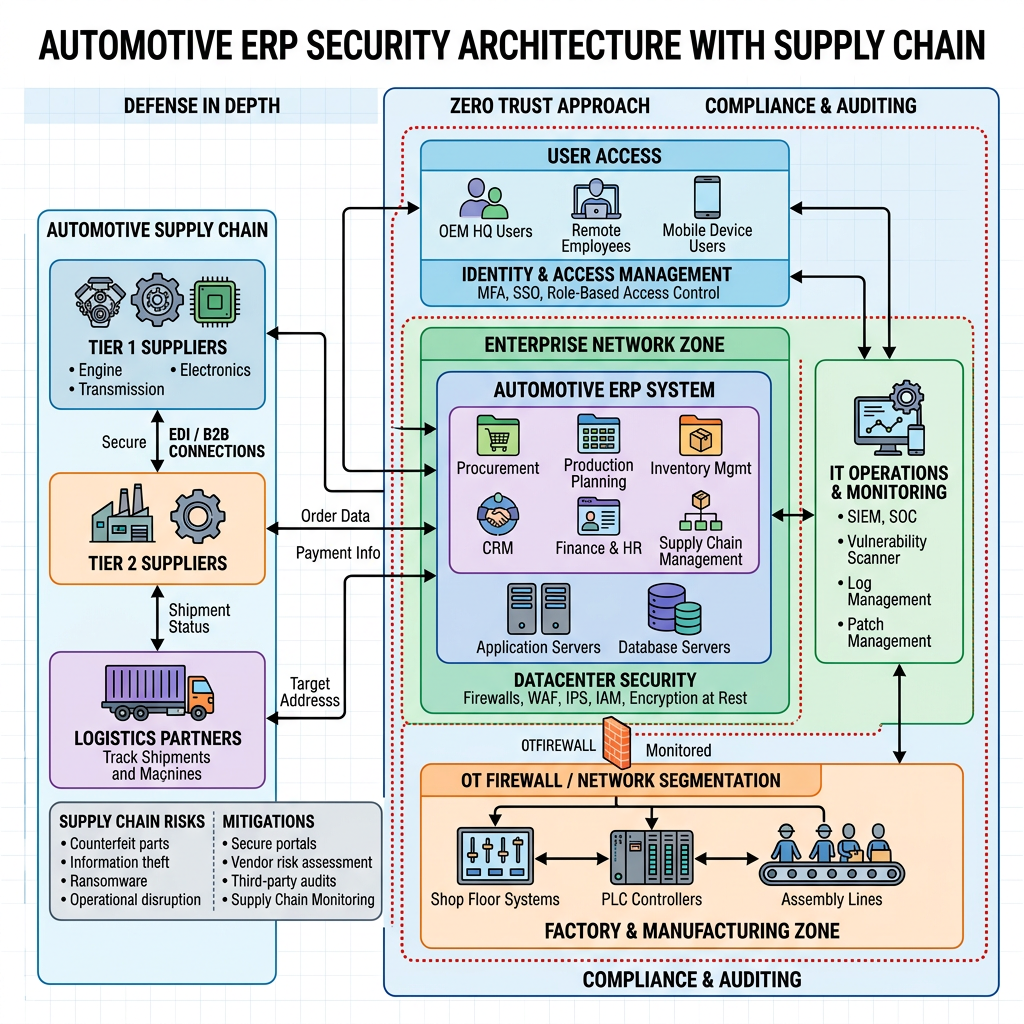
Introduction: The “Invisible Risks” in Global ERP Transformation
Tier‑1 automotive suppliers are accelerating global core system transformation and digitalization initiatives with SAP S/4HANA and other ERP platforms at the center of their enterprise architecture.
As overseas sites expand and OEMs demand stricter quality, traceability, inventory optimization, and advanced demand forecasting, ERP modernization and cloud migration have become non‑negotiable agenda items for executive management.
However, beneath this transformation lies a complex risk landscape around security, privacy, and data protection, driven by global handling of highly sensitive information such as customer, employee, and supplier data, design drawings, quality records, and telematics/IoT streams.
Addressing these risks through isolated security controls is no longer sufficient; they must be integrated into the overall enterprise architecture (EA) strategy, systematically designed, implemented, and governed as part of the ERP transformation itself.
For CIOs, project managers, and EA leads, this means treating security and privacy as first‑class architectural concerns that shape business processes, data models, application structures, and technology platforms from the outset—not as late‑stage checklist items.
TOGAF® ADM Perspective on Security and Privacy
In TOGAF®, security architecture is defined as a cross‑cutting concern that spans all architecture domains—business, data, application, and technology—rather than being isolated to a single layer or team.
For ERP transformation programs, this translates into elevating security beyond “an infrastructure topic”, embedding it into process design, data architecture, and application landscape decisions across the entire SAP‑centric ecosystem.
Concretely, TOGAF® ADM recommends handling security, privacy, and data protection considerations in every phase as follows:
Preliminary / Phase A
- Formalize organizational security policies, privacy policies, and information classification schemes, and position them as architectural constraints for all ERP‑related initiatives.
- Involve security architects and risk officers in the EA team from the earliest stages, clarifying roles and responsibilities for the ERP transformation program.
Phases B–D (Business / Data / Application / Technology)
- Analyze end‑to‑end business processes (order‑to‑delivery, production, logistics, after‑sales) to define “who accesses which data” and “across which trust boundaries”, then design authentication, authorization, logging, and privacy consent as integral parts of those processes.
- Incorporate information classification and protection requirements—encryption, masking, retention periods, deletion and anonymization policies—directly into the data architecture for each master and transaction object (customers, suppliers, employees, drawings, quality data, etc.).
- Derive SAP and surrounding system designs for authentication/authorization, API security, logging platforms, and network segmentation from business and data requirements rather than treating them as purely technical add‑ons.
Phases E–H / Requirements Management
- Embed security and privacy requirements into the EA‑wide requirements management process, treating them as shared assumptions across all ERP projects and rollouts.
- Feed back incidents, audit findings, and regulatory changes (GDPR, local privacy laws, cybersecurity legislation) into requirements management, triggering new ADM cycles when necessary.
From this TOGAF‑aligned viewpoint, security and privacy in ERP transformation must be integrated into EA strategy from the very beginning; checking compliance only around testing or go‑live is structurally insufficient.
Use Case 1: Global Customer and Supplier Master Data Protection
In Tier‑1 automotive supplier ERP programs, global harmonization of customer, supplier, and business partner master data is a central initiative.
These domains include not only corporate information but also personal data such as buyer and sales contact details, bank account information, and tax data—all attributes that are subject to stringent privacy and compliance requirements.
A TOGAF® ADM‑based structuring of this scenario can be summarized as follows:
Phase A: Vision and Scope
- When defining “global customer and supplier master data harmonization” as a key business objective, explicitly add “data protection and privacy compliance (GDPR and local regulations)” as a non‑functional objective.
- Integrate security policy and information classification schemes into the master data harmonization scope, specifying protection levels for each attribute type.
Business and Data Architecture (Phases B/C)
- Design create/change/delete workflows for business partners so that roles, approvals, and auditability around personal data handling are explicitly embedded in process models.
- Enhance customer/supplier master data models with classification labels, defining fields subject to encryption, masking, and role‑based access control in SAP S/4HANA and SAP MDG.
Application and Technology Architecture (Phases C/D)
- Implement global and local role concepts for SAP S/4HANA and MDG that avoid excessive privilege grants and person‑dependent access designs.
- Design cloud platform encryption, key management, backup/DR strategies, and long‑term log retention with a balanced view of regulatory obligations and business risk.
This approach transforms master data harmonization from “just consolidating records” into building a globally compliant, trusted foundation that enables future data‑driven use cases such as analytics, personalization, and supplier performance evaluation.
Use Case 2: Supply Chain Collaboration and Partner Federation
Another typical scenario is system integration across OEMs, Tier‑2 suppliers, logistics providers, and third‑party service platforms.
As EDI/API connectivity, portal access, and shared platforms grow, cross‑enterprise access patterns and data exchange amplify the importance of well‑designed security and trust architectures.
In a TOGAF® ADM and SAP‑centric architecture, key considerations include:
Phase A: Federation Principles
- Define which business scenarios involve which partners and which data sets, and codify security and compliance boundary conditions (data location, encryption standards, logging, incident response responsibilities) at the contractual level.
- Align these boundary conditions with the EA vision so that federation is treated as a strategic capability, not a one‑off integration.
Business and Application Architecture (Phases B/C)
- Design authentication and authorization flows for external users accessing ERP and surrounding systems, tied directly to business processes and partner roles.
- Define portal and API access rights based on business roles to achieve both least‑privilege access and comprehensive traceability.
Technology Architecture (Phase D)
- Incorporate zero‑trust, SASE, EDR, API gateway, and WAF capabilities into the network and security architecture for external connectivity.
- Treat external connectivity entry points (DMZs, reverse proxies, partner gateways) as explicit trust boundaries and design logging, anomaly detection, and forensics capabilities anchored at these boundaries.
By doing so, partner collaboration evolves from fragmented VPN tunnels and ad‑hoc accounts to a federation architecture grounded in EA strategy, providing a secure platform that can scale with global business expansion.
Guidance for Project Managers, CIOs, and EA Leads
To properly address security, privacy, and data protection in Tier‑1 automotive ERP transformations, project managers, CIOs, and EA leads should focus on three priorities:
- Position security as part of EA strategy
Define security policies and information classification as EA principles and standards, and apply them as requirements across all ERP‑related projects. - Make ADM‑phase‑specific security considerations explicit
Embed security, privacy, and data protection checkpoints and deliverables into project plans and templates for each ADM phase. - Integrate security architects into governance structures
Ensure security architects and risk officers are permanent members of decision boards and architecture review councils for the ERP program.
This structural approach is essential for moving beyond isolated tactical measures to build a globally scalable, safe, and trustworthy ERP foundation for the automotive supply chain.
Summary
Global ERP transformation in Tier‑1 automotive suppliers inherently exposes critical security, privacy, and data protection risks because of the worldwide handling of sensitive core business data.
TOGAF® ADM provides a robust framework for integrating these concerns across business, data, application, and technology domains, ensuring security architecture is embedded throughout the transformation lifecycle.
By applying TOGAF® to concrete SAP S/4HANA and MDG use cases—such as global customer/supplier master harmonization and federated supply chain collaboration—organizations can build compliant, resilient, and data‑ready foundations instead of mere consolidated systems.
For project managers, CIOs, and EA leads, the key is to treat security as EA strategy, operationalize it phase by phase in ADM, and anchor it in governance through dedicated security architecture roles.
Reference Links
- SAP S/4HANA Cloud–based core system renewal in automotive
https://news.sap.com/japan/2026/02/0203_ubukata-core-system-renewal-sap-s4hana-cloud/ - SAP automotive ERP transformation for suppliers (KPMG Japan)
https://kpmg.com/jp/ja/services/alliances/sap/sap-automotive-erp.html - Manufacturing and transportation ERP security and privacy considerations
https://www.otsuka-shokai.co.jp/erpnavi/category/manufacturing/transportation/ - Security architecture and the TOGAF ADM (The Open Group)
https://pubs.opengroup.org/onlinepubs/7699949499/toc.pdf - Security and risk management in TOGAF 10 (blog article)
https://note.com/crea_vision/n/n2eaff2fc519e - SAP Enterprise Architecture Framework presentation at TOGAF® Standard, 10th Edition launch
https://community.sap.com/t5/enterprise-architecture-blog-posts/sap-ea-framework-presentation-at-the-togaf-standard-10th-edition-launch/ba-p/4289 - SAP S/4HANA case study for automotive suppliers (Hitachi Systems)
https://www.hitachi-systems.com/ind/sap/case/case12/ - ERP for automotive suppliers and OEMs (Infor)
https://www.infor.com/ja-jp/solutions/erp/automotive - Zero‑trust, SASE, and modern security architectures (Atmark IT)
https://atmarkit.itmedia.co.jp/ait/articles/2601/21/news047.html - Enterprise architecture strategy and digital transformation with TOGAF
https://www.go-togaf.com/ja/enterprise-architecture-strategy-blueprint-digital-transformation/
Disclaimer
Parts of this article were developed with reference to generative AI suggestions and were reviewed, refined, and supplemented based on the author’s professional expertise and judgment.

Leave a Reply