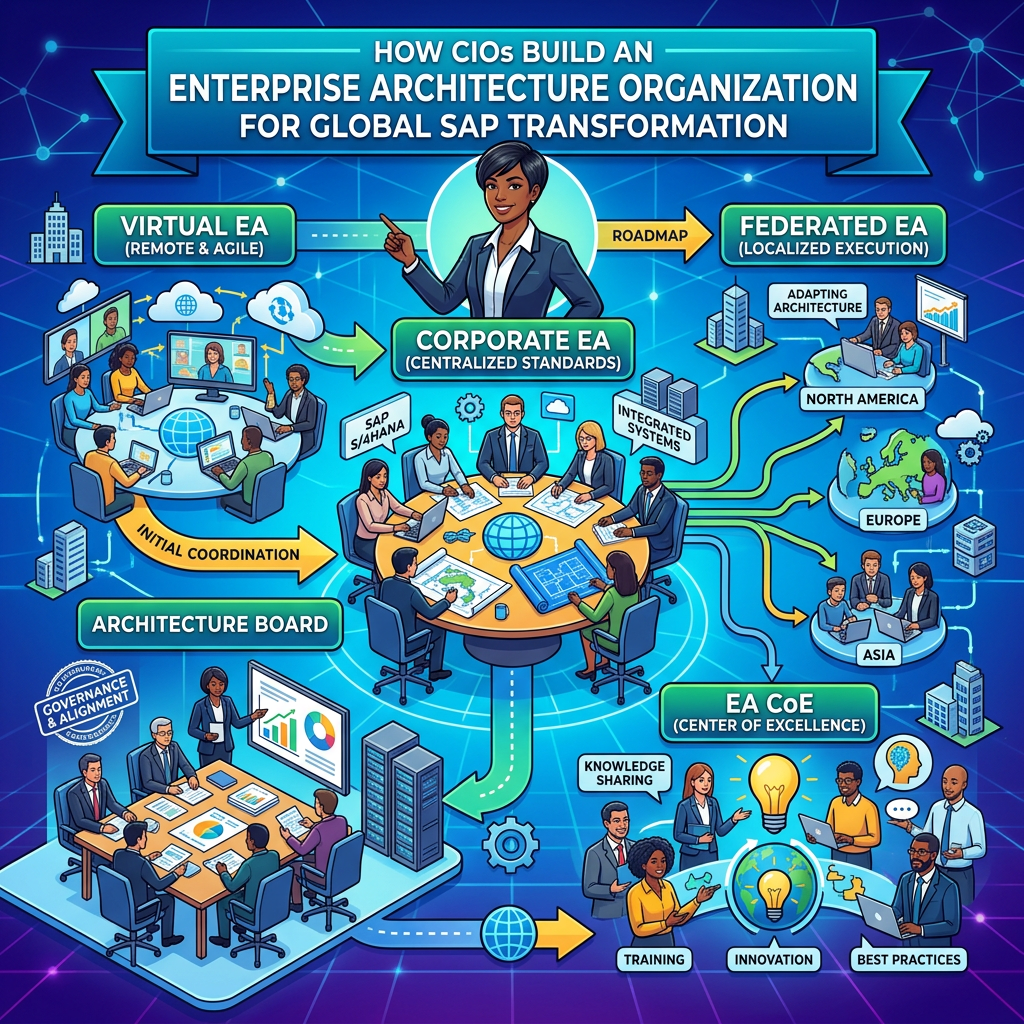
Implementing SAP S/4HANA and other enterprise systems globally is not simply an ERP implementation. For many organizations, it is a multi-year business and technology transformation that gradually reshapes processes, data, applications, integrations, and technology across regions and business units.
At the beginning of an SAP transformation, organizations naturally focus on questions such as:
- Which SAP solutions should we implement?
- Where should we start?
- Should we build a Global Template?
- Which countries and business units should be included in each rollout wave?
- What should the future SAP landscape look like?
However, as SAP is gradually rolled out across multiple regions and business units, another question becomes increasingly important:
Who should own, govern, and continuously evolve the Enterprise Architecture?
An SAP implementation project may initially be able to manage architecture within the project team. As the transformation expands, however, organizations often begin to experience issues such as:
- Different systems being introduced by different regions
- Increasing exceptions to the Global Template
- Duplicate capabilities implemented across multiple applications
- Different data models across countries and business units
- Proliferation of SAP and non-SAP applications
- Increasing integration complexity
- Unclear decision rights between global and local organizations
To prevent these issues, CIOs need to build not only an SAP implementation capability but also an Enterprise Architecture capability that evolves alongside the transformation.
This article explains the major Enterprise Architecture organization models and how CIOs can progressively develop an EA organization as SAP expands from an initial implementation to a global enterprise platform.
There Is No Single Correct Enterprise Architecture Organization Model
The first point CIOs should understand is that there is no single Enterprise Architecture organization model that works for every company.
SAP identifies several possible EA organization and operating models, including:
Informal, Separated, Federated, and Centralized.
Forrester has also described EA organizations as centralized, federated, matrixed, and combinations of these models.
Therefore, the question should not be:
“What is the correct EA organization structure?”
Instead, CIOs should ask:
“Which EA operating model best fits our business operating model and the current stage of our SAP transformation?”
This distinction is important because an organization implementing SAP in one country has very different architecture governance requirements from a multinational organization operating SAP across dozens of countries and multiple business units.
Enterprise Architecture Organization Models for Global SAP Transformation
Several EA organization models can be considered when SAP is implemented progressively and eventually expanded globally.
| EA Organization Model | Basic Concept | Fit with SAP Transformation |
| Informal / Virtual EA | No dedicated EA organization | Early SAP planning |
| Centralized EA | Corporate EA manages enterprise-wide architecture | Global Template development |
| Separated / Decentralized EA | EA teams exist within individual business units or regions | Highly autonomous businesses |
| Federated EA | Corporate EA combined with regional or business-unit EA | Global SAP rollout |
| Matrix EA | Architects operate across both domains and business organizations | Large, complex enterprises |
| EA Center of Excellence | Develops EA methods, standards, tools, and skills | EA capability maturity |
| Program-based EA | EA is established within the SAP transformation program | Large SAP implementation |
| Hybrid EA | Combines multiple EA organization models | Mature global enterprises |
These models should not necessarily be treated as permanent choices.
As SAP transformation progresses, the EA organization itself can evolve:
Virtual EA → Program EA → Centralized EA → Federated EA → Hybrid EA
This allows the EA capability to grow in line with actual business and transformation requirements.
Stage 1: SAP Strategy and Planning — Start with a Virtual EA Team
When an organization first begins considering an SAP transformation, it may not yet have a dedicated Enterprise Architecture organization.
At this stage, organizations can create a Virtual EA Team consisting of members from areas such as:
CIO Office
↓
IT Strategy / SAP Team / Business Transformation
↓
Virtual EA Team
SAP describes the Informal model as one in which there are no dedicated EA teams and EA skills are incorporated into other organizational roles.
This can be an effective way to begin EA activities without immediately creating a large permanent organization.
At this stage, the EA team should not start by developing highly detailed Solution Architectures.
Instead, CIOs should establish fundamental enterprise-level architecture directions, such as:
- To what extent should SAP become the global standard?
- How strongly should Fit-to-Standard be enforced?
- Should the company establish a Global Template?
- Should SAP use a single-instance or regional-instance strategy?
- Where should the boundary between SAP and non-SAP applications be defined?
- Should Master Data be globally standardized?
- Should Cloud First become an Architecture Principle?
- Should the integration platform be standardized?
- How should the enterprise data platform be designed?
The most important deliverable at this stage is therefore not detailed Technology Architecture.
It is the definition of Architecture Principles that will guide future transformation decisions.
Stage 2: SAP Implementation — Establish Program-Based Enterprise Architecture
Once an SAP S/4HANA implementation formally begins, managing architecture as a part-time activity becomes increasingly difficult.
The organization should therefore establish a Chief Architect or Lead Enterprise Architect within the SAP Transformation Program.
A typical structure might look like this:
SAP Transformation Program
↓
Chief Architect
↓
Business Architecture
Data Architecture
SAP Application Architecture
Integration Architecture
Technology Architecture
This EA team manages architecture decisions across SAP workstreams.
Its most important responsibility is to ensure that architecture decisions are made from an enterprise perspective rather than a project or workstream perspective.
For example:
Should a particular capability be implemented in SAP S/4HANA?
Should it be developed as an extension on SAP BTP?
Should an existing legacy application remain?
Should a new SaaS solution be introduced?
If these decisions are made independently by individual project workstreams, the enterprise architecture can quickly become fragmented.
The EA team therefore needs to evaluate these decisions in the context of the future Enterprise Architecture.
Stage 3: Global Template Development — Strengthen Centralized Enterprise Architecture
If SAP will eventually be deployed globally rather than implemented at only one site or business unit, the Enterprise Architecture organization should be strengthened during Global Template development.
At this stage, establishing a Corporate EA Office under the CIO or a similar executive organization can be effective.
For example:
CIO
↓
Chief Enterprise Architect
↓
Corporate EA Office
The organization may include roles such as:
- Business Architect
- Data Architect
- Application Architect
- Technology Architect
- Integration Architect
- Security Architect
In a Centralized EA model, the central EA team is responsible for architecture across the organization.
This becomes particularly important when creating an SAP Global Template.
A Global Template should not be treated simply as a standardized collection of SAP configurations.
It should represent the future operating model of the enterprise from an architecture perspective.
Corporate EA may therefore govern areas such as:
Global Processes
Global Data Model
SAP Solution Architecture
Integration Architecture
Extension Architecture
Technology Standards
Security Architecture
Architecture Principles
In other words, the SAP Global Template should increasingly become an implementation model of the target Enterprise Architecture.
Stage 4: Global SAP Rollout — Move Toward Federated Enterprise Architecture
As SAP begins expanding across North America, Europe, Asia-Pacific, and other regions, a purely Centralized EA organization can reach its limits.
A central team may not have sufficient knowledge of:
- Country-specific regulations
- Local business requirements
- Existing legacy applications
- Plant-specific requirements
- Customer-specific requirements
- Local integrations
This is where a Federated EA Model becomes particularly valuable.
The organization may evolve into:
Corporate EA
↓
Global Architecture Standards
combined with:
Americas EA
EMEA EA
APAC EA
In a Federated EA model, Corporate EA and Regional or Local EA organizations have different but complementary responsibilities.
Corporate EA Responsibilities
Corporate EA typically manages enterprise-wide architecture, including:
- Architecture Principles
- Global Template
- Reference Architecture
- Technology Standards
- Enterprise Roadmap
- Global Data Architecture
- Architecture Governance
Regional / Local EA Responsibilities
Regional or Local EA organizations operate closer to the business and may be responsible for:
- Local Business Requirements
- Local Regulatory Requirements
- Local Solution Architecture
- Plant Architecture
- Local Integration
- Global Template Fit/Gap
This structure can help the organization balance two competing objectives:
Global Standardization
and
Local Business Agility
For large multinational organizations, achieving this balance becomes one of the most important objectives of Enterprise Architecture.
Decision Rights Are Critical to a Global SAP Rollout
Simply creating a Federated EA organization does not guarantee effective architecture governance.
The most important question is:
Who has the authority to make which architecture decisions?
Suppose a local subsidiary requests an exception to the SAP Global Template.
Who should make the decision?
Local IT?
The Global SAP Program?
The Global Business Process Owner?
Corporate EA?
The CIO?
Without clearly defined decision rights, Architecture Exceptions can increase with every SAP rollout wave.
Organizations therefore need an explicit escalation mechanism such as:
Local EA
↓
Corporate EA
↓
Architecture Board
This turns architecture governance into a repeatable management process rather than an informal negotiation between project teams.
Establish an Architecture Board
Alongside the EA team, another important governance mechanism is the Architecture Board.
The Architecture Board should not be viewed simply as another architecture design team.
Its primary role is to provide architecture governance and decision-making authority.
A possible structure is:
Executive Committee
↓
Architecture Board
↓
Chief Enterprise Architect
↓
EA Team
The Architecture Board may review and approve matters such as:
- Global Template Exceptions
- Technology Standard Exceptions
- Introduction of new SaaS applications
- Adoption of non-SAP solutions
- Major Architecture Changes
- Data Architecture Exceptions
- Integration Standard Exceptions
This elevates Enterprise Architecture from a collection of IT design guidelines to an enterprise-level governance mechanism.
Build an Enterprise Architecture Center of Excellence
As the global SAP rollout expands, the central EA team cannot design and review every architecture decision itself.
Organizations therefore need to develop architecture capabilities across the enterprise.
An Enterprise Architecture Center of Excellence (EA CoE) can support this objective.
The purpose of an EA CoE is not to design every architecture centrally.
Its role is to establish and scale the capability required for different parts of the organization to practice Enterprise Architecture consistently.
An EA CoE may manage:
- EA Methodology
- TOGAF®
- Architecture Principles
- Architecture Templates
- Reference Architectures
- Architecture Repository
- EA Tools
- Architecture Training
- Architect Community
A useful distinction is:
The EA Team develops and governs architecture.
The EA CoE develops the organizational capability to practice architecture consistently.
This becomes increasingly important as SAP expands across regions, business units, plants, and transformation programs.
The Target Model for a Global SAP Enterprise
As SAP expands across multiple regions and business units, the Enterprise Architecture organization will often evolve toward a Hybrid Model rather than remain purely centralized or decentralized.
Forrester has described EA organizations as centralized, federated, matrixed, and various combinations of these structures.
A mature global organization might therefore look like this:
Executive Committee
↓
Architecture Board
↓
Chief Enterprise Architect
↓
Corporate EA Office
The Corporate EA Office may contain:
Business Architecture
Data / AI Architecture
Application Architecture
Technology Architecture
It can then be connected to a Federated EA Network:
Americas EA
EMEA EA
APAC EA
with additional roles such as:
Business Unit Architects
SAP Architects
Solution Architects
An EA Center of Excellence can operate horizontally across these organizations to provide methodology, standards, tools, training, and community development.
The resulting model is therefore:
Corporate EA + Federated EA + Architecture Board + EA CoE
This structure provides central architectural direction while keeping architects sufficiently close to regional and business requirements.
Mature the EA Organization Alongside the SAP Transformation
CIOs do not necessarily need to establish a large Enterprise Architecture department before the SAP transformation begins.
A more practical approach is to mature the EA capability as the transformation progresses.
For example:
Phase 1: SAP Strategy
Virtual EA
↓
Phase 2: SAP Implementation
Program EA
↓
Phase 3: Global Template
Centralized Corporate EA
↓
Phase 4: Global Rollout
Federated EA
↓
Phase 5: Enterprise Transformation
Hybrid EA + Architecture Board + EA CoE
This approach prevents the creation of an EA organization from becoming an objective in itself.
Instead, the organization adds EA capabilities when they become necessary to support business transformation.
Five Decisions CIOs Should Make First
Before drawing an EA organization chart, CIOs should clarify five fundamental questions.
1. Define the Enterprise Architecture Mandate
What authority does the EA organization have?
Does it only make recommendations, or does it have formal Architecture Decision Authority?
The answer determines whether EA can genuinely influence the SAP transformation.
2. Define Global and Local Decision Rights
Who makes the final decision when a Global Standard conflicts with a Local Requirement?
This becomes increasingly important as the number of SAP rollout countries increases.
3. Establish Architecture Governance
Define the Architecture Board, Design Authorities, Architecture Review Process, and Exception Process.
Governance should be designed before the number of architecture exceptions becomes difficult to control.
4. Define the Relationship Between the SAP Program and Enterprise Architecture
Is Enterprise Architecture simply one function within the SAP Transformation Program?
Or is it a permanent enterprise-level capability that governs SAP and non-SAP architecture?
This distinction becomes increasingly important as the transformation expands beyond ERP.
5. Plan the EA Capability Beyond the SAP Implementation
This is one of the most easily overlooked considerations.
Even after an SAP implementation project ends, the organization will still need to manage:
Enterprise Roadmaps
Application Portfolios
Data Architecture
Technology Standards
Architecture Governance
The organization should therefore plan from the beginning for the transition from:
Program EA → Permanent EA Practice
rather than allowing the architecture capability to disappear when the SAP project closes.
Conclusion: Build an Architecture Capability, Not Just an SAP Project Organization
A global SAP implementation is not simply an ERP project.
SAP S/4HANA, SAP BTP, cloud platforms, data platforms, AI, SaaS applications, integrations, and legacy systems collectively form the future Enterprise Architecture.
CIOs therefore need to consider not only:
“Which SAP solutions should we implement?”
but also:
“Who will continuously govern and evolve this architecture?”
The Enterprise Architecture organization does not need to reach its final form on day one.
Organizations can start with a Virtual EA Team, establish Program EA during implementation, strengthen Corporate EA during Global Template development, move toward Federated EA during global rollout, and ultimately establish a Hybrid model combining:
Corporate EA + Federated EA + Architecture Board + EA CoE
The objective is not simply to create another organization within IT.
The objective is to establish an Enterprise Architecture capability that balances Global Standardization with Local Agility and continues to govern enterprise transformation long after the initial SAP implementation is complete.
For CIOs planning a multi-year global SAP transformation, that capability can become one of the most important mechanisms for ensuring that individual implementation decisions collectively lead toward a coherent target enterprise architecture.
Reference Links
| Source | Recommended use |
| SAP Learning – Maturing an Enterprise Architecture Practice | Primary source for Informal, Separated, Federated/Distributed and Centralized EA operating models. (SAP Learning) |
| SAP LeanIX / SAP Help Portal | Supports the role of EA in managing and scaling enterprise architecture across an organization. (SAP Help Portal) |
| SAP Enterprise Architecture Management | Supports EA as an enabler of transformation roadmaps, application rationalization and continuous transformation. (SAP) |
| The Open Group – Architecture Board | Primary source for cross-organizational Architecture Governance and Architecture Board responsibilities. (The Open Group) |
| The Open Group – Centers of Excellence | Supports the EA/architecture CoE concept and spreading architecture skills and capabilities across an organization. (The Open Group) |
| Forrester – EA Team Structures Vary Widely | Supports centralized, federated, matrixed and composite EA structures and the importance of matching the EA organization to the enterprise operating model. (Forrester) |
| SAP IEA10 – Applying the SAP Enterprise Architecture Framework | Official SAP course material confirming that “Maturing an Enterprise Architecture Practice” is part of the SAP EA Framework curriculum. (SAP Training) |
Disclaimer
Parts of this article were developed with reference to generative AI suggestions and were reviewed, refined, and supplemented based on the author’s professional expertise and judgment.

Leave a Reply