Introduction
In PLM and SAP S/4HANA Private Edition implementations, it is not uncommon to enter the requirements definition phase with weak alignment between business goals and project objectives, even after completing the initial planning phase.
When scope reduction is driven purely by cost considerations in this situation, the project risks prioritizing “reducing implementation scope” over maximizing return on investment. As a result, organizations often fail to realize the full business and operational value of PLM and ERP systems.
A practical solution at this stage is not to introduce Enterprise Architecture (EA) as a large-scale activity, but to embed it as a lightweight decision-making framework within the requirements definition phase.
Why Enterprise Architecture Matters Now
The purpose of implementing SAP S/4HANA is not merely system replacement. It should enable business transformation through:
- Process integration
- Real-time data utilization
- Advanced decision-making
However, in many projects, once target business areas are identified, discussions quickly shift to individual requirements without clearly linking them to business KPIs and strategic goals.
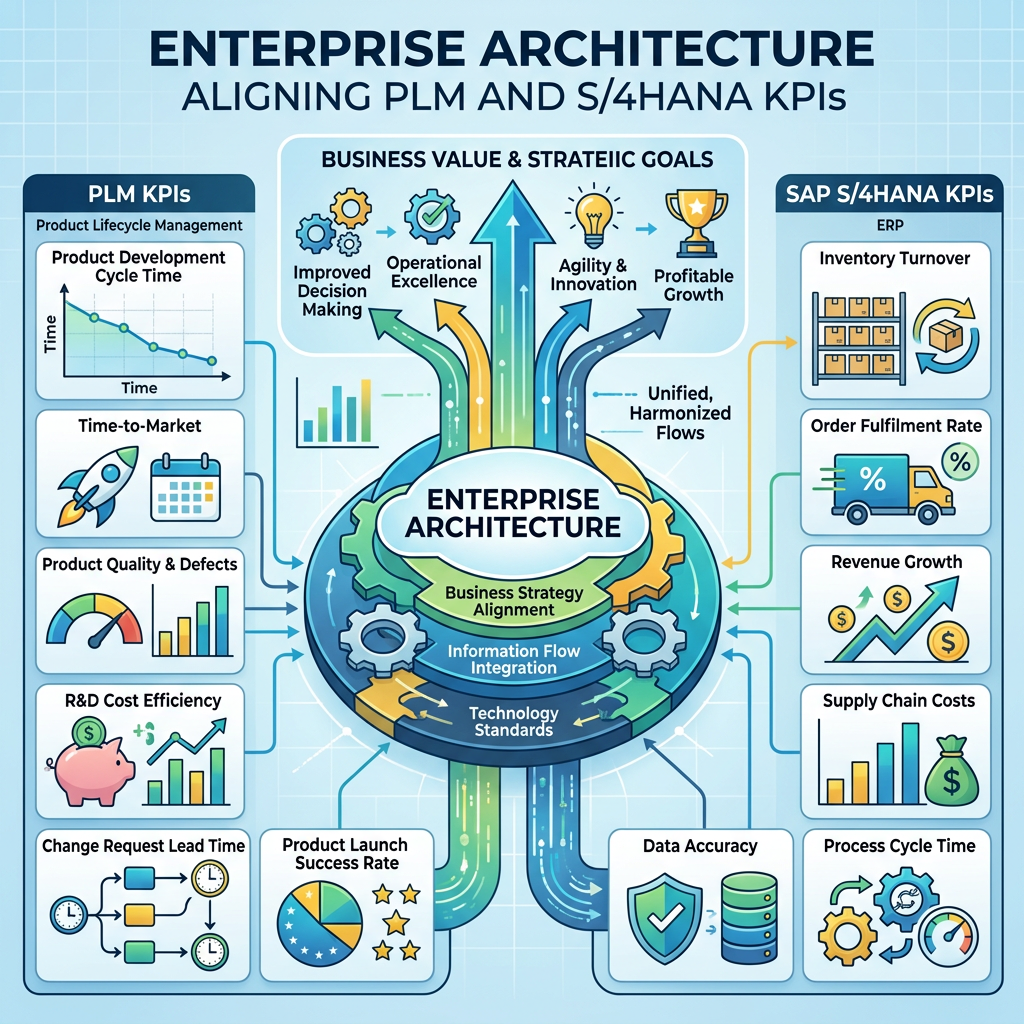
Enterprise Architecture bridges this gap by connecting:
- Business objectives
- Capabilities
- Processes
- Applications
- Data
into a unified structure.
Source: https://kobesoft.co.jp/mikata/words/system-procurement/kpi-kgi/
In the PLM domain, fragmentation between engineering data (design, BOM, change management, quality) and ERP processes (procurement, production, costing, inventory) leads to siloed optimization.
The true value of PLM lies in enabling a digital thread across the product lifecycle and tight integration with ERP systems.
Source: https://lean-operation.com/media/management/kpi/
For project managers, the key question is not “which functions to implement,” but:
“What business outcomes should be achieved, and what should be prioritized to achieve them?”
Key Messages for Project Managers
1. Scope Reduction Is Not Success
Reducing scope alone does not define project success. What matters is designing implementation sequencing aligned with business objectives while maintaining a global optimization perspective.
Shifting the conversation from:
- “Cut because it’s expensive”
to - “Prioritize what drives KGI achievement”
moves the discussion from cost-centric to value-centric.
Source: https://by-independent.com/column/sap-s4-hana-introduction-pkg/
2. Define KGI and KPI as Preconditions
KPIs are not just tracking metrics; they visualize the path to achieving strategic goals.
In SAP S/4HANA, embedded analytics and KPI-driven management are core principles. Therefore, each requirement must explicitly answer:
“Which KPI does this improve?”
Source: https://ops-in.com/blog/rdd_ea/
3. Leverage Middle Management as the Bridge
Even in bottom-up organizational cultures, progress can be driven effectively through middle management.
The “middle-up-down” approach emphasizes translating strategy into executable actions.
Position EA not as governance to suppress business needs, but as a mechanism to connect those needs to business outcomes.
Source: https://www.fortience.com/insight/column/200721-00/
How to Embed EA into the Requirements Phase
A practical approach is to introduce a 2–4 week “mini EA sprint” before or during requirements definition.
Key deliverables should be limited to:
- Alignment from business goals to project KGIs
- KPI tree
- Process-to-system mapping (PLM and SAP S/4HANA)
- Prioritized implementation roadmap
Avoid overproducing EA artifacts—focus only on what supports decision-making.
Source: https://note.com/skijima/n/ne000abc340cf
Outcome-Based Requirements Workshops
Instead of discussing requirements in isolation, structure workshops around business outcomes.
For each theme (e.g., design change management, BOM alignment, cost planning, procurement integration, prototype-to-mass production transition), define:
- Target KPIs
- Related departments
- PLM functions
- SAP S/4HANA functions
- Required master data
- Measurement methods
This approach helps filter out low-impact or Phase 1–irrelevant requirements.
Source: https://techtouch.jp/media/sap/sap-plm-case
Structuring the Requirements Document
Embed EA perspectives directly into the requirements definition document with sections such as:
- Business objectives and implementation purpose
- KGI/KPI definitions
- Business capabilities and target processes
- Application and data integration strategy
- Phase-based roadmap
This ensures consistency across design, development, CRP, UAT, and post-go-live evaluation.
Source: https://www.fortience.com/solutions/enterprise/sap-global-implementation/
How PMs Should Communicate This
Instead of saying “we need to introduce EA,” frame it as:
“Aligning decision criteria to ensure successful requirements definition.”
Even if stakeholders resist the term “Enterprise Architecture,” the actual activities—goal alignment, KPI design, prioritization, and roadmap planning—are directly tied to project success.
Source: https://www.kobelcosys.co.jp/lp/sap/column/26061701.html
Example messaging:
- Target scope is defined, but KGI/KPI alignment and prioritization remain weak
- Introduce a short alignment phase around requirements definition
- Clarify which PLM and SAP capabilities should be prioritized from a business perspective
- Position Phase 1 as value-driven, not cost-driven
This makes it easier to explain investment decisions to executives.
Source: https://www.jfe-systems.com/products/businessobjects/kpimart.html
Practical Actions for PMs
- Conduct a 90-minute KGI alignment workshop with executives, business leads, and IT
- Require each requirement to include KPI, expected benefit, and risk if not implemented
- Define PLM–SAP boundaries based on business events, not system ownership
- Prioritize Phase 1 scope using KGI impact, dependencies, and implementation complexity
- Include KPI improvement validation in CRP evaluation criteria
Sources:
https://lean-operation.com/media/organization/middle-up-down/
https://solution.lmi.ne.jp/column/c468
https://free-sap-consultant.com/news/2024/08/22/17884/
https://lean-operation.com/media/management/kpi/
https://help.sap.com/docs/SAP_S4HANA_CLOUD/6b39bd1d0e5e4099a5b65d835c29c696/c00cbf7fe8464663aee830fb6e7eec13.html?locale=en-US
The Value of EA for PMs
The value of Enterprise Architecture for project managers is not in producing more documentation, but in continuously aligning project decisions with business outcomes.
In cross-functional transformations like PLM × SAP S/4HANA—spanning departments, data, and product lifecycles—even late-stage alignment can significantly impact success.
Enterprise Architecture is not “too late” at this stage. It is the final practical lever to transform requirements definition into a value creation phase.
Source: https://www.sap.com/japan/products/scm/plm-r-d-engineering.html
Summary
Embedding Enterprise Architecture into the requirements definition phase enables project managers to shift from cost-driven scope reduction to value-driven implementation.
By aligning KGI, KPI, and system capabilities, and introducing a lightweight EA sprint, organizations can maximize ROI and ensure that PLM and SAP S/4HANA deliver meaningful business transformation.
Reference Links
SAP S/4HANA, KPIs, and ROI
- SAP Help Portal – Key Performance Indicators in SAP S/4HANA Cloud
English documentation on how to define and use Key Performance Indicators (KPIs) in SAP S/4HANA Cloud, including KPI evaluations, thresholds, and embedded analytics use cases.[help.sap]
Link - SAP S/4HANA implementation guide – project phases, requirements, and ROI considerations
Japanese article explaining S/4HANA project phases, requirement definition, and points for evaluating investment effectiveness; can be cited in English as “Japanese guide explaining S/4HANA project phases and ROI evaluation.” Link - SAP S/4HANA – general overview and KPI‑driven analytics (example whitepaper on Scribd)
Example S/4HANA whitepaper that describes overall S/4HANA concepts and KPI‑driven analytics scenarios, available as a PDF on Scribd. Link - Business innovation with S/4HANA – KPI‑based monitoring example deck
Slide deck (PDF) showing an S/4HANA transformation strategy for business innovation, including examples of KPI‑based monitoring and dashboarding. Link
PLM, PLM × ERP, and SAP PLM
- SAP PLM – R&D and Engineering (official SAP product page)
Official SAP product page for SAP PLM (R&D/Engineering), explaining how PLM capabilities support digitalized product development, innovation, and an end‑to‑end digital thread across the product lifecycle.[sap] Link - What is a PLM system? To‑be process definition and KPI setting for PLM projects
Japanese consulting article that explains PLM system concepts, to‑be process design, and KPI setting for PLM initiatives in manufacturing; can be referenced in English as “Example of PLM project approach in Japanese manufacturing companies.” Link - SAP PLM software and its integration with ERP – use cases and best practices
Japanese case‑based article introducing SAP PLM implementation patterns, ERP integration use cases, and practical best practices; can be cited as a case‑study source for SAP PLM in Japan. Link
Enterprise Architecture, EA‑based Requirements, and Strategy
- Introduction to Enterprise Architecture (in Japanese, EA overview from Japan)
Japanese introduction to Enterprise Architecture concepts, scope, and positioning; useful as an EA overview reference in the Japanese context. Link - Practical requirements definition based on EA frameworks (Japanese case, methodology is generic)
Japanese article describing how to conduct practical requirements definition using EA frameworks; although written for Japan, the method is generally applicable. Link - Enterprise Architecture before IT projects – discussion on the positioning of EA (in Japanese)
Blog‑style discussion in Japanese on why and how to position Enterprise Architecture before launching IT projects. Link
KPI, KGI, and Management
- General concepts of KPIs and performance measurement in management (Japanese sources, summarized in English)
A set of Japanese management articles explaining the fundamentals of KPI/KGI, how to design performance indicators, and how to apply them in corporate management and system procurement contexts. - KPI‑based management and analytics template for SAP ERP (KPI Mart)
Product page for “KPI Mart,” a KPI‑oriented management and analytics template for SAP ERP / SAP BusinessObjects provided by JFE Systems, focusing on KPI‑driven reporting and dashboards. Link
Middle‑Up‑Down, Bottom‑Up, and Top‑Down
- Middle‑up‑down management and its role between top‑down and bottom‑up
Japanese article explaining the middle‑up‑down management concept, positioned between traditional top‑down and bottom‑up styles, and its implications for organizational innovation. Link - Middle‑up‑down as a new management style
Japanese glossary‑type article introducing middle‑up‑down as an emerging management style and summarizing its key characteristics. Link - Background and practical steps of middle‑up‑down management
Japanese column that describes the background, benefits, and practical implementation steps for middle‑up‑down management in organizations. Link
Disclaimer
Parts of this article were developed with reference to generative AI suggestions and were reviewed, refined, and supplemented based on the author’s professional expertise and judgment.

Leave a Reply