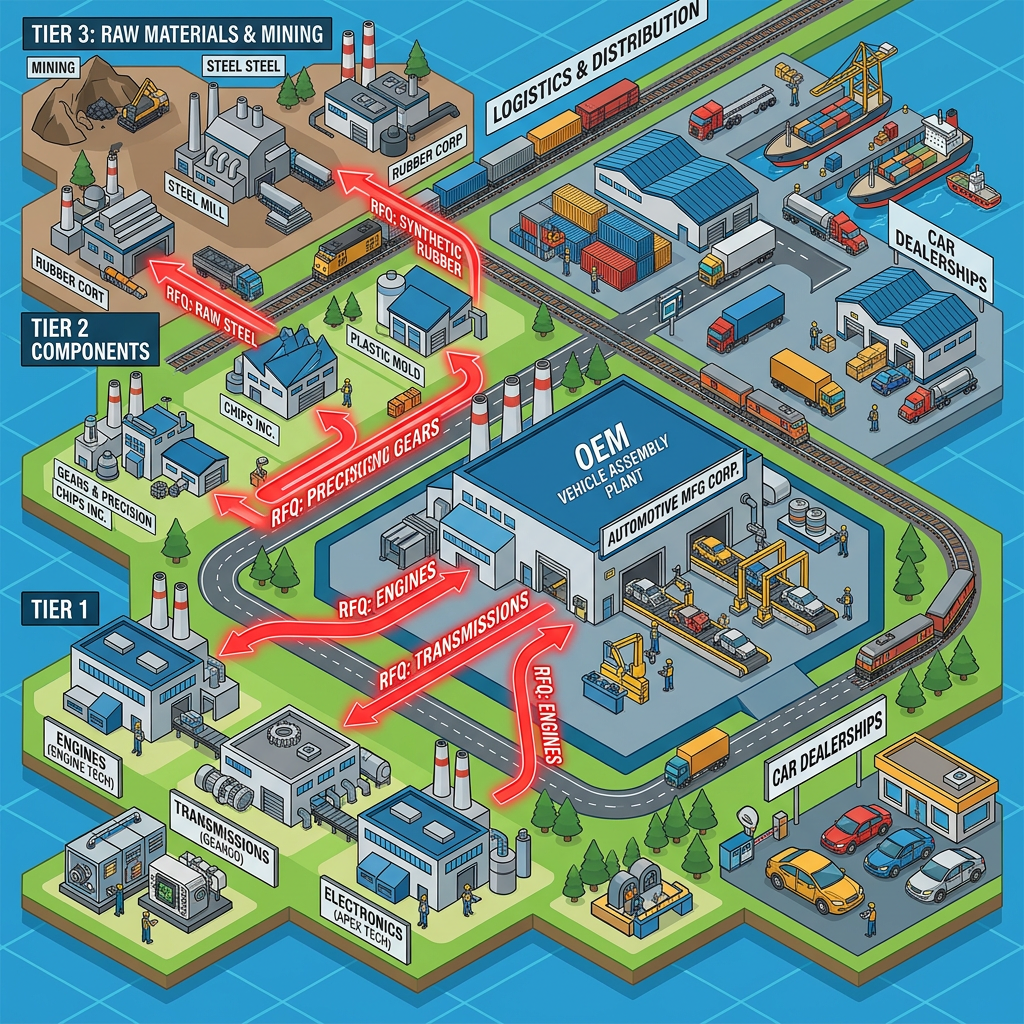
In this article, we will walk through how an automotive Tier‑1 supplier should approach RFQs for new vehicle projects, and how SAP S/4HANA can support the end‑to‑end process from a practical, hands‑on perspective. The goal is to connect real‑world RFQ operations with robust ERP design, instead of treating SAP as a mere “system of record” detached from how OEM programs actually run.
1. What RFQ Means for Automotive Tier‑1 Suppliers
We first clarify where Tier‑1 suppliers sit in the automotive supply chain and how the RFQ process works end to end. Having this shared picture makes the later SAP design discussion far more coherent and aligned with the business reality.
- Tier‑1’s role: the OEM’s design partner
- Tier hierarchy (Tier‑1, Tier‑2, Tier‑3) and responsibility boundaries
- Typical flow from OEM RFQ to quotation submission
1‑1. Tier‑1’s role: the OEM’s “design partner”
A Tier‑1 supplier is a company that delivers parts or systems directly to the OEM (vehicle manufacturer), and in many cases joins the project from the concept and design phase. Unlike Tier‑2 or Tier‑3 suppliers, who mainly provide raw materials or small parts, Tier‑1 players typically deliver complete modules and actively participate in design.
The automotive supply chain is structured in layers—Tier‑1, Tier‑2, Tier‑3—with clearly defined roles and responsibilities at each level. Tier‑1 suppliers not only bear final responsibility toward the OEM but also orchestrate the entire network of Tier‑2 and Tier‑3 suppliers behind them as a central player in the ecosystem.
1‑2. From OEM RFQ to quotation: the typical flow
When an automotive Tier‑1 supplier receives a new RFQ, the process that leads to the final quotation can be broken down into the following steps:
- Receipt of new product concept and RFQ from the OEM
- Joint clarification of concept, requirements, and scope
- High‑level design and initial cost assumptions
- Cost build‑up involving purchasing, manufacturing engineering, and quality
- Profitability and risk assessment
- Quotation submission including commercial and contractual conditions
At a glance this may look like a sales‑driven process, but in reality it is a company‑wide process that pulls in design, purchasing, manufacturing engineering, quality, finance, and contract management from an early stage.
2. What to Clarify in Early OEM Discussions and Specification Alignment
In the earliest RFQ phase, the Tier‑1 supplier needs to quickly determine whether to seriously commit to the opportunity. To do that, you must structure the information from the OEM and define what needs to be aligned in the joint development process.
2‑1. Sharing project overview and baseline conditions to evaluate the opportunity
When you receive an RFQ for a new product or vehicle program, it is critical to clarify the basic information such as project overview, concept, expected volumes, timing, and rough budget range. From the Tier‑1 perspective, the key question is whether you have enough data points—cost range, annual volume, ramp‑up timing, expected end‑of‑production, and so on—to make a serious go / no‑go decision.
If these fundamentals remain vague, subsequent discussions tend to become “nice slides with no executable plan.” A clear baseline at this stage is what prevents the entire RFQ effort from turning into a theoretical exercise disconnected from operational feasibility.
2‑2. Joint development, specification alignment, and designing from risk
Once the concept has been shared, the Tier‑1 supplier—led by its engineering organization—moves into detailed specification alignment with the OEM. A Tier‑1 is not a simple contract manufacturer. It acts as a partner that delivers complete modules and participates from the early design and development stages.
Supplier collaboration in new vehicle development starts very early in the vehicle lifecycle. Specifications, schedules, and quality assurance processes must be aligned across a multi‑tier supply chain that spans several companies and regions. Decisions made in this early phase have a decisive impact on cost structure, quality performance, and ramp‑up risks later on. This is why the RFQ response process at this stage becomes the first critical control point for the entire program.
3. Building a Cross‑Functional Quotation Process with Procurement, Manufacturing Engineering, and Quality
To treat RFQs as more than just a conversation between sales and engineering, Tier‑1 suppliers need a quotation process that anticipates the full supply chain and future call‑off (forecast) operations. This mindset should be reflected both in the business process and in the SAP design.
3‑1. High‑level design and building the cost backbone
Once the concept and high‑level specifications have stabilized, engineering develops a preliminary design and defines assumptions for materials, structure, main components, and manufacturing methods. The output of this stage forms the backbone of the cost model.
Key elements include:
- Types and grades of raw materials and components
- Targeted key suppliers for critical items
- Manufacturing processes and any special processes required
- Module structure (separate components vs. integrated designs)
These assumptions become the foundation for purchasing quotations, manufacturing engineering cost estimates, and quality‑related costs.
3‑2. Bottom‑up costing that anticipates the full supply chain and call‑off operations
Once the preliminary design is visible, purchasing, manufacturing engineering, and quality teams should fully join the RFQ process. The key question here is whether the quotation is built with a clear view of the entire supply chain and the future call‑off (forecast) mechanisms.
In the automotive industry, everything from raw material procurement and production planning through workforce allocation and logistics is prepared based on OEM forecasts and call‑offs. These forecasts are the primary input for revenue and capacity planning on both the supplier and sub‑supplier sides. Many suppliers also deliver not only directly to OEMs but also to other part makers designated by the OEM under “customer‑furnished / chargeable” arrangements, creating a complex web of flows behind the scenes.
At the RFQ stage, OEM forecasts are still provisional. Without a proper understanding of volume fluctuation ranges, the timing and accuracy of firm vs. forecast orders, and each OEM’s specific “forecast behavior,” the assumptions behind capital investment and supplier contracts can easily collapse. From an SAP design standpoint, this is where you must decide how to represent forecasts in the system and how to feed them into MRP and revenue planning in a consistent, auditable way.
4. Contract Terms and the Basis for Long‑Term Partnerships
Tier‑1 suppliers carry final responsibility toward the OEM. This section outlines how to design contract terms that reflect that responsibility and how to connect them back to the quotation.
4‑1. Final responsibility and quality management at Tier‑1
As direct suppliers to OEMs, Tier‑1 manufacturers bear final responsibility for quality, delivery, cost, and technical capability. This demands a quality management system that truly works on the shop floor, not just a set of formal documents to pass audits.
Robust control of special processes, end‑to‑end traceability, continuous supplier evaluation, and improvement activities are baseline expectations for audit compliance and relationship continuity. Elements such as traceability design, special process control, and supplier evaluation methodologies need to be woven into the RFQ and quotation stage from the outset; trying to bolt on audit‑compliant mechanisms later is usually too late and extremely costly.
4‑2. Contract terms across quality, delivery, IP, and risk
In OEM contracts, non‑price conditions often carry as much weight as the price itself. Typical contracts define detailed requirements for delivery performance, quality thresholds, pricing mechanisms, intellectual property, and clearly delineated responsibilities for each phase of the process.
To avoid unnecessary disputes when problems occur, OEMs and Tier‑1 suppliers must agree in advance on how to handle quality issues, delivery delays, and risk mitigation measures, and then document these as formal contract terms. A Tier‑1 quotation should therefore be seen not just as a price proposal, but as a complete package of conditions that defines how the partnership will operate over the product lifecycle.
5. Design Priorities for SAP Implementation Project Managers
Based on the business realities described so far, we now look at how SAP S/4HANA or similar ERP systems should support the RFQ‑to‑quotation process from a PM and enterprise architect perspective.
5‑1. Modeling scope of responsibility and organizational boundaries
Tier‑1 suppliers bear final responsibility toward the OEM, while the overall supply chain is segmented by tier‑based roles and responsibilities. The first design question is how to model this structure in SAP.
You need to express responsibility boundaries using organizational elements such as Company Code, Plant, and Purchasing Organization, along with business partners like OEMs, Tier‑2 suppliers, and logistics providers, and master data such as long‑term agreements, supply contracts, and quality master data. It is particularly important to ensure that you can trace, via reports and audit trails, which organizational unit is responsible for which OEM and which product families for both audit and management control purposes.
5‑2. Linking co‑development, specification control, and cost information
In new vehicle programs, OEMs expect suppliers to join early and align specifications, schedules, and quality assurance processes. SAP alone cannot hold all the detailed design information and PLM data, so integration with surrounding systems becomes a key architectural concern.
Concretely, you need to define:
- The interface boundaries with PLM and design systems (what data enters SAP and when)
- How to handle change numbers, engineering change control, and valid‑from dates
- How to keep RFQ cost estimates consistent with standard costs at SOP and mass production
The core is to build a mechanism that can consistently trace how specification changes propagate into BOMs, routings, costs, and production plans across the entire RFQ‑to‑ramp‑up process.
5‑3. Treating quotations and contract terms as one integrated object
In OEM relationships, contracts must clearly define delivery, quality standards, pricing, and IP‑related conditions. On the SAP side, the design focus is how to link SD quotations, sales orders, and long‑term agreements (such as scheduling agreements) with quality, warranty, and penalty conditions in a way that is both transparent and maintainable.
Key design decisions include where to store the assumptions made at quotation time, to what level of detail to transfer them into long‑term contracts or scheduling agreements, and how to structure the data so that actual delivery performance, defect rates, and warranty costs can be compared against the original assumptions. The project’s success often hinges on whether you adopt a clear principle that “conditions are as visible and managed in the system as prices.”
5‑4. Forecast‑driven supply, demand, and profitability management
In automotive, almost all preparation for manufacturing and shipping is driven by OEM forecasts and call‑offs, which serve as the core input for revenue and capacity planning. To leverage this in SAP, you must design how forecast data will be received, in what format and frequency, and how it will flow into demand planning, MRP, capacity planning, and profitability analysis.
This requires early decisions on interfaces for receiving OEM forecasts, logic for managing the delta between forecasts and firm orders (backlog and probability), and how to propagate forecasts from OEMs to Tier‑2 suppliers. Business process design and system design must go hand in hand here. PMs need to recognize that “how we treat forecasts” is a strategic topic that is extremely difficult to retrofit later.
5‑5. Designing traceability, auditability, and quality management
Tier‑1 suppliers are expected to operate a quality management system that can withstand rigorous OEM audits and customer requirements. In SAP, you can build the foundation for this by combining batch and serial number management with quality inspection lots, non‑conformance management, and supplier evaluation.
PMs must make design decisions based on RFQ requirements and audit expectations, such as: which products and processes require tracing and at what granularity (batch vs. serial), how to model complex flows like customer‑furnished materials or subcontracting, and where to store quality data (within SAP vs. specialized surrounding systems). These choices should reflect real RFQ and contract requirements rather than being driven solely by system constraints.
6. Summary
For automotive Tier‑1 suppliers, the RFQ‑to‑quotation process for new products is a company‑wide initiative involving not just sales, but also engineering, purchasing, manufacturing engineering, quality, finance, and contract management. Tier‑1 suppliers carry final responsibility for quality, delivery, cost, and technology toward OEMs, and they operate under the scrutiny of multi‑tier supply chains and demanding audit regimes.
For SAP implementation PMs, the key questions are how to model roles and responsibility boundaries, how to connect co‑development and specification management with cost information, how to manage contract conditions together with pricing, how to translate OEM forecasts into supply–demand and profitability management, and how to support traceability and quality management in the system. If you use the RFQ‑to‑quotation process as a lens to visualize gaps between business operations and systems, you can move beyond a “plain ERP rollout” and drive a digital transformation that strengthens the OEM–Tier‑1 relationship at its core.
Please also refer to the following blog post regarding Source-To-Pay (S2P) in the automotive parts manufacturing industry.
The Importance of S2P for Automotive Parts Manufacturers
Reference Links
– Improving RFQ Processes in Supply Chain: 10 Best Practices
https://catalyst-sourcing.com/improving-rfq-processes-in-supply-chain-management-10-best-practices-for-success/
– Request for Quotation Process in SAP S/4HANA – SAP Community
https://community.sap.com/t5/enterprise-resource-planning-blog-posts-by-members/request-for-quotation-process-in-sap-s-4-hana/ba-p/13865430
– Working with Requests for Quotation – SAP Learning
https://learning.sap.com/courses/sourcing-in-sap-s4hana/working-with-requests-for-quotation
– SAP S/4HANA for Automotive and IM&C Product Sourcing – SAP Community
https://community.sap.com/t5/enterprise-resource-planning-blog-posts-by-sap/sap-s-4hana-for-product-sourcing-for-automotive-and-im-c/ba-p/13588734
– SAP S/4HANA for Automotive Parts Manufacturers – Hicron
https://hicron.com/offer/sap-s4hana-for-automotive-suppliers/
Disclaimer
Parts of this article were developed with reference to generative AI suggestions and were reviewed, refined, and supplemented based on the author’s professional expertise and judgment.

Leave a Reply